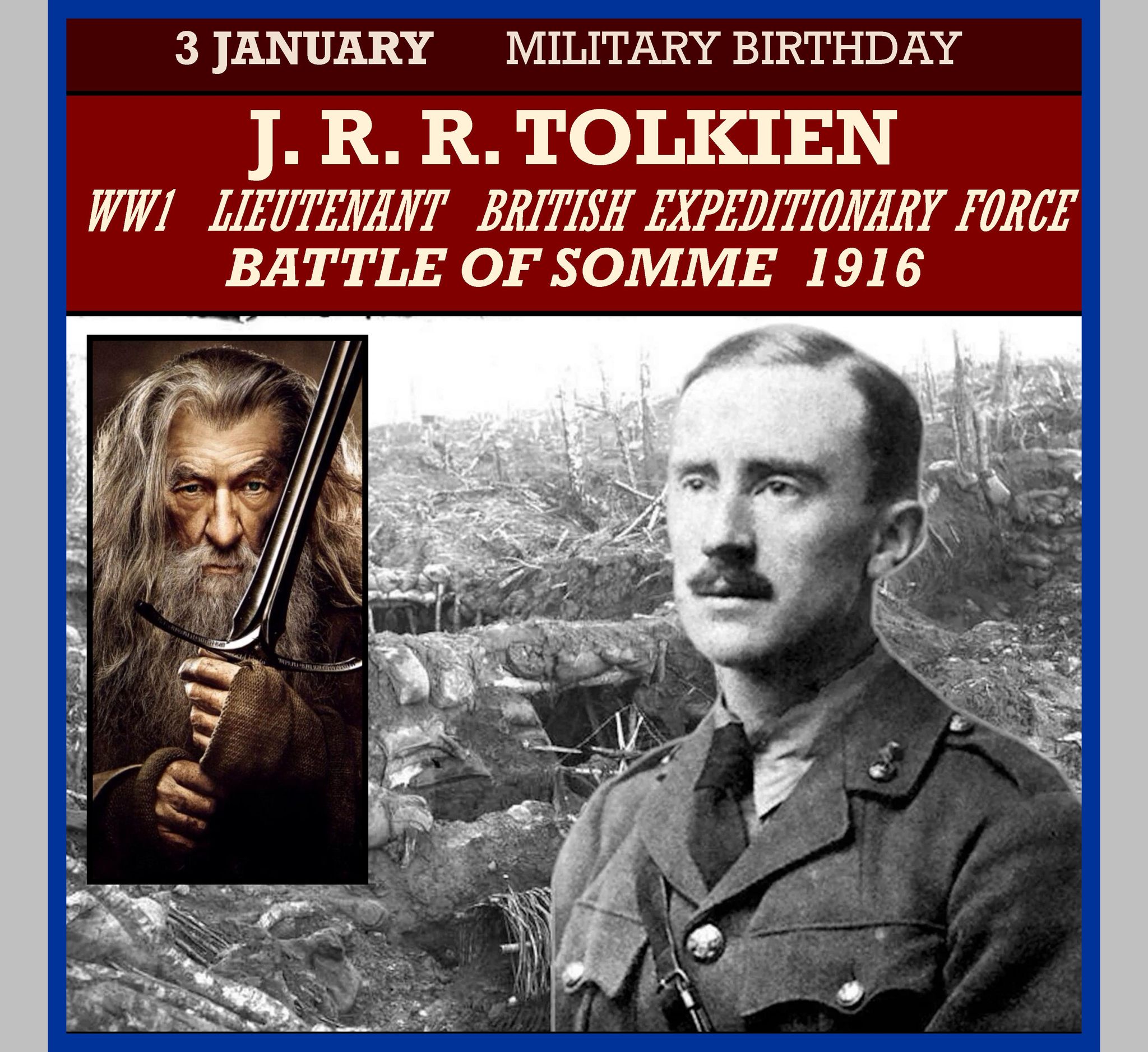
John Ronald Reuel Tolkien CBE FRSL (3 January 1892 â 2 September 1973) was an English writer and philologist. He was the author of the high fantasy works The Hobbit and The Lord of the Rings.
He was commissioned as a temporary second lieutenant in the Lancashire Fusiliers on 15 July 1915. He trained with the 13th (Reserve) Battalion on Cannock Chase, Rugeley Camp near to Rugeley, Staffordshire, for 11 months. In a letter to Edith, Tolkien complained: “Gentlemen are rare among the superiors, and even human beings rare indeed.” Following their wedding, Lieutenant and Mrs. Tolkien took up lodgings near the training camp. On 2 June 1916, Tolkien received a telegram summoning him to Folkestone for posting to France. The Tolkiens spent the night before his departure in a room at the Plough & Harrow Hotel in Edgbaston, Birmingham. He later wrote: “Junior officers were being killed off, a dozen a minute. Parting from my wife then… it was like a death.”
On 5 June 1916, Tolkien boarded a troop transport for an overnight voyage to Calais. Like other soldiers arriving for the first time, he was sent to the British Expeditionary Force’s (BEF) base depot at Ãtaples. On 7 June, he was informed that he had been assigned as a signals officer to the 11th (Service) Battalion, Lancashire Fusiliers. The battalion was part of the 74th Brigade, 25th Division. While waiting to be summoned to his unit, Tolkien sank into boredom. To pass the time, he composed a poem entitled The Lonely Isle, which was inspired by his feelings during the sea crossing to Calais. To evade the British Army’s postal censorship, he developed a code of dots by which Edith could track his movements. He left Ãtaples on 27 June 1916 and joined his battalion at Rubempré, near Amiens. He found himself commanding enlisted men who were drawn mainly from the mining, milling, and weaving towns of Lancashire. According to John Garth, he “felt an affinity for these working class men”, but military protocol prohibited friendships with “other ranks”. Instead, he was required to “take charge of them, discipline them, train them, and probably censor their letters … If possible, he was supposed to inspire their love and loyalty.” Tolkien later lamented, “The most improper job of any man … is bossing other men. Not one in a million is fit for it, and least of all those who seek the opportunity.”
Tolkien arrived at the Somme in early July 1916. In between terms behind the lines at Bouzincourt, he participated in the assaults on the Schwaben Redoubt and the Leipzig salient. Tolkien’s time in combat was a terrible stress for Edith, who feared that every knock on the door might carry news of her husband’s death. Edith could track her husband’s movements on a map of the Western Front. The Reverend Mervyn S. Evers, Anglican chaplain to the Lancashire Fusiliers, recorded that Tolkien and his fellow officers were eaten by “hordes of lice” which found the Medical Officer’s ointment merely “a kind of hors d’oeuvre and the little beggars went at their feast with renewed vigour.” On 27 October 1916, as his battalion attacked Regina Trench, Tolkien contracted trench fever, a disease carried by lice. He was invalided to England on 8 November 1916. Many of his dearest school friends were killed in the war. Among their number were Rob Gilson of the Tea Club and Barrovian Society, who was killed on the first day of the Somme while leading his men in the assault on Beaumont Hamel. Fellow T.C.B.S. member Geoffrey Smith was killed during the battle, when a German artillery shell landed on a first-aid post. Tolkien’s battalion was almost completely wiped out following his return to England.
MILITARY HISTORY SOCIETY OF ROCHESTER
ROCHESTERMILITARY.COM