The Tokyo Express. The original name of the resupply missions was “The Cactus Express”, coined by Allied forces on Guadalcanal, who used the code name “Cactus” for the island. After the U.S. press began referring to it as the “Tokyo Express,” apparently in order to preserve operational security for the code word, Allied forces also began to use the phrase. The Japanese themselves called the night resupply missions “Rat Transportation” (é¼ è¼¸é, nezumi yusÅ), because they took place at night.
Most of the warships used for Tokyo Express missions came from the Eighth Fleet, based at Rabaul and Bougainville, although ships from Combined Fleet units based at Truk were often temporarily attached for use in Express missions. The warship formations assigned to Express missions were often formally designated as the “Reinforcement Unit”, but the size and composition of this unit varied from mission to mission.
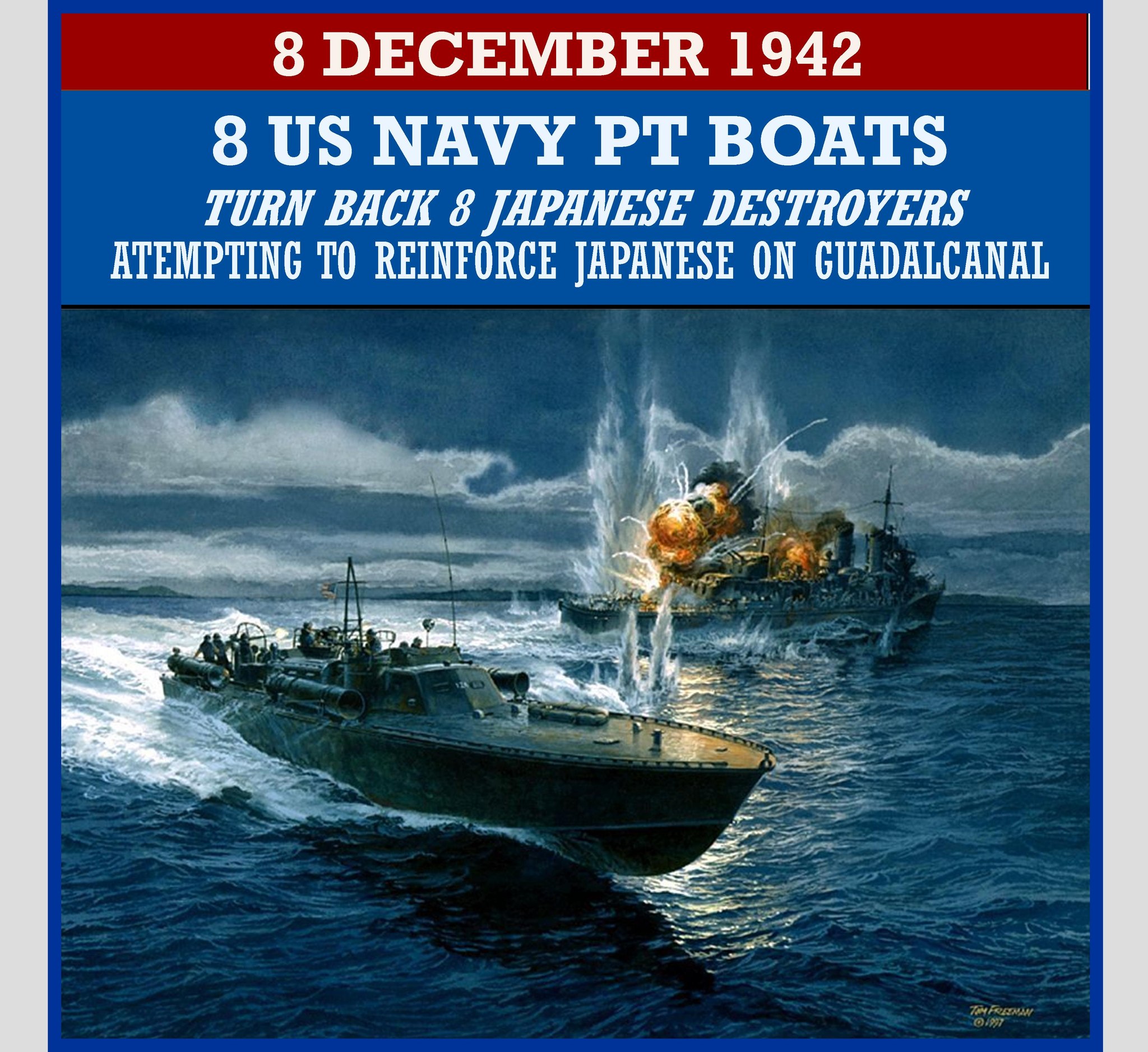
On the night of 8 December 1942, eight American PT boats (PT 36, PT 37, PT 40, PT 43, PT 44, PT 48, PT 59, and PT 109) turn back eight Japanese destroyers attempting to reinforce Japanese forces on Guadalcanal.
The Tokyo Express ended up being a lose-lose gambit for the Japanese, because many destroyers were lost during the fifteen months of the Tokyo Express, for no gain. These ships could not be replaced by the stressed Japanese shipyards, and were already in short supply. In addition, they were desperately needed for convoy duty to protect Japanese shipping supplying the Home Islands from the depredations of American submarines.
MILITARY HISTORY SOCIETY OF ROCHESTER
ROCHESTERMILITARY.COM