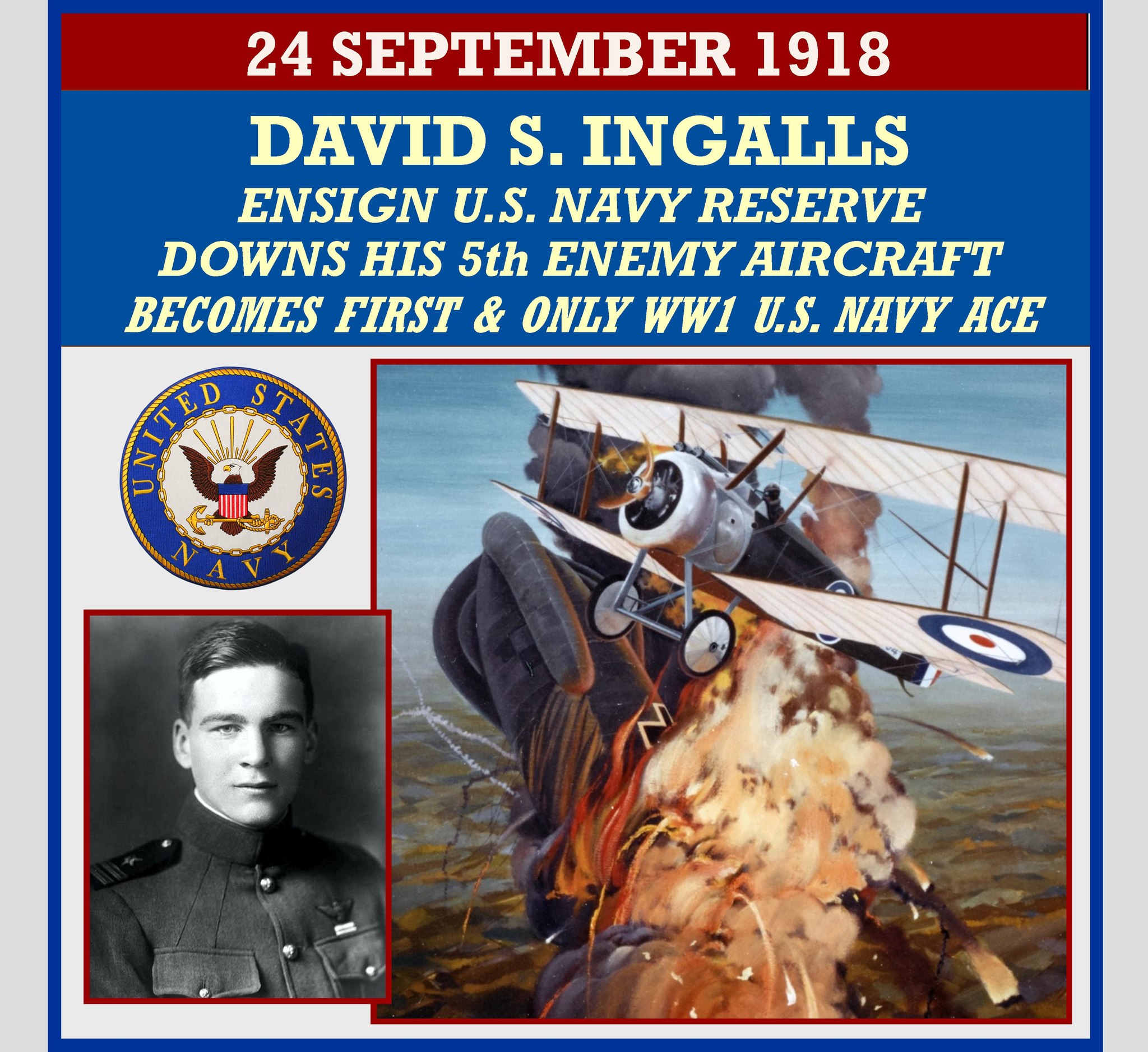
David Sinton Ingalls (January 28, 1899 â April 26, 1985) was the US Navy’s only flying ace of World War I, with six credited victories; thus he was the first ace in U. S. Navy history.
On March 26, 1917, Ingalls was enlisted as Naval Aviator No. 85. He was called to active duty on 4 April 1917, two days before the American entry into World War I.
Ingalls was attached to the British 213 Squadron and flew Sopwith Camels in attacks on German submarine bases. He was temporarily assigned to No. 218 Squadron RAF in July 1918 to gain experience flying bombers. Once back with 213 Squadron, Ingalls began tallying victories. On August 11, 1918, Ingalls and his flight leader, Colin Peter Brown, shot down a German observation plane behind enemy lines. Two days later, he was involved in a surprise attack on a German aerodrome, which destroyed thirty-eight planes.[citation needed] On 21 August, Ingalls shared a win over an LVG two-seater with Brown and fellow ace George Stacey Hodson.
On September 15, he destroyed a Rumpler in company with fellow ace Harry Smith. Three days later, he teamed with Smith and Hodson to become a balloon buster. Two days after that, Ingalls lost his engine and knew he had to crash land. As he was descending, he saw a woman sitting in a field smoking a pipe. He had never seen a woman smoking a pipe, so he tried to land in that field. Then his engine kicked back in and he was able to fly again. But by now he was well behind enemy lines. As a result, he was able to come at the Germans from behind and destroy a Fokker D.VII to become an ace. On a later attack on a German aerodrome, Ingalls destroyed more planes.[citation needed] On his way back to base on September 24, 1918, he spotted a German observation plane, which he and Hodson shot down. His last flight of the war came on October 3, 1918.
The following day, he headed home and was awarded the Navy Distinguished Service Medal for exceptionally and meritorious Service as chase pilot operating with No. 213 Squadron RAF while attached to the Northern Bombing Group. Ingalls was also decorated by Great Britain with the Distinguished Flying Cross and by France with the Legion of Honour. On 1 January 1919, he was also Mentioned in Despatches by the British. He was released from the military on January 2, 1919.
MILITARY HISTORY SOCIETY OF ROCHESTER
ROCHESTERMILITARY.COM