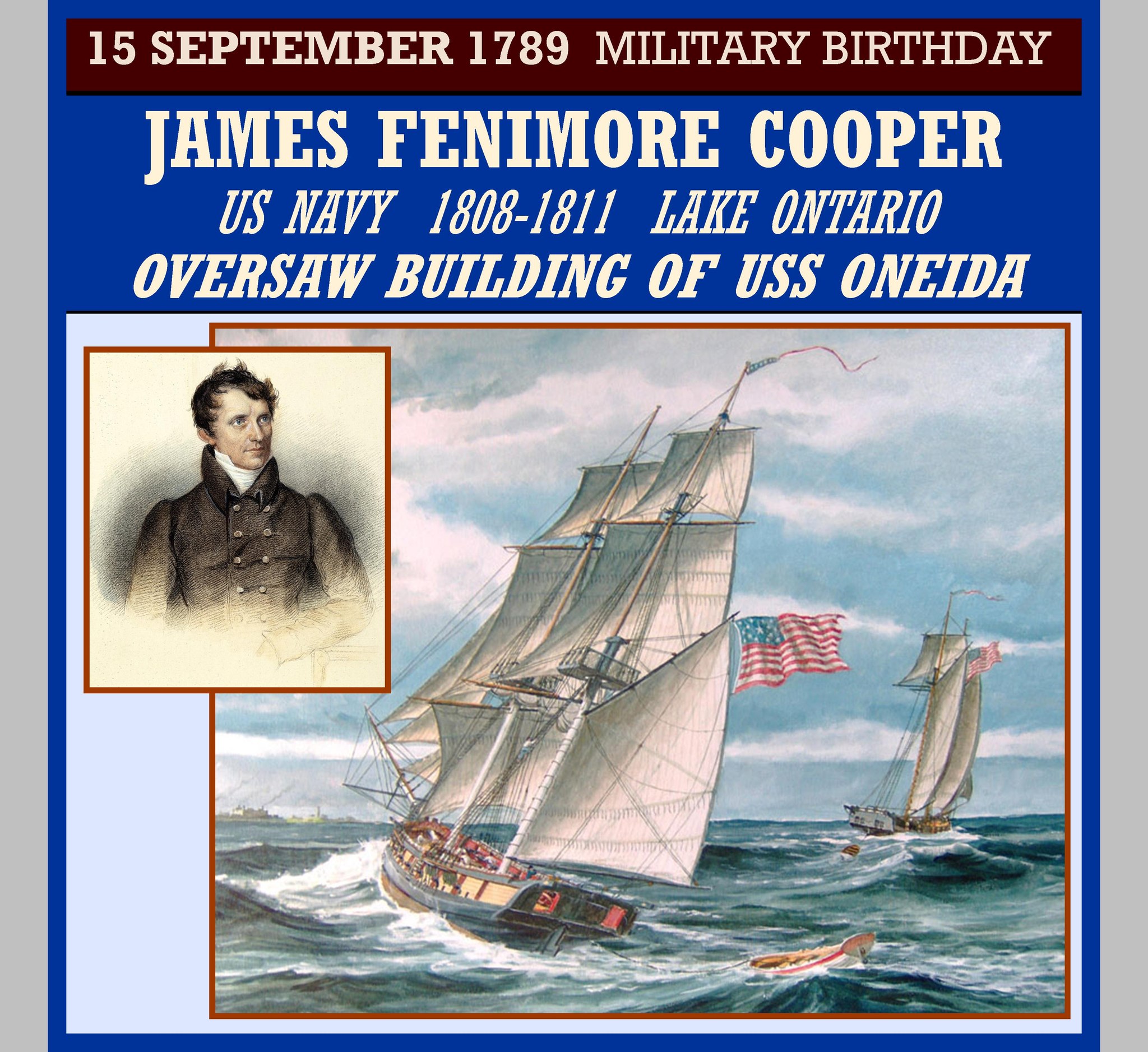
James Fenimore Cooper (September 15, 1789 â September 14, 1851) was an American writer of the first half of the 19th century, whose historical romances depicting colonist and Indigenous characters from the 17th to the 19th centuries brought him fame and fortune. He lived much of his boyhood and the last fifteen years of life in Cooperstown, New York, which was founded by his father William Cooper on property that he owned.
In 1806 at the age of 17, Cooper joined the crew of the merchant ship Sterling as a common sailor. At the time, the Sterling was commanded by young John Johnston from Maine. Cooper served as a common seaman before the mast. His first voyage took some 40 stormy days at sea and brought him to an English market in Cowes where they sought information on where best to unload their cargo of flour. There Cooper saw his first glimpses of England. Britain was in the midst of war with Napoleon’s France at the time, so their ship was immediately approached by a British man-of-war and was boarded by some of its crew. They seized one of the Sterling’s best crew members and impressed him into the British Royal Navy. Cooper thus first encountered the power of his country’s former colonial master, which led to a lifelong commitment to helping create an American art independent culturally as well as politically from the former mother country.
After serving aboard the Sterling for 11 months, he joined the United States Navy on January 1, 1808, when he received his commission as a midshipman. Cooper had conducted himself well as a sailor, and his father, a former U.S. Congressman, easily secured a commission for him through his long-standing connections with politicians and naval officials. The warrant for Cooper’s commission as midshipman was signed by President Jefferson and mailed by Naval Secretary Robert Smith, reaching Cooper on February 19. On February 24, he received orders to report to the naval commander at New York City. Joining the United States Navy fulfilled an aspiration he had had since his youth.
Cooper’s first naval assignment came on March 21, 1808, aboard the USS Vesuvius, an 82-foot bomb ketch that carried twelve guns and a thirteen-inch mortar. For his next assignment, he served under Lieutenant Melancthon Taylor Woolsey near Oswego on Lake Ontario, overseeing the building of the brig USS Oneida for service on the lake. The vessel was intended for use in a war with Great Britain which had yet to begin. The vessel was completed, armed with sixteen guns, and launched in Lake Ontario in the spring of 1809. It was in this service that Cooper learned shipbuilding, shipyard duties and frontier life. During his leisure time, Cooper would venture through the forests of New York state and explore the shores of Lake Ontario. He occasionally ventured into the Thousand Islands. His experiences in the Oswego area later inspired some of his work, including his novel The Pathfinder.
After completion of the Oneida in 1809, Cooper accompanied Woolsey to Niagara Falls, who then was ordered to Lake Champlain to serve aboard a gunboat until the winter months when the lake froze over. Cooper himself returned from Oswego to Cooperstown and then New York. On November 13 of the same year, he was assigned to the USS Wasp under the command of Captain James Lawrence, who was from Burlington and became a personal friend of Cooper’s.
MILITARY HISTORY SOCIETY OF ROCHESTER
ROCHESTERMILITARY.COM