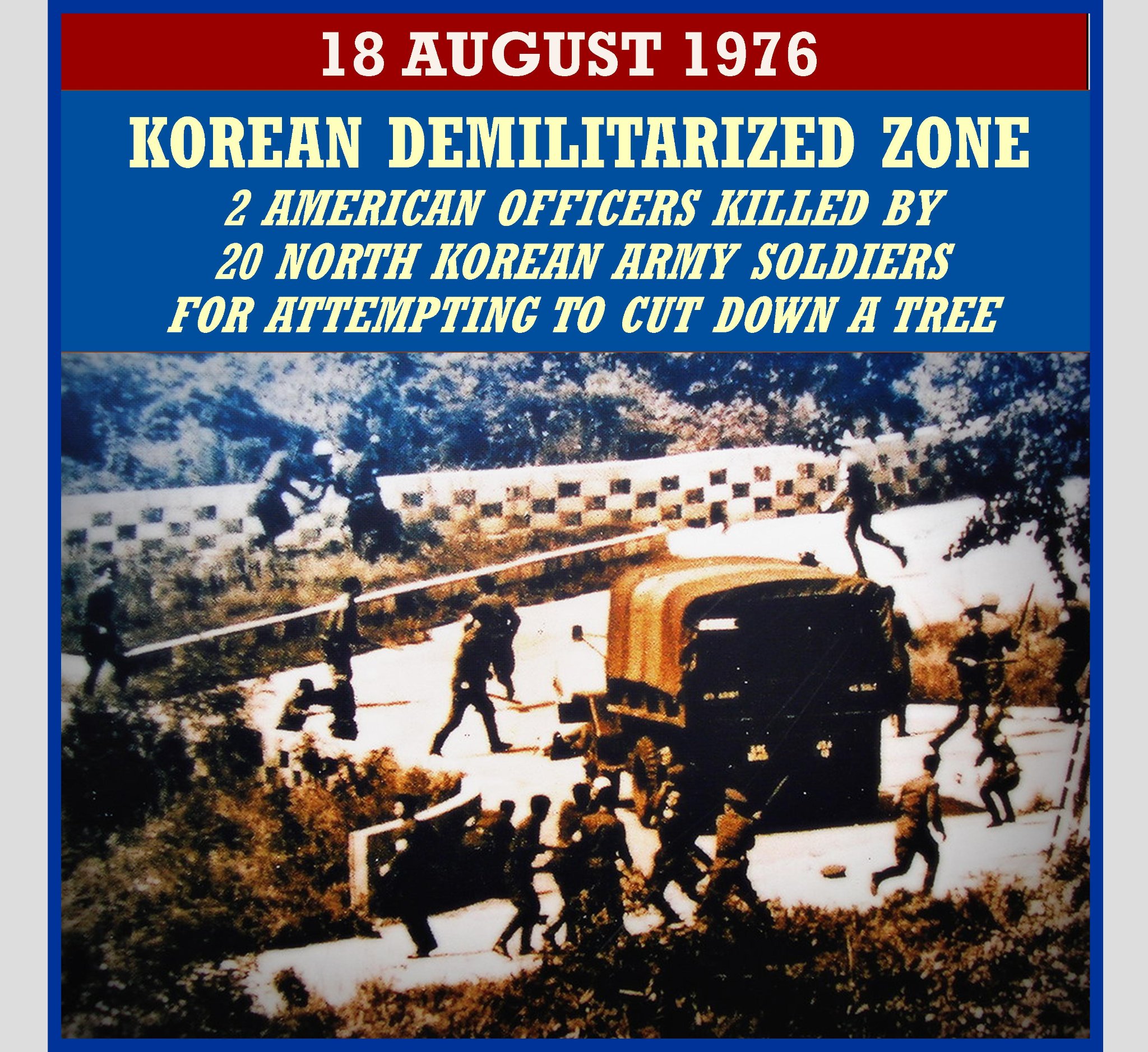
The tree was a serious problem, decided the United Nations Command. The large, leafy frame of the 80-foot Normandy poplar was obstructing the view of a vital checkpoint at the mouth of the Bridge of No Return. So, on the morning of August 18, 1976, a cadre of soldiers assembled in the most volatile area of the Korean Demilitarized Zone to cut it back. Fifteen men under the command of Capt. Bonifas set out on the task â five South Korean civilian laborers and ten UNC officers as escorts. Not all would return.
A North Korean officer, Lt. Pak Chul, arrived to warn the soldiers to cease the operation. He told them to cease trimming the tree âbecause Kim Il Sung personally planted it and nourished it and itâs growing under his supervision.â Pak had been named âBulldogâ by forces on the South Korean side of the Joint Security Area for his indiscriminate aggression, and in this case, Bonifas ignored him, and urged the men to keep working.
Pak sent word back to the North Korean side, and in return a truck came bearing about 20 soldiers, armed with blunt melee weapons like pipes and clubs. Pak commanded the team to stop cutting the tree another time, but Bonifas instructed them to continue, and turned his back to Pak. Pak yelled âkill the bastardsâ in Korean. The mob of North Korean officers suddenly enveloped the UNC troops with a vicious and bludgeoning assault. South Korean soldiers dropped their axes, and North Korean soldiers seized them, attacking Capt. Bonifas, who lay dead and mutilated on the pavement. Eight U.N. soldiers were badly injured in the assault, and another man, Lt. Mark Barret, was fatally injured. He was found alive and bloodied in the grass, but soon died of head trauma, marking the second murder to come from the axe incident.
After three days of deliberation and planning, the UNC forces initiated Operation Paul Bunyan (seriously) on the morning of August 21, 1976. The operation was executed by a team of 110 troops, 64 of whom were Korean tae kwon do experts. A handful came armed with chainsaws and descended upon the poplar. Swarming above and standing at the ready was a garrison of tactical military equipment, including 27 helicopters and farther off, three B-52 bombers. They required 42 minutes to trim the tree, three minutes longer than estimated. Soldiers left standing a six-foot-long section of the trunk to mark the position of the axe murder incident. In 1987, a bronze plaque was put in its place.
MILITARY HISTORY SOCIETY OF ROCHESTER
ROCHESTERMILITARY.COM