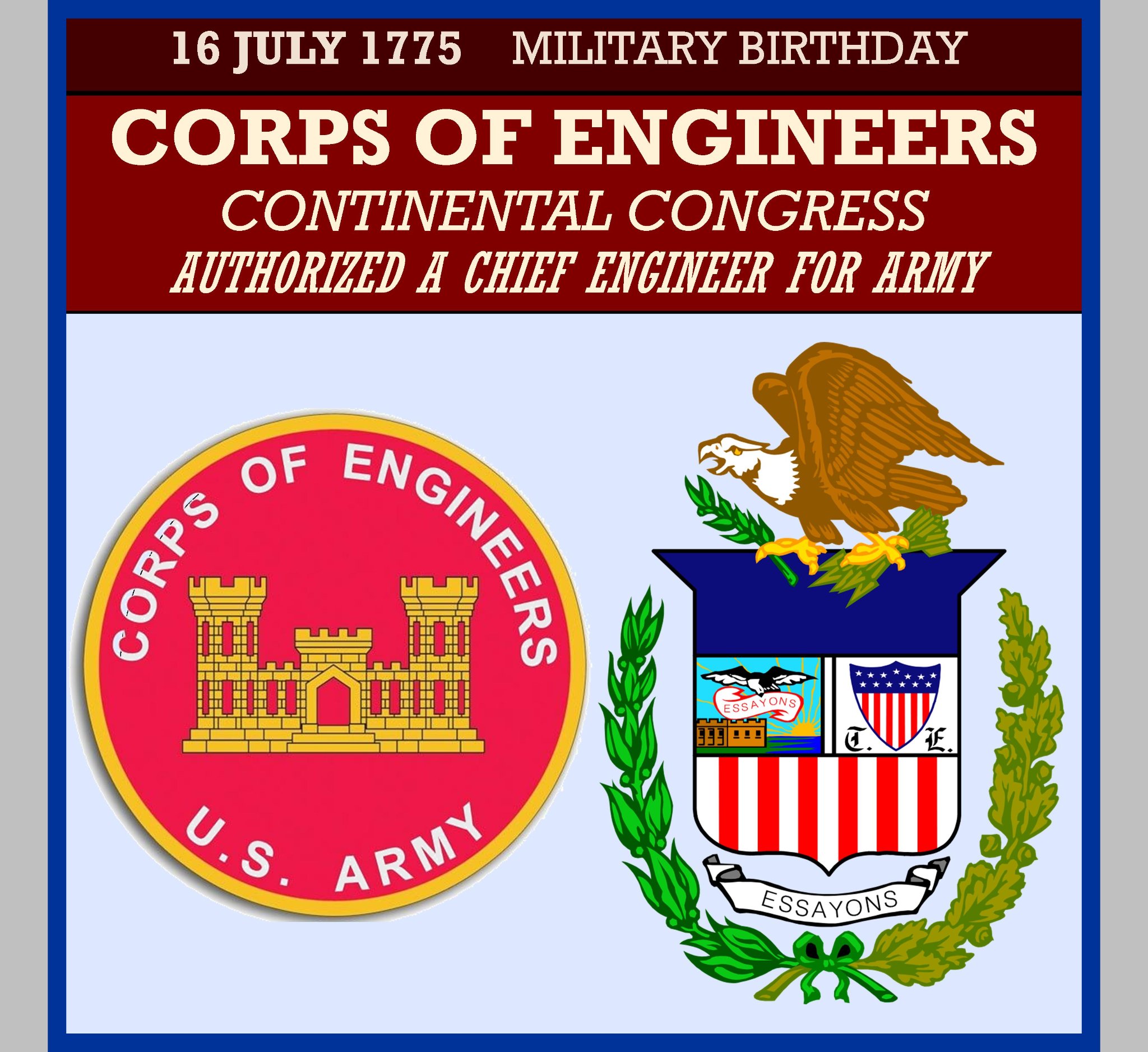
The history of United States Army Corps of Engineers can be traced back to the revolutionary era. On 16 June 1775, the Continental Congress organized an army which staff included a chief engineer and two assistants. Colonel Richard Gridley became General George Washington’s first chief engineer. One of his first tasks was to build fortifications near Boston at Bunker Hill. The Continental Congress recognized the need for engineers trained in military fortifications and asked the government of King Louis XVI of France for assistance. Many of the early engineers in the Continental Army were former French officers.
The United States Army Corps of Engineers (USACE) is an engineer formation of the United States Army that has three primary mission areas: Engineer Regiment, military construction, and civil works. The day-to-day activities of the three mission areas are administered by a lieutenant general known as the commanding general/chief of engineers. The chief of engineers commands the Engineer Regiment, comprising combat engineer, rescue, construction, dive, and other specialty units, and answers directly to the Chief of Staff of the Army. Combat engineers, sometimes called sappers, form an integral part of the Army’s combined arms team and are found in all Army service components: Regular Army, National Guard, and Army Reserve. Their duties are to breach obstacles; construct fighting positions, fixed/floating bridges, and obstacles and defensive positions; place and detonate explosives; conduct route clearance operations; emplace and detect landmines; and fight as provisional infantry when required. For the military construction mission, the commanding general is directed and supervised by the Assistant Secretary of the Army for installations, environment, and energy, whom the President appoints and the Senate confirms. Military construction relates to construction on military bases and worldwide installations.
MILITARY HISTORY SOCIETY OF ROCHESTER
ROCHESTERMILITARY.COM