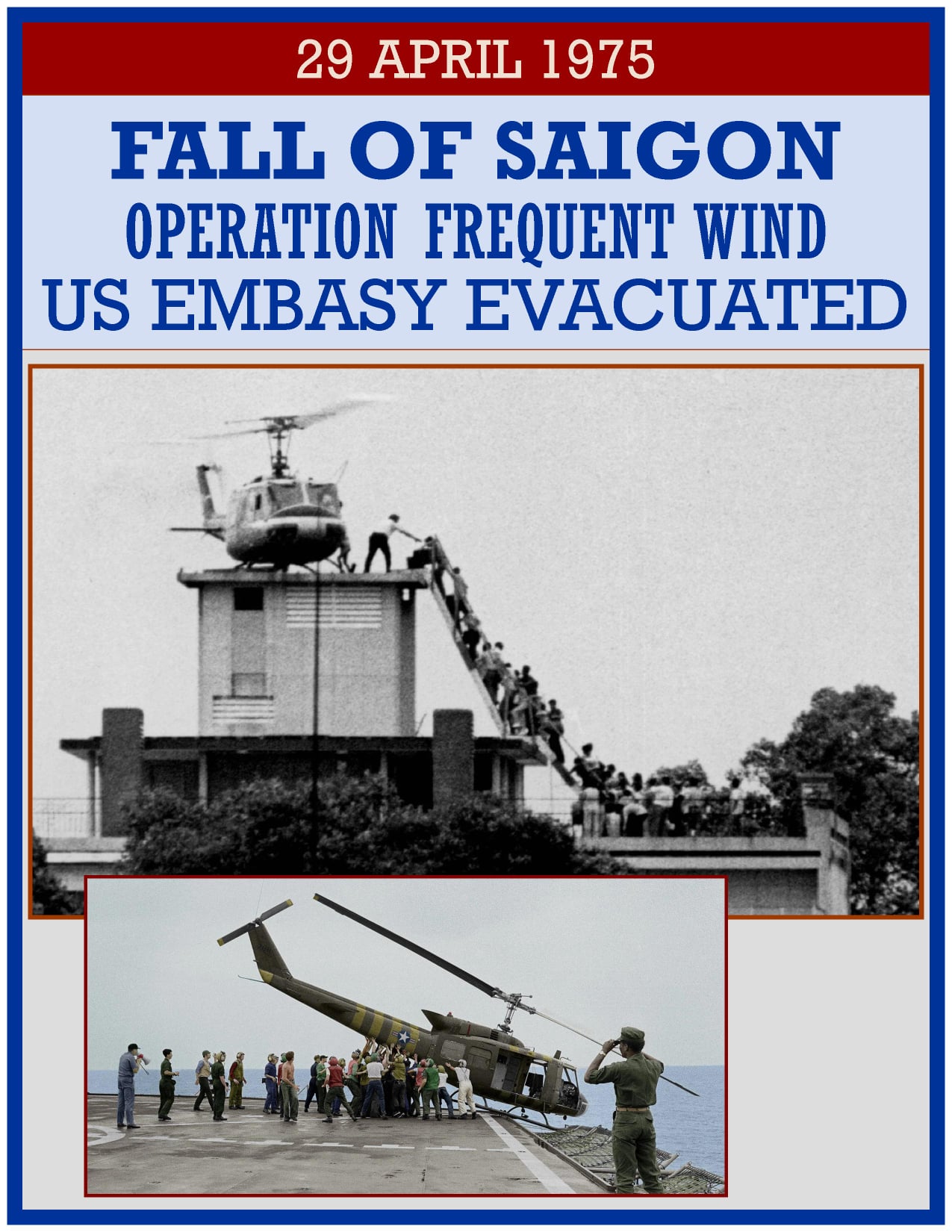
The Fall of Saigon, also known as the Liberation of Saigon by North Vietnamese or Liberation of the South by the current government, was the capture of Saigon, the capital of South Vietnam, by the People’s Army of Vietnam (PAVN) and the National Liberation Front of South Vietnam (Viet Cong) on 30 April 1975. The event marked the end of the Vietnam War and the start of a transition period from the formal reunification of Vietnam into the Socialist Republic of Vietnam.
The PAVN, under the command of General VÄn Tiến DÅ©ng, began their final attack on Saigon on 29 April 1975, with the Army of the Republic of Vietnam (ARVN) forces commanded by General Nguyá»
n VÄn Toà n suffering a heavy artillery bombardment. By the afternoon of the next day, the PAVN and the Viet Cong had occupied the important points of the city and raised their flag over the South Vietnamese presidential palace.
The capture of the city was preceded by Operation Frequent Wind, the evacuation of almost all American civilian and military personnel in Saigon, along with tens of thousands of South Vietnamese civilians who had been associated with the Republic of Vietnam regime. A few Americans chose not to be evacuated. United States ground combat units had left South Vietnam more than two years prior to the fall of Saigon and were not available to assist with either the defense of Saigon or the evacuation. The evacuation was the largest helicopter evacuation in history. In addition to the flight of refugees, the end of the war and the institution of new rules by the communist government contributed to a decline in the city’s population until 1979, after which the population increased again.
MILITARY HISTORY SOCIETY OF ROCHESTER
ROCHESTERMILITARY.COM