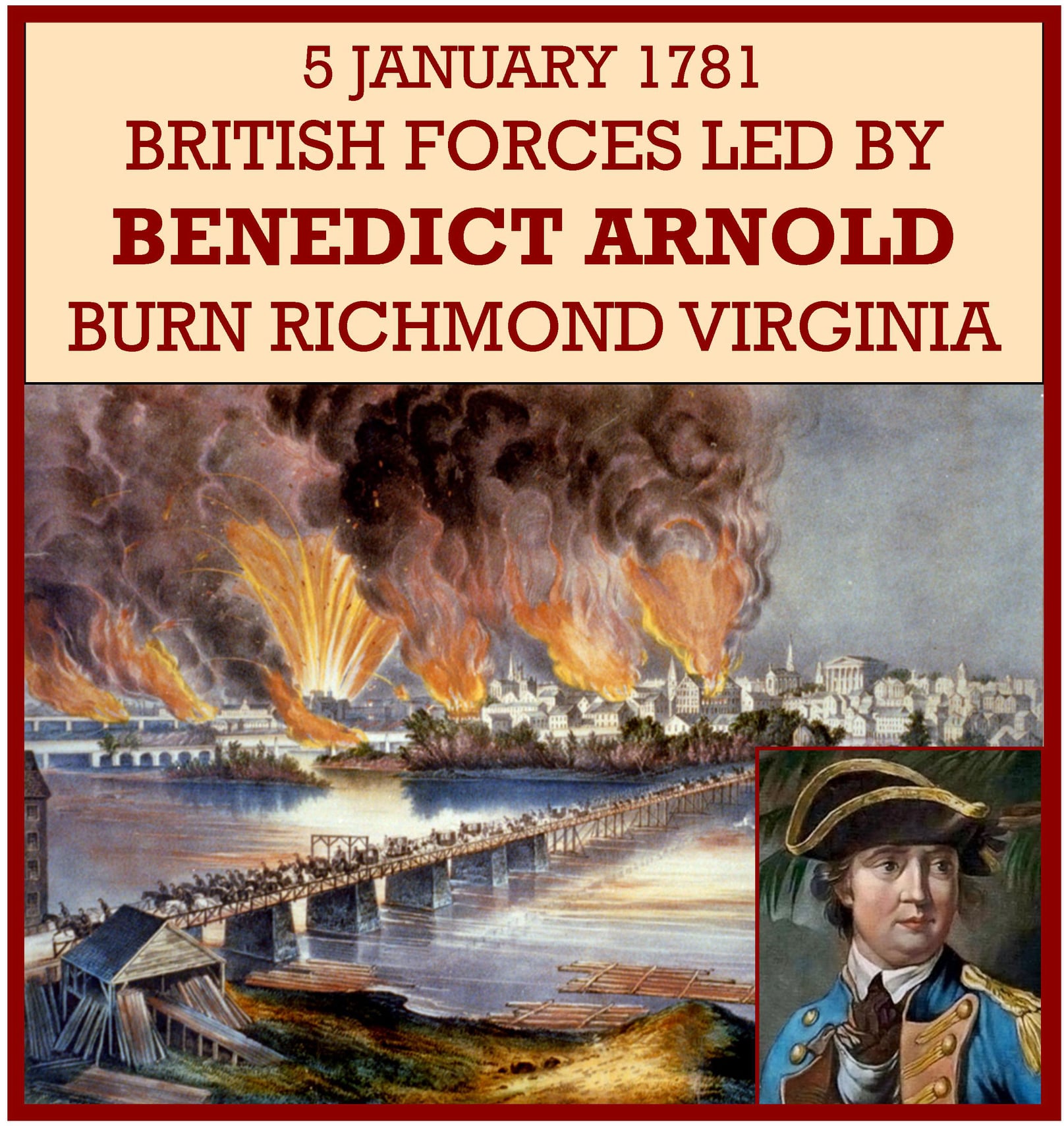
1781 â A British naval expedition led by Benedict Arnold burned Richmond, Va., causing Governor Thomas Jefferson to flee as the Virginia militia, led by Sampson Mathews, defended the city. It was Arnoldâs greatest success as a British commander. Arnoldâs 1,600 largely Loyalist troops sailed up the James River at the beginning of January, eventually landing in Westover, Virginia. Leaving Westover on the afternoon of January 4, Arnold and his men arrived at the virtually undefended capital city of Richmond the next afternoon. Virginiaâs governor, Thomas Jefferson, had frantically attempted to prepare the city for attack by moving all arms & other Military Stores and records from the city to a foundry five miles outside Richmond. As news of Arnoldâs unexpectedly rapid approach reached him, Jefferson then tried to orchestrate their removal to Westham, seven miles further north. He was too lateâArnoldâs men quickly reached and burned the foundry and then proceeded towards Westham, which Jefferson had asked the formidable Prussian military advisor Baron Friedrich Wilhelm von Steuben to guard. Finding von Steuben, Arnold chose to return to Richmond, burning much of the city the following morning. Only 200 militiamen responded to Governor Jeffersonâs call to defend the capitalâmost Virginians had already served and therefore thought they were under no further obligation to answer such calls. Despite this untenable military position, the author of the Declaration of Independence was criticized by some for fleeing Richmond during the crisis. Later, two months after Cornwallis surrendered at Yorktown, he was cleared of any wrongdoing during his term as governor. Jefferson went on to become the leader of the Democratic-Republican Party, and his presidential victory over the Federalists is remembered as The Revolution of 1800. After the war, Benedict Arnold attempted and failed to establish businesses in Canada and London. He died a pauper on June 14, 1801, and lays buried in his Continental Army uniform at St. Maryâs Church, Middlesex, London. To this day, his name remains synonymous with the word âtraitorâ in the United States.
MILITARY HISTORY SCIETY OF ROCHESTER
ROCHESTERMILITARY.COM