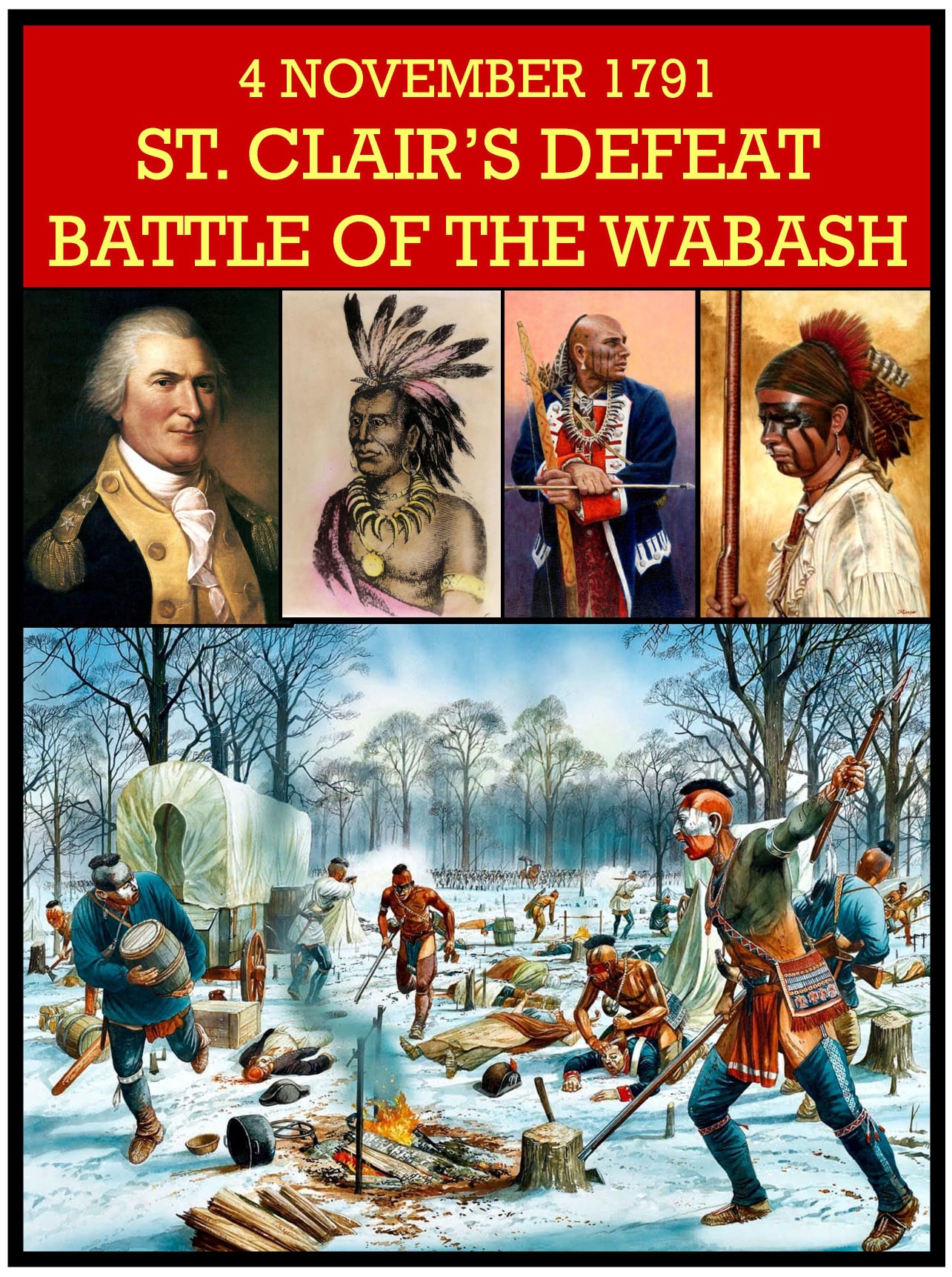
St. Clair’s defeat, also known as the Battle of the Wabash, the Battle of Wabash River or the Battle of a Thousand Slain, was a battle fought on 4 November 1791 in the Northwest Territory of the United States of America. The U.S. Army faced the Western Confederacy of Native Americans, as part of the Northwest Indian War. It was “the most decisive defeat in the history of the American military” and its largest defeat ever by Native Americans.
The Native Americans were led by Little Turtle of the Miamis, Blue Jacket of the Shawnees, and Buckongahelas of the Delawares (Lenape). The war party numbered more than 1,000 warriors, including many Potawatomis from eastern Michigan and the Saint Joseph. The opposing force of about 1,000 Americans was led by General Arthur St. Clair. The forces of the American Indian confederacy attacked at dawn, taking St. Clair’s men by surprise. Of the 1,000 officers and men that St. Clair led into battle, only 24 escaped unharmed. As a result, President George Washington forced St. Clair to resign his post, and Congress initiated its first investigation of the executive branch.
MILITARY HISTORY SOCIETY OF ROCHESTER
ROCHESTERMILITARY.COM