JULY 31
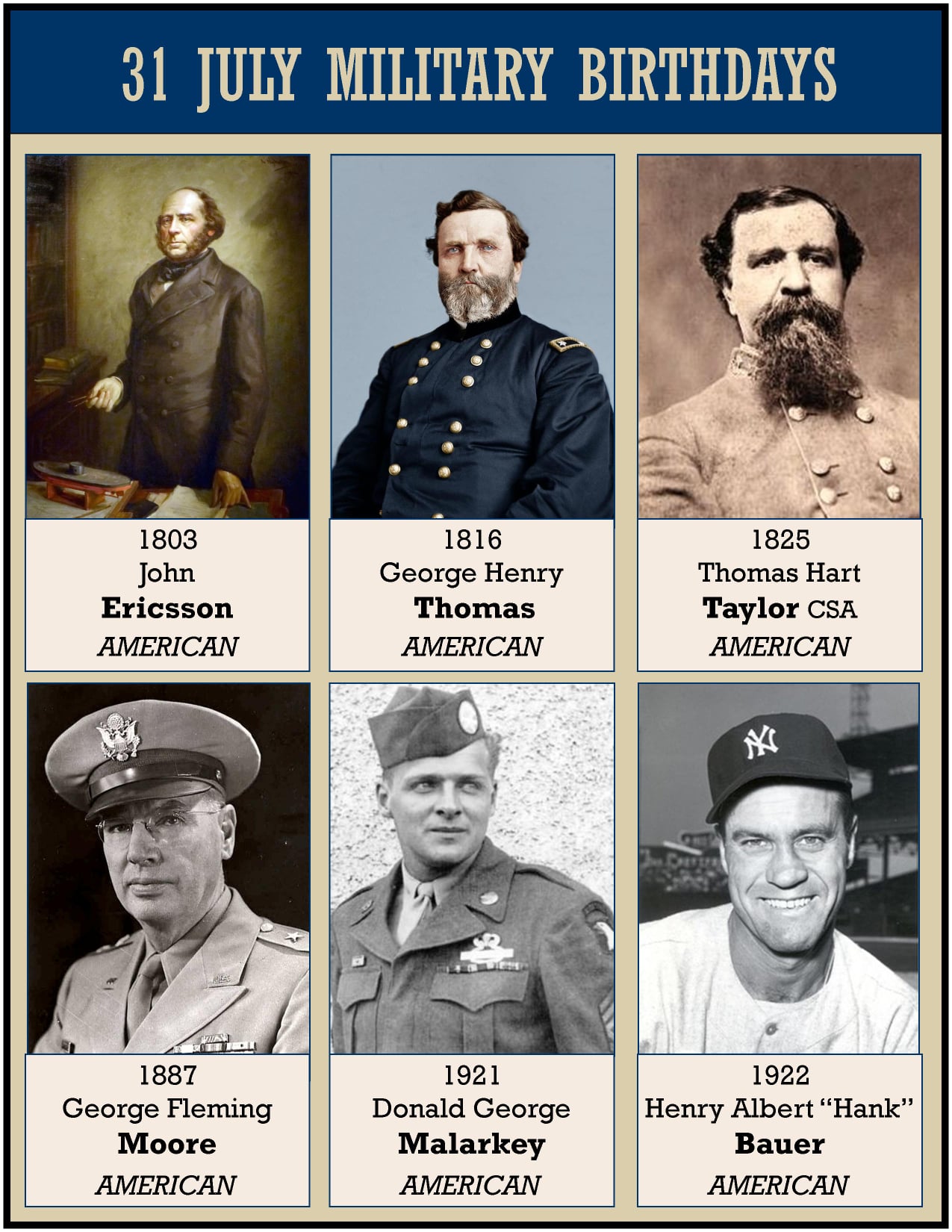
1803 John Ericsson (born Johan Ericsson; July 31, 1803 â March 8, 1889) was a Swedish-American inventor. He was active in England and the United States. A partnership with Cornelius H. DeLamater (1821-1889), of the DeLamater Iron Works in New York City resulted in the first armored ironclad warship equipped with a rotating gun turret, USS Monitor, which dramatically saved the U.S. (Union Navy) naval blockading squadron from destruction by an ironclad Confederate States naval vessel, CSS Virginia, at the famous Battle of Hampton Roads at the southern mouth of Chesapeake Bay (with the James River) in March 1862, during the American Civil War.
1816 George Henry Thomas (July 31, 1816 â March 28, 1870) was a United States Army officer and a Union general during the American Civil War, one of the principal commanders in the Western Theater.
1825 Thomas Hart Taylor (July 31, 1825 â April 12, 1901) was a Confederate States Army colonel, brigade commander, provost marshal and last Confederate post commander at Mobile, Alabama during the American Civil War.
1887 George Fleming Moore (July 31, 1887 â December 2, 1949) was a highly decorated officer of the United States Army with the rank of major general. General Moore commanded the Harbor Defenses of Manila and Subic Bays and the Philippine Coast Artillery during the Battle of Bataan.
1921 Technical Sergeant Donald George Malarkey (July 31, 1921 â September 30, 2017) was a non-commissioned officer with Easy Company, 2nd Battalion, 506th Parachute Infantry Regiment, in the 101st Airborne Division of the United States Army during World War II. Malarkey was portrayed in the HBO miniseries Band of Brothers by Scott Grimes.
1922 Henry Albert Bauer (July 31, 1922 â February 9, 2007) was an American right fielder and manager in Major League Baseball. One month after the Japanese attack on Pearl Harbor, Bauer enlisted in the U.S. Marine Corps and served with the 4th Raider Battalion and G Company, 2nd Battalion, 4th Marines. While deployed to the Pacific Theater, Bauer contracted malaria on Guadalcanal, however he recovered from that well enough to earn 11 campaign ribbons, two Bronze Stars, two Purple Hearts (for being wounded in action) in 32 months of combat and the Navy Commendation Medal. Bauer was wounded his second time during the Battle of Okinawa, when he was a sergeant in command of a platoon of 64 marines. Only six of the 64 marines survived the Japanese counterattack, and Bauer was wounded by shrapnel in his thigh. His wounds were severe enough to send him back to the United States to recuperate.
MILITARY HISTORY SOCIETY OF ROCHESTER
ROCHESTERMILITARY.COM