JULY 20
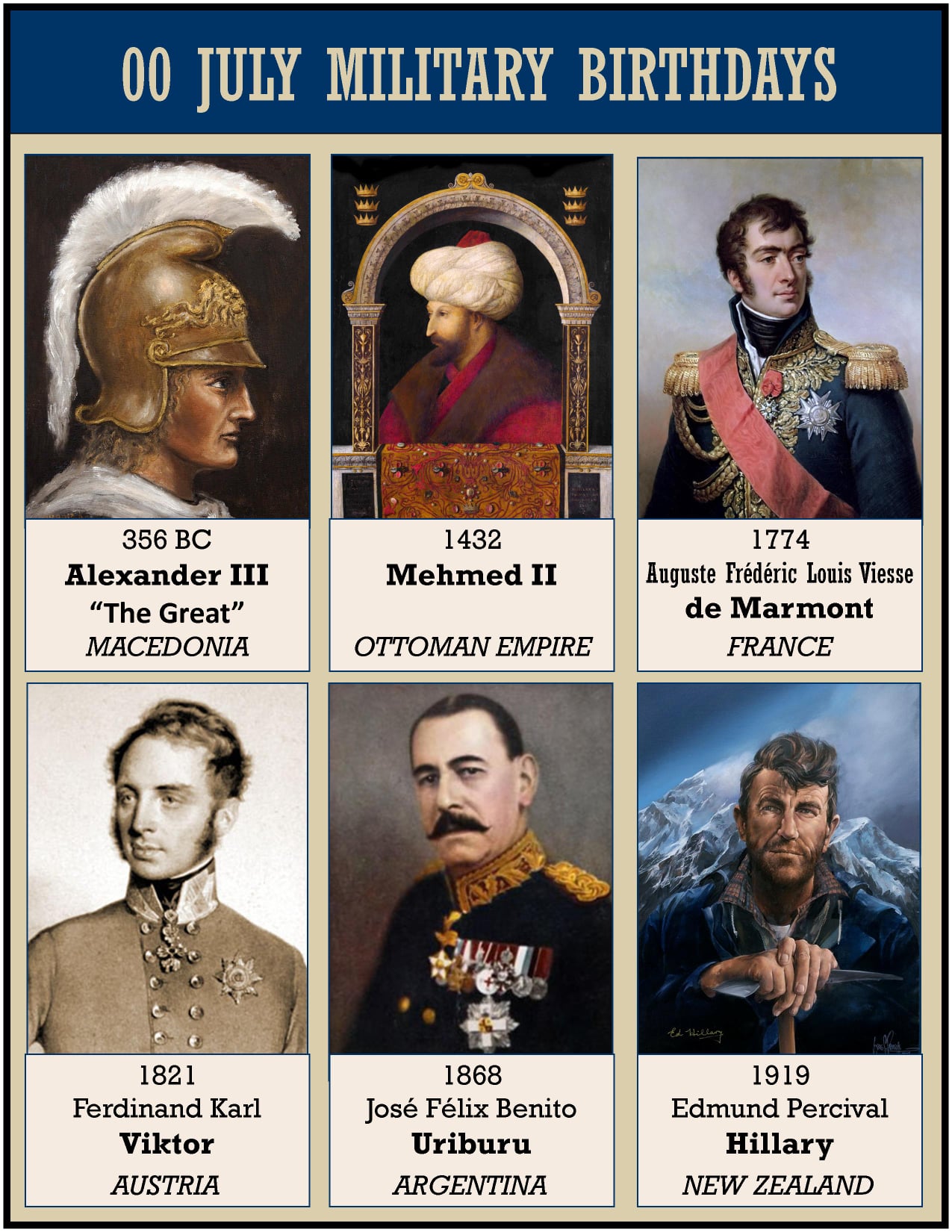
356 BC Alexander III of Macedon (20 July 356 BC â 11 June 323 BC), commonly known as Alexander the Great, was a king of the ancient Greek kingdom of Macedon.[a] A member of the Argead dynasty, he was born in Pellaâa city in Ancient Greeceâin 356 BC. He succeeded his father King Philip II to the throne at the age of 20, and spent most of his ruling years conducting a lengthy military campaign throughout Western Asia and Northeastern Africa. By the age of thirty, he had created one of the largest empires in history, stretching from Greece to northwestern India. He was undefeated in battle and is widely considered to be one of history’s most successful military commanders.
1432 Mehmed II (30 March 1432 â 3 May 1481), commonly known as Mehmed the Conqueror), was an Ottoman sultan who ruled from August 1444 to September 1446, and then later from February 1451 to May 1481. In Mehmed II’s first reign, he defeated the crusade led by John Hunyadi after the Hungarian incursions into his country broke the conditions of the truce Peace of Szeged. When Mehmed II ascended the throne again in 1451 he strengthened the Ottoman navy and made preparations to attack Constantinople. At the age of 21, he conquered Constantinople (modern-day Istanbul) and brought an end to the Byzantine Empire.
1774 Auguste Frédéric Louis Viesse de Marmont (20 July 1774 â 22 March 1852) was a French general and nobleman who rose to the rank of Marshal of the Empire and was awarded the title Duke of Ragusa (French: duc de Raguse). In the Peninsular War Marmont succeeded the disgraced André Masséna in the command of the French army in northern Spain, but lost decisively at the Battle of Salamanca.
1821 Ferdinand Karl Viktor (20 July 1821 â 15 December 1849) was Archduke of Austria-Este and Prince of Modena. Ferdinand, who was a Feldmarschalleutnant (Austrian “two stars” general rank), died at Brno a few months later at the age of 28 from typhus.
1868 Lieutenant General José Félix Benito Uriburu y Uriburu (20 July 1868 â 29 April 1932) was the first de facto (not de jure) president of Argentina, ousting president Hipólito Yrigoyen by means of a military coup and declaring himself president. From 6 September 1930 to 20 February 1932, he controlled both the Executive and Legislative branches of government. Under the title of “President of the Provisional Government,” he acted as the de facto Head of state of Argentina. His was the first of a series of successful coups d’état and unconstitutional governments that came to power in 1943, 1955, 1962, 1966, and 1976.
1919 Sir Edmund Percival Hillary KG ONZ KBE (20 July 1919 â 11 January 2008) was a New Zealand mountaineer, explorer, and philanthropist. On 29 May 1953, Hillary and Sherpa mountaineer Tenzing Norgay became the first climbers confirmed to have reached the summit of Mount Everest. They were part of the ninth British expedition to Everest, led by John Hunt. From 1985 to 1988 he served as New Zealand’s High Commissioner to India and Bangladesh and concurrently as Ambassador to Nepal. At the outbreak of World War II, Hillary applied to join the Royal New Zealand Air Force (RNZAF) but quickly withdrew the application, later writing that he was “harassed by [his] religious conscience”. In 1943, with the Japanese threat in the Pacific and the arrival of conscription, he joined the RNZAF as a navigator in No. 6 Squadron RNZAF and later No. 5 Squadron RNZAF on Catalina flying boats. In 1945, he was sent to Fiji and to the Solomon Islands, where he was badly burnt in an accident.
MILITARY HISTORY SOCIETY OF ROCHESTER
ROCHESTERMILITARY.COM