JULY 13
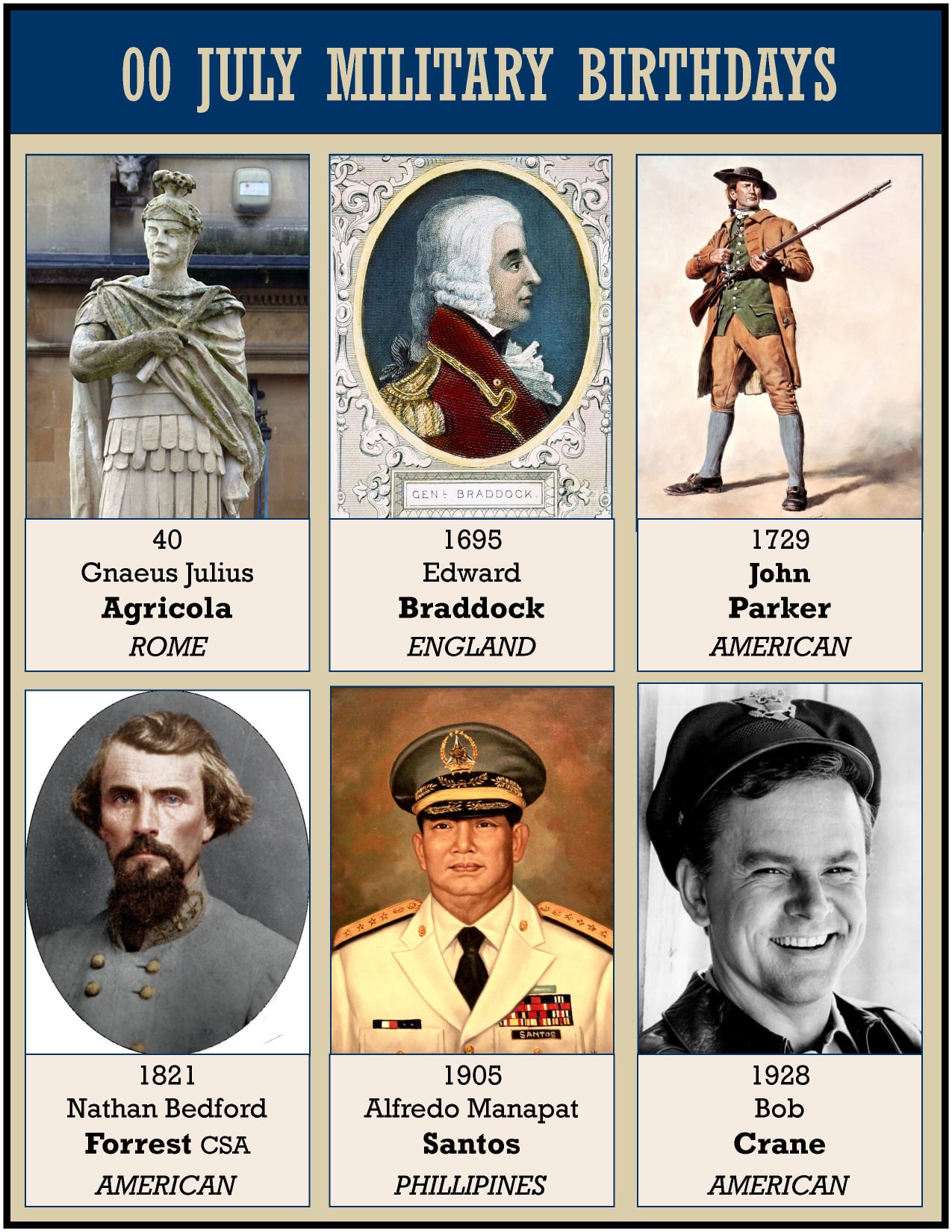
40 Gnaeus Julius Agricola (13 June 40 â 23 August 93) was a Roman Italo-Gallic general responsible for much of the Roman conquest of Britain. Written by his son-in-law Tacitus, the De vita et moribusIuliiAgricolae is the primary source for most of what is known about him,[1] along with detailed archaeological evidence from northern Britain.
1695 General Edward Braddock (January 1695 â 13 July 1755) was a British soldier and commander-in-chief for the 13 colonies during the actions at the start of the French and Indian War (1754â1765). He is generally best remembered for his command of a disastrous expedition against the French-occupied Ohio Country in 1755, in which he lost his life.
1729 John Parker (July 13, 1729 â September 17, 1775) was an American farmer, mechanic, and soldier, who commanded the Lexington militia at the Battle of Lexington on April 19, 1775.His experience as a soldier in the French and Indian War (Seven Years War) at the Siege of Louisbourg and conquest of Quebec most likely led to his election as militia captain by the men of the town.. Tradition reports he ordered “Stand your ground. Don’t fire unless fired upon, but if they mean to have a war, let it begin here.”
1821 Nathan Bedford Forrest CSA (July 13, 1821 â October 29, 1877) was a prominent Confederate Army general during the American Civil War and the first Grand Wizard of the Ku Klux Klan from 1867 to 1869. Before the war, Forrest amassed substantial wealth as a cotton plantation owner, horse and cattle trader, real estate broker, and slave trader. In June 1861, he enlisted in the Confederate Army and became one of the few soldiers during the war to enlist as a private and be promoted to general without any prior military training. An expert cavalry leader, Forrest was given command of a corps and established new doctrines for mobile forces, earning the nickname “The Wizard of the Saddle”. His methods influenced future generations of military strategists, although the Confederate high command is seen by some commentators to have underappreciated his talents.[3] Although scholars generally acknowledge Forrest’s skills and acumen as a cavalry leader and military strategist, he has remained a controversial figure in Southern racial history for his main role in the massacre of several hundred Union soldiers at Fort Pillow, a majority of them black, coupled with his role following the war as a leader of the Klan.
1905 AlfredoManapat Santos (July 13, 1905 â February 7, 1990) was Chief of Staff of the Armed Forces of the Philippines in 1962 to 1965, making him the first four-star general of the Philippines’ armed forces.
1928 Bob Crane (July 13, 1928 d. 1978) American actor. TV: Hogan’s Heroes (1965-71, Col. Robert Hogan). In 1948 he enlisted for two years in the Connecticut Army National Guard and was honorably discharged in 1950. Crane was found murdered in his apartment. He had been bludgeoned to death and an electrical cord was tied around his neck. Blood matching Crane’s was found in his friend John Henry Carpenter’s rental car (DNA testing was not available at the time). Carpenter had been visiting Crane the night before the murder. Due to lack of evidence, Carpenter was not tried for the murder until 1994, when new evidence arose. Photos of Carpenter’s rental car showed what appeared to be brain matter. Carpenter was acquitted and maintained his innocence until his death.
MILITARY HISTORY SOCIETY OF ROCHESTER
ROCHESTERMILITARY.COM