JULY 2
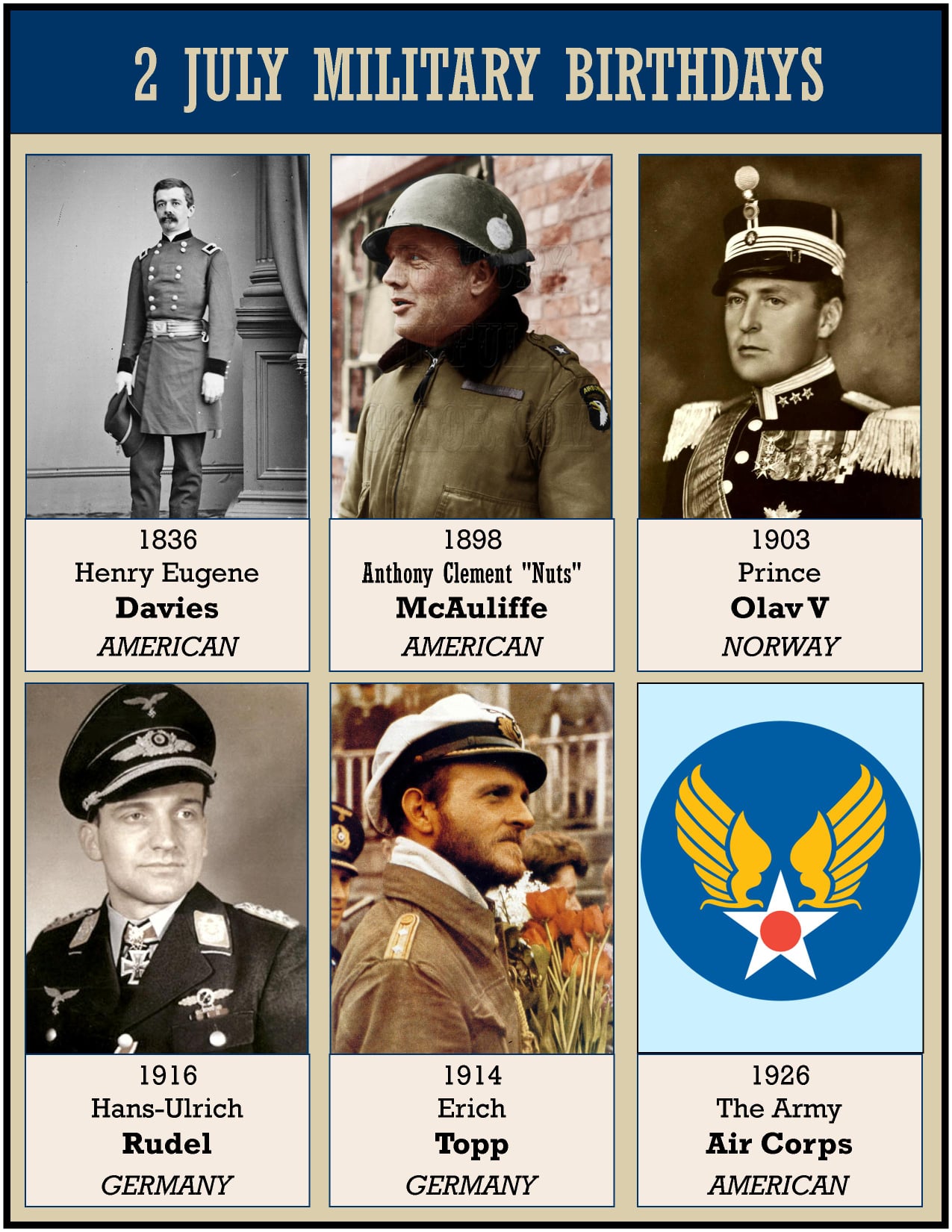
1836 Henry Eugene Davies (July 2, 1836 â September 7, 1894) was an American soldier, writer, public official and lawyer. He served in the Union Army as a brigadier general of volunteers in cavalry service during the American Civil War (“Civil War”) and was promoted to the grade of major general of volunteers at the end of the war. Davies was one of the few nonprofessional soldiers in the Union cavalry in the East to be promoted to the grade of general. He led his brigade in several major battles, especially during the Overland Campaign, the Battle of Trevilian Station, the Siege of Petersburg and the Appomattox Campaign at the end of the war.
1898 Anthony Clement “Nuts” McAuliffe (July 2, 1898 â August 10, 1975) was a senior United States Army officer who earned fame as the acting commander of the 101st Airborne Division defending Bastogne, Belgium, during the Battle of the Bulge in World War II. He is celebrated for his one-word reply to a German surrender ultimatum: “Nuts!” After the battle, McAuliffe was promoted and given command of the 103rd Infantry Division, which he led from January 1945 to July 1945. In the post-war era, he was commander of United States Army Europe.
1903 Olav V (born Prince Alexander of Denmark; 2 July 1903 â 17 January 1991) was King of Norway. Olav V of Norway reigned as the King of Norway from September 1957 until his death in January 1991. He was born as Prince Alexander of Denmark and became the Crown Prince of Norway in 1905, when his father was elected the Norwegian King. Following the completion of his civil education, he underwent extensive military exercise and served as a general of the Norwegian Army, as well as an admiral of the Royal Norwegian Navy. For his contributions during World War II, he was named the Norwegian Chief of Defence and, apart from several honor and medals in Norway, also earned titles and decorations from other countries, such as the ‘Legion of Merit’ from the United States and the Médaille Militaire from France. He became the King of Norway following his father’s death in 1957. At the time of his death, he was the worldâs oldest reigning monarch at 87, and was the last surviving grandchild of King Edward VII of the United Kingdom and Alexandra of Denmark. Olav, who was adored by his people for his simplicity and humility, was named ‘Norwegian of the Century’ in a poll conducted by the Norwegian Broadcasting Corporation in 2005.
1916 Hans-Ulrich Rudel (2 July 1916 â 18 December 1982) was a German ground-attack pilot during World War II, in which he was the most decorated German serviceman and a recipient of the Knight’s Cross with Golden Oak Leaves, Swords, and Diamonds. Rudel was credited with the destruction of 519 tanks, one battleship, one cruiser, 70 landing craft and 150 artillery emplacements. He claimed 51 aerial victories and the destruction of more than 800 vehicles. He flew 2,530 ground-attack missions exclusively on the Eastern Front, usually flying the Junkers Ju 87 “Stuka” dive bomber.
1914 Erich Topp (2 July 1914 â 26 December 2005) was the third most successful of German U-Boat commanders of World War II. He was a recipient of the Knight’s Cross of the Iron Cross with Oak Leaves and Swords of Nazi Germany. He sank 35 ships for a total of 197,460 gross register tons (GRT). After the war he served with the Federal German Navy, reaching the rank of Konteradmiral (rear admiral). He later served in NATO.
1926 The United States Army Air Corps (USAAC) was the aerial warfare service component of the United States Army between 1926 and 1941. After World War I, as early aviation became an increasingly important part of modern warfare, a philosophical rift developed between more traditional ground-based army personnel and those who felt that aircraft were being underutilized and that air operations were being stifled for political reasons unrelated to their effectiveness. The USAAC was renamed from the earlier United States Army Air Service on 2 July 1926, and was part of the larger United States Army. The Air Corps became the United States Army Air Forces (USAAF) on 20 June 1941, giving it greater autonomy from the Army’s middle-level command structure. During World War II, although not an administrative echelon, the Air Corps (AC) remained as one of the combat arms of the Army until 1947, when it was legally abolished by legislation establishing the Department of the Air Force.
MILITARY HISTORY SOCIETY OF ROCHESTER
ROCHESTERMILITARY.COM