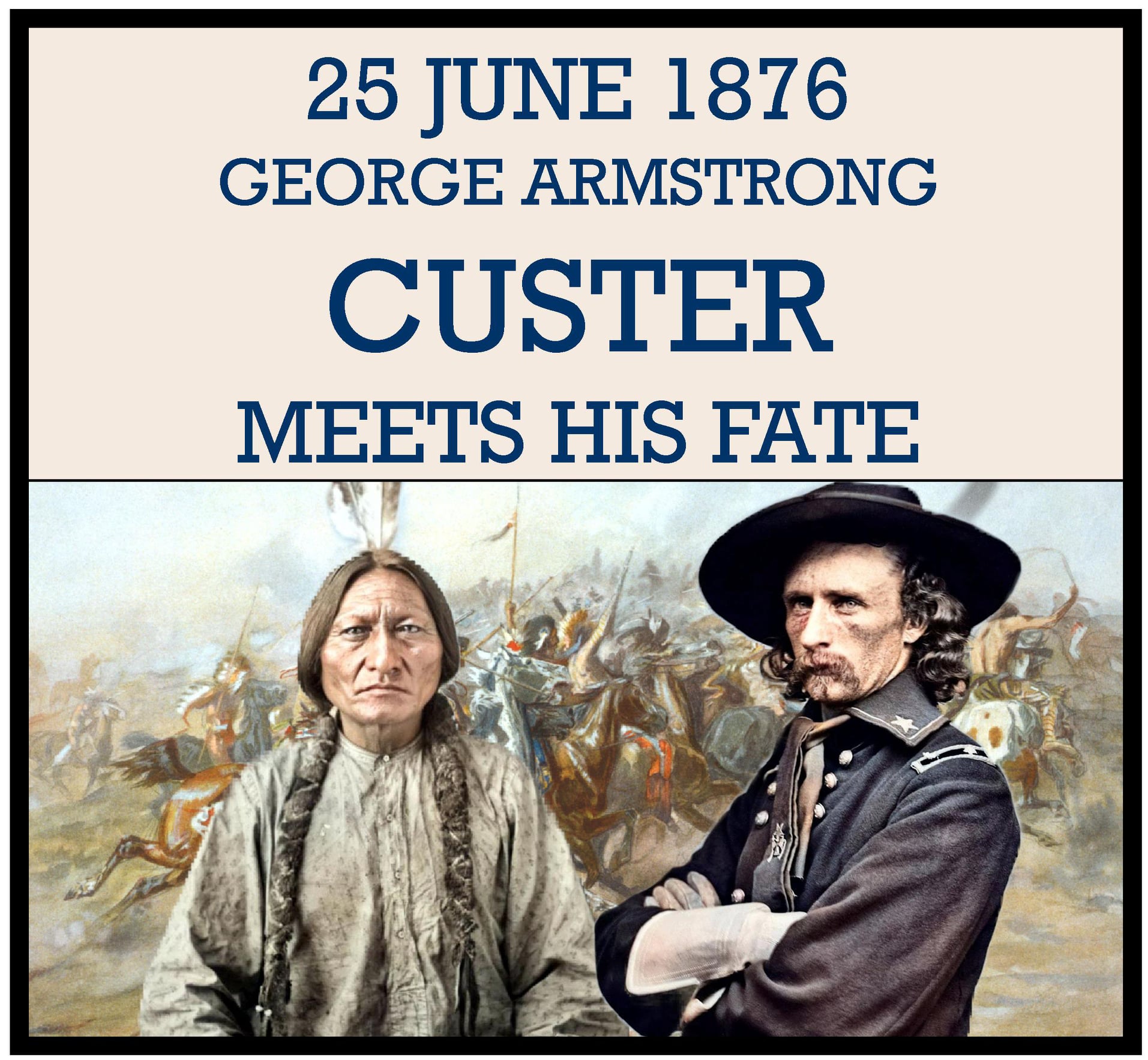
The Battle of the Little Bighorn, known to the Lakota and other Plains Indians as the Battle of the Greasy Grass and also commonly referred to as Custer’s Last Stand, was an armed engagement between combined forces of the Lakota, Northern Cheyenne, and Arapaho tribes and the 7th Cavalry Regiment of the United States Army. The battle, which resulted in the defeat of U.S. forces, was the most significant action of the Great Sioux War of 1876. It took place on June 25â26, 1876, along the Little Bighorn River in the Crow Indian Reservation in southeastern Montana Territory.
The fight was an overwhelming victory for the Lakota, Northern Cheyenne, and Arapaho, who were led by several major war leaders, including Crazy Horse and Chief Gall, and had been inspired by the visions of Sitting Bull (TÈatÈáÅka Ãyotake). The U.S. 7th Cavalry, a force of 700 men, suffered a major defeat while commanded by Lieutenant Colonel George Armstrong Custer (formerly a brevetted major general during the American Civil War). Five of the 7th Cavalry’s twelve companies were annihilated and Custer was killed, as were two of his brothers, a nephew, and a brother-in-law. The Seventh Cavalry lost 16 officers, 242 troopers, and 10 scouts. Included among the dead were Custer, all of the personnel in the five-company battalion under his immediate command, and 18 men who fought in the southern part of the battlefield (valley and hilltop engagements in the Reno-Benteen Battlefield).
MILITARY HISTORY SOCIETY OF ROCHESTER
ROCHESTRMILITARY.COM