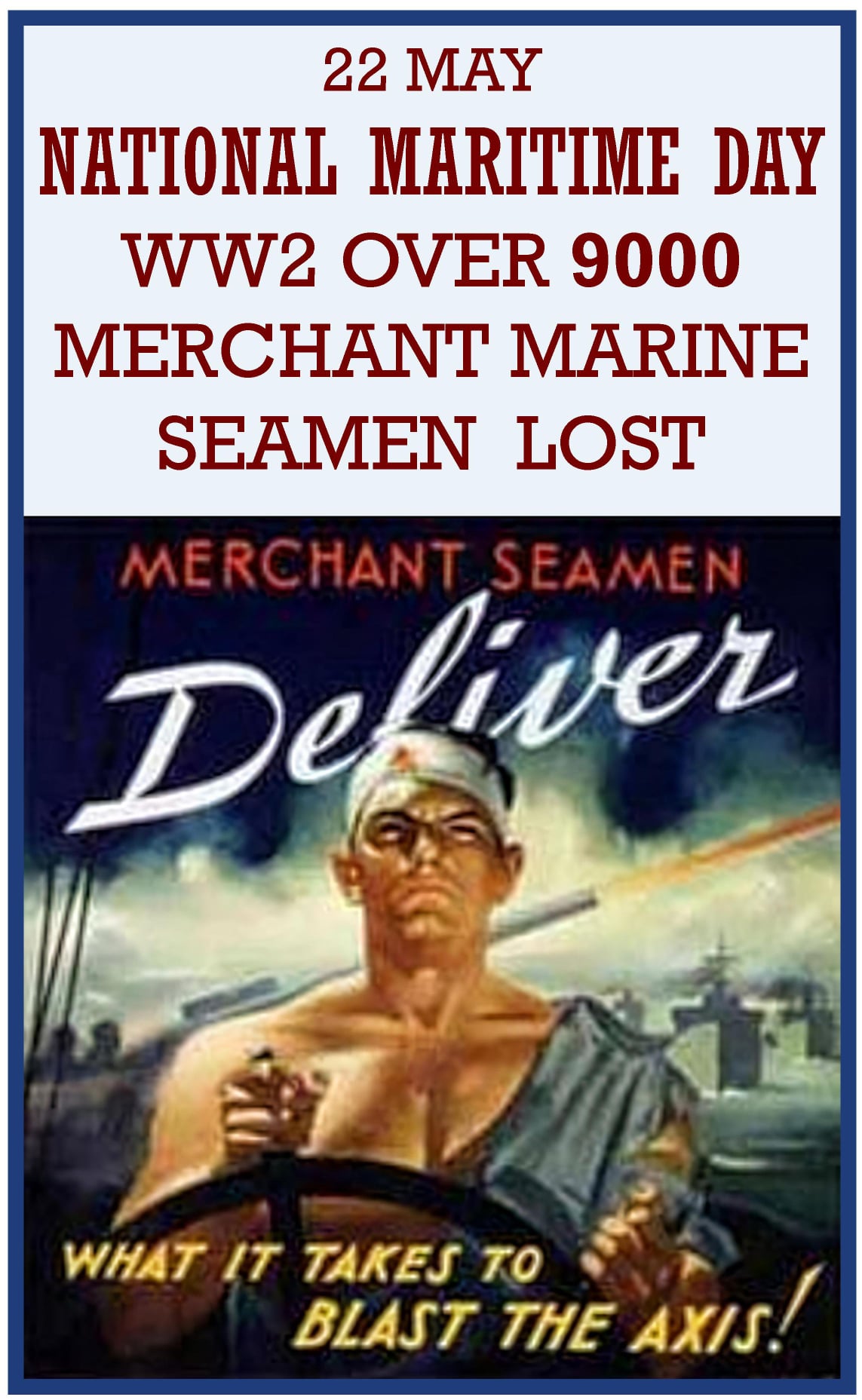
U.S. Merchant Marine in World War II
One way to understand the Second World War is to appreciate the critical role of merchant shipping… the availability or non-availability of merchant shipping determined what the Allies could or could not do militarily…. when sinkings of Allied merchant vessels exceeded production, when slow turnarounds, convoy delays, roundabout routing, and long voyages taxed transport severely, or when the cross-Channel invasion planned for 1942 had to be postponed for many months for reasons which included insufficient shipping.
Had these ships not been produced, the war would have been in all likelihood prolonged many months, if not years. Some argue the Allies would have lost as there would not have existed the means to carry the personnel, supplies, and equipment needed by the combined Allies to defeat the Axis powers. [It took 7 to 15 tons of supplies to support one soldier for one year.] The U.S. wartime merchant fleet. . . constituted one of the most significant contributions made by any nation to the eventual winning of the Second World War.
The United States Merchant Marine provided the greatest sealift in history between the production army at home and the fighting forces scattered around the globe in World War II. The prewar total of 55,000 experienced mariners was increased to over 215,000 through U.S. Maritime Service training programs.
Merchant ships faced danger from submarines, mines, armed raiders and destroyers, aircraft, “kamikaze,” and the elements. About 8,300 mariners were killed at sea, 12,000 wounded of whom at least 1,100 died from their wounds, and 663 men and women were taken prisoner. (Total killed estimated 9,300.) Some were blown to death, some incinerated, some drowned, some froze, and some starved. 66 died in prison camps or aboard Japanese ships while being transported to other camps. 31 ships vanished without a trace to a watery grave.
1 in 26 mariners serving aboard merchant ships in World WW II died in the line of duty, suffering a greater percentage of war-related deaths than all other U.S. services. Casualties were kept secret during the War to keep information about their success from the enemy and to attract and keep mariners at sea.
MILITARY HISTORY SOCIETY OF ROCHESTER
ROCHESTERMILITARY.COM