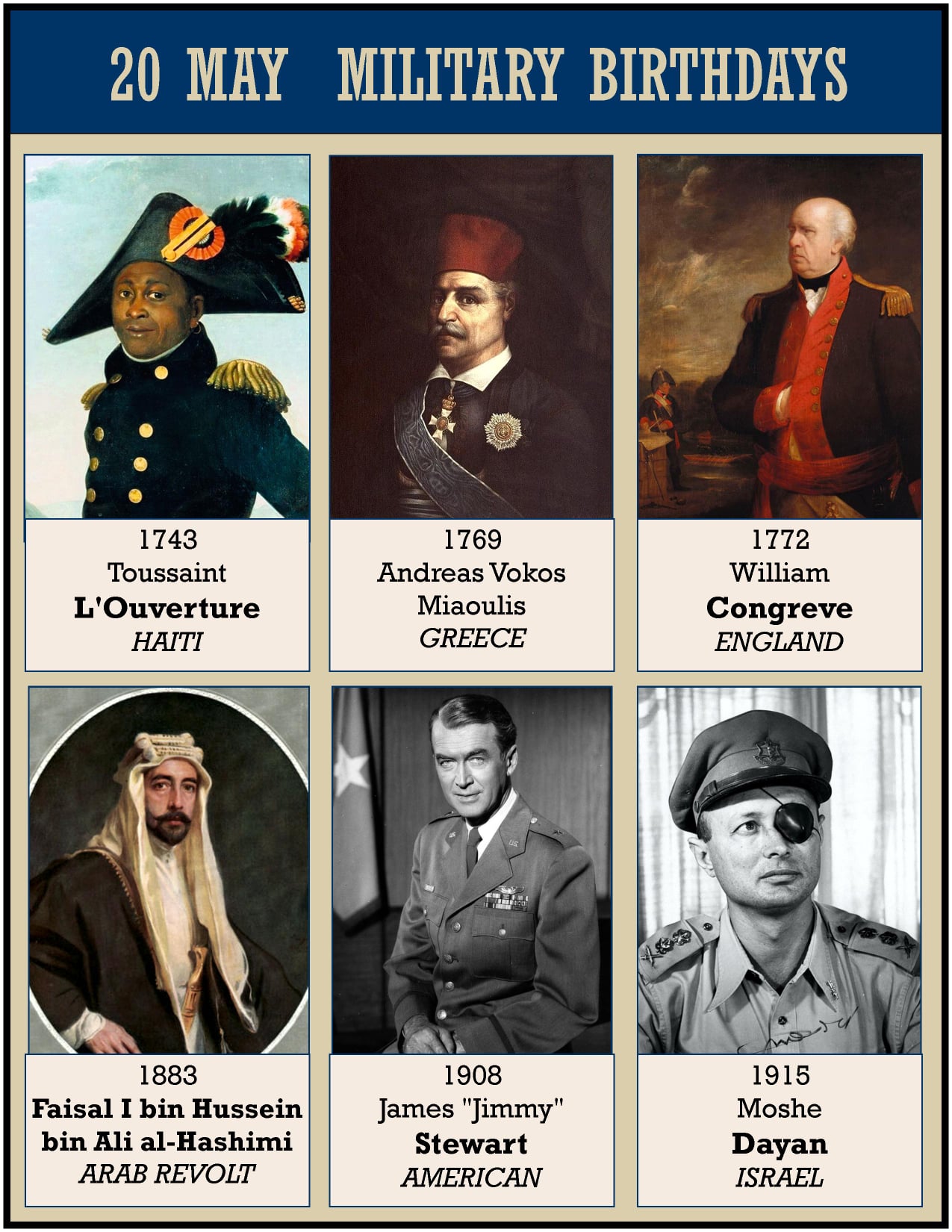
20 MAY
1743 François-Dominique Toussaint Louverture (20 May 1743 â 7 Apr 1803) was a Haitian general and the most prominent leader of the Haitian Revolution. During his life, Louverture first fought against the French, then for them, and then finally against France again for the cause of Haitian independence. As a revolutionary leader, Louverture’s military and political acumen helped transform the fledgling slave rebellion into a revolutionary movement. Louverture is now known as the “Father of Haiti.”
1765 Andreas Vokos, nicknamed Miaoulis (20 May 1765 â 24 June 1835), was a Greek admiral and politician who commanded Greek naval forces during the Greek War of Independence (1821â1829).
1772 Sir William Congreve, 2nd Baronet KCH FRS (20 May 1772 â 16 May 1828) was an English soldier, publisher, inventor, rocket artillery pioneer renowned for his development and deployment of Congreve rockets, and a Tory Member of Parliament.
1885 Faisal I bin Al-Hussein bin Ali Al-Hashemi (20 May 1885 â 8 September 1933) was King of the Arab Kingdom of Syria or Greater Syria in 1920, and was King of Iraq from 23 August 1921 to 1933. He was the third son of Hussein bin Ali, the Grand Emir and Sharif of Mecca, who was proclaimed as King of the Arabs in June 1916. He was a 38th-generation direct descendant of Muhammad, as he belongs to the Hashemite family. Faisal fostered unity between Sunni and Shiite Muslims to encourage common loyalty and promote pan-Arabism in the goal of creating an Arab state that would include Iraq, Syria and the rest of the Fertile Crescent. While in power, Faisal tried to diversify his administration by including different ethnic and religious groups in offices. However, Faisal’s attempt at pan-Arab nationalism possibly contributed to the isolation of certain groups.
1908 James Maitland “Jimmy” Stewart (May 20, 1908 â July 2, 1997) was an American actor. On March 22, 1941, Jimmy Stewart was drafted into the U.S. Armed Forces, the first major Hollywod to be inducted. He was assigned to the Army Air Corps as an enlisted man and stationed at Moffett Field, Calif. During his nine months of training at that base, he also took extension courses with the idea of obtaining a commission. He completed the courses and was awaiting the results when Pearl Harbor took place. A month later he received his commission, and because he had logged over 400 hours as a civilian, he was permitted to take basic flight training at Moffett and received his pilot wings. During the next nine months, he instructed in AT-6, AT-9 and B-17 aircraft and flew bombardiers in the training school at Albuquerque, N.M. In the fall of 1943, Stewart went to England as Commanding Officer of the 703d Bomb Squadron, equipped with B-24s. He began flying combat missions and on March 31, 1944, was appointed Operations Officer of the 453rd Bomb Group and, subsequently, Chief of Staff of the 2nd Combat wing, 2nd Air Division of the 8th Air Force. Stewart ended the war with 20 combat missions. He remained in the USAF Reserve and was promoted to brigadier general on July 23, 1959. He retired on May 31, 1968.
1915 Moshe Dayan (20 May 1915 â 16 October 1981) was an Israeli military leader and politician. As commander of the Jerusalem front in the 1948 ArabâIsraeli War, Chief of Staff of the Israel Defense Forces (1953â1958) during the 1956 Suez Crisis, but mainly as Defense Minister during the Six-Day War in 1967, he became a worldwide fighting symbol of the new state of Israel. In the 1930s, Dayan joined the Haganah, the pre-state Jewish defense force of Mandatory Palestine. He served in the Special Night Squads under Orde Wingate during the Arab revolt in Palestine and later lost an eye in a raid on Vichy forces in Lebanon during World War II. Dayan was close to David Ben-Gurion and joined him in leaving the Mapai party and setting up the Rafi party in 1965 with Shimon Peres. Dayan became Defence Minister just before the 1967 Six-Day War. After the Yom Kippur War of 1973, during which Dayan served as Defense Minister, he was blamed for the lack of preparedness; after some time he resigned. In 1977, following the election of Menachem Begin as Prime Minister, Dayan was expelled from the Labor Party because he joined the Likud-led government as Foreign Minister, playing an important part in negotiating the peace treaty between Egypt and Israel.
MILITARY HISTORY SOCIETY OF ROCHESTER
ROCHESTERMILITARY.COM