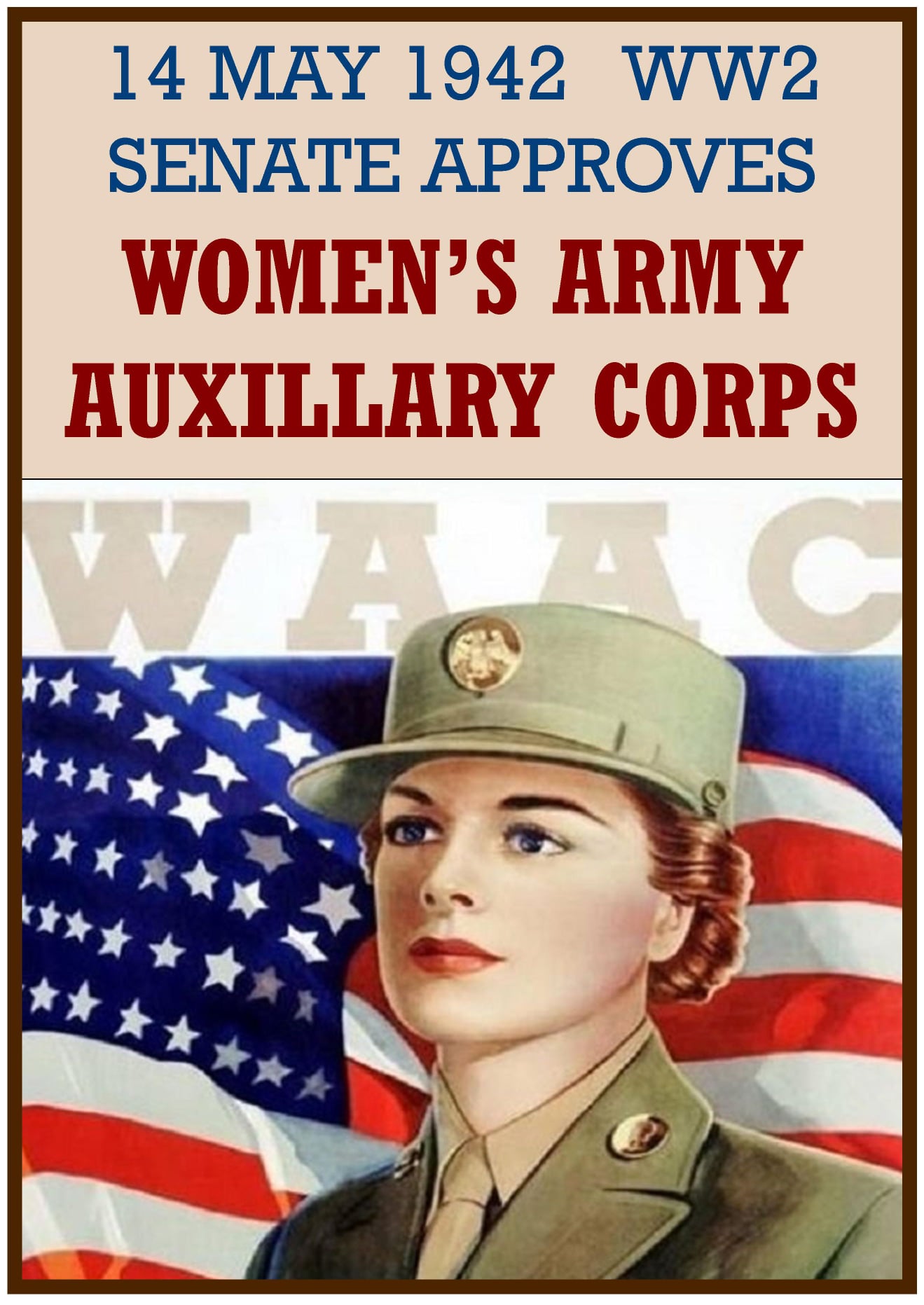
The Women’s Army Corps (WAC) was the women’s branch of the United States Army. It was created as an auxiliary unit, the Women’s Army Auxiliary Corps (WAAC) on 15 May 1942 by and converted to an active duty status in the Army of the United States as the WAC on 1 July 1943. Its first director was Oveta Culp Hobby, a prominent woman in Texas society. The WAC was disbanded in 1978, and all units were integrated with male units
The WAAC’s organization was designed by numerous Army bureaus coordinated by Lt. Col. Gillman C. Mudgett, the first WAAC Pre-Planner; however, nearly all of his plans were discarded or greatly modified before going into operation because he expected a corps of only 11,000 women. Without the support of the War Department, Representative Edith Nourse Rogers of Massachusetts introduced a bill on 28 May 1941, providing for a Women’s Army Auxiliary Corps. The bill was held up for months by the Bureau of the Budget but was resurrected after the United States entered the war. The senate approved the bill on 14 May 1942 and became law on 15 May 1942. The day after President Franklin D. Roosevelt signed the bill he set a recruitment goal of 25,000 women for the first year. That goal was unexpectedly exceeded, so the Secretary of War Henry L. Stimson decided to increase the limit by authorizing the enlistment of 150,000 volunteers.
MILITARY HISTORY SOCIETY OF ROCHESTER
ROCHESTERMILITARY.COM