29 APRIL
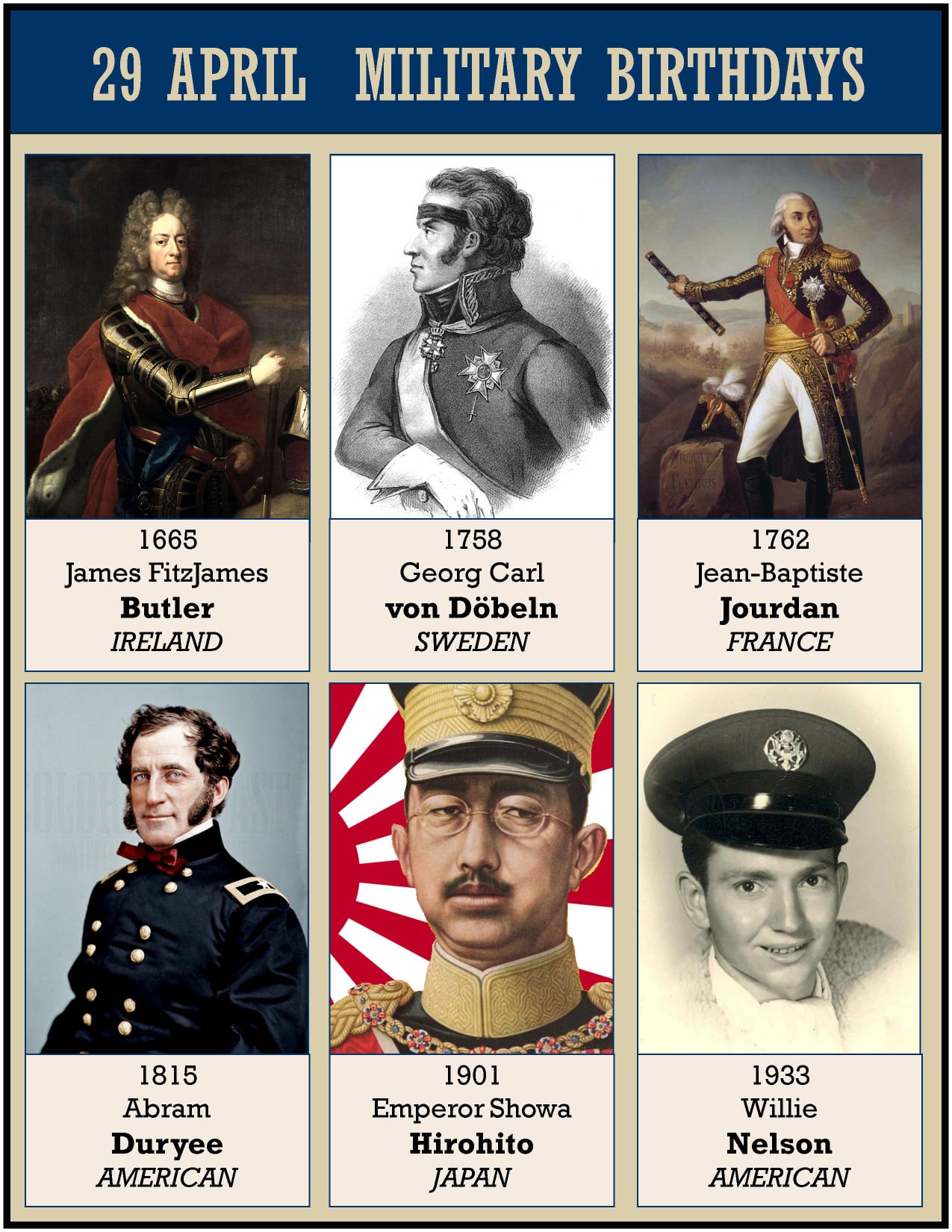
1665 James FitzJames Butler, 2nd Duke of Ormonde, KG (1665â1745) was an Irish statesman and soldier. He was the third of the Kilcash branch of the family to inherit the earldom of Ormond. Like his grandfather, the 1st Duke, he was raised as a Protestant, unlike his extended family who held to Roman Catholicism. He served in the campaign to put down the Monmouth Rebellion, in the Williamite War in Ireland, in the Nine Years’ War and in the War of the Spanish Succession but was accused of treason and went into exile after the Jacobite rising of 1715.
1758 Georg Carl von D̦beln (Apr 29, 1758 РFeb 16, 1820) was a Swedish friherre, Lieutenant general and above all known for his efforts on the Swedish side during the Finnish War.
1762 Jean-Baptiste Jourdan, 1st Count Jourdan (29 April 1762 â 23 November 1833), was a French military commander who enlisted as a private in the French Royal Army, before rising to command armies during the French Revolutionary Wars. He was made a Marshal of the Empire by Emperor Napoleon I in 1804 and he also fought in the Napoleonic Wars. After 1815, he became reconciled to the Bourbon Restoration. Jourdan was one of the most successful commanders of the French Revolutionary Army, but is notable for his decisive defeat at the Battle of Vitoria which resulted in the French Empire’s permanent loss of Spain.
1815 Abram Duryée ( April 29, 1815 â September 27, 1890) was a Union Army general during the American Civil War, the commander of one of the most famous Zouave regiments, the 5th New York Volunteer Infantry. After the war he was New York City Police Commissioner. Just after the start of Civil War, Duryée raised a new regiment, the 5th New York Volunteers, in less than a week. He became its colonel on May 14, 1861. It was one of the several Zouave units that were formed in the mid-19th century. “Duryée’s Zouaves”, as they became known, fought at Big Bethel. Duryée was appointed brigadier general, on August 31, 1861, to rank from that date. Duryée was given command of a brigade in the division under General James B. Ricketts. He later fought in the Battle of Cedar Mountain, Second Battle of Bull Run, and several others. At the Battle of Antietam, he succeeded Ricketts as division commander, when the latter replaced General Joseph Hooker as corps commander. He was not afraid to be in the thick of the action; he was wounded at Second Bull Run, South Mountain, and Antietam.
1901 Emperor ShÅwa (æå, 29 April 1901 â 7 January 1989), better known in English by his personal name Hirohito[a] (è£ä»), was the 124th emperor of Japan according to the traditional order of succession, ruling over the Empire of Japan[b] from 25 December 1926 until 2 May 1947, after which he was Emperor of the state of Japan[c] until his death. He was succeeded by his fifth child and eldest son, Akihito. Hirohito and his wife, Empress KÅjun, had seven children, two sons and five daughters. By 1979, Hirohito was the only monarch in the world with the title “emperor.” Hirohito was the longest-lived and longest-reigning historical Japanese emperor and one of the longest-reigning monarchs in the world.
1933 Willie Hugh Nelson (born April 29, 1933) After graduating high school, young Willie Nelson voluntarily joined the Air Force. In the midst of the Korean War, Willie enlisted hoping to be a jet pilot. He received his first basic training at Lackland Air Force Base in San Antonio, but it was concluded Willie was too âabsentmindedâ (as Willie puts it) to be in the cockpit of a jet, so the Air Force shipped him to Shepherd Air Force Base in Wichita Falls, TX, and eventually to Scott Air Force Base in Illinois for more basic training. Eventually they made him a medic, but years of bailing hay back in Abbott, TX had given him a bad back and he was discharged after 9 months of service.
MILITARY HISTORY SOCIETY OF ROCHESTER
ROCHESTERMILITARY.COM