19 APRIL
1757 Admiral Edward Pellew, 1st Viscount Exmouth, GCB (19 April 1757 â 23 January 1833) was a British naval officer. He fought during the American War of Independence, the French Revolutionary Wars, and the Napoleonic Wars. His younger brother Israel Pellew also pursued a naval career.
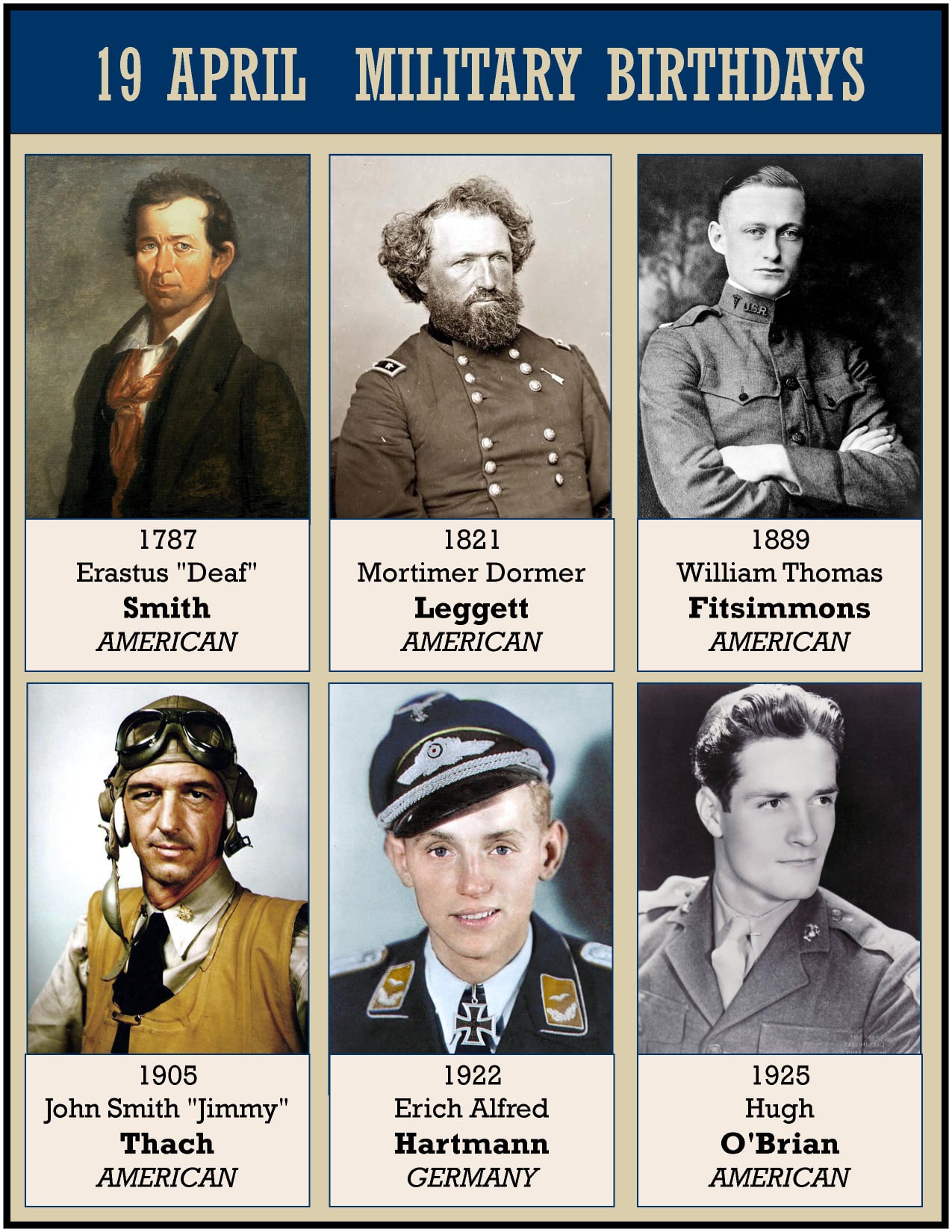
1787 Erastus “Deaf” Smith (April 19, 1787 â November 30, 1837), who earned his nickname due to hearing loss in childhood, was an American frontiersman noted for his part in the Texas Revolution and the Army of the Republic of Texas. He fought in the Grass Fight and the Battle of San Jacinto. After the war, Deaf Smith led a company of Texas Rangers.
1821 Mortimer Dormer Leggett (April 19, 1821 â January 6, 1896) was a lawyer, school administrator, professor, and major general in the Union Army during the American Civil War.
1905 John Smith Thach (April 19, 1905 â April 15, 1981) was a World War II Naval Aviator, air combat tactician, and United States Navy admiral. Thach developed the Thach Weave, a combat flight formation that could counter enemy fighters of superior performance, and later the big blue blanket, an aerial defense against kamikaze attacks.
1922 Erich Alfred Hartmann (19 April 1922 â 20 September 1993) was a German fighter pilot during World War II and the most successful fighter ace in the history of aerial warfare.[1] He flew 1,404 combat missions and participated in aerial combat on 825 separate occasions.[2] He was credited with shooting down a total of 352 Allied aircraft, those being 345 Soviet planes and seven American while serving with the Luftwaffe. During the course of his career, Hartmann was forced to crash-land his fighter 16 times due to either damage received from parts of enemy aircraft he had just shot down or mechanical failure; he was never shot down from direct enemy action.
1925 Hugh O’Brian (19 Apr 1925 â5 Sep 2016) was born Hugh Charles Krampe in Rochester, New York. He then enlisted in the Marine Corps during World War II, at the age of 17 and became the youngest Marine Corps drill instructor in American history. OâBrian served as a tank crewman, during his four-year service, he won a coveted Fleet appointment to the Naval Academy. After passing the entrance exams, he declined the appointment, to enroll at Yale University, to study law. He was honorably discharged at the rank of Corporal.
MILITARY HISTORY SOCIETY OF ROCHESTER
ROCHESTERMILITARY.COM