3 APRIL
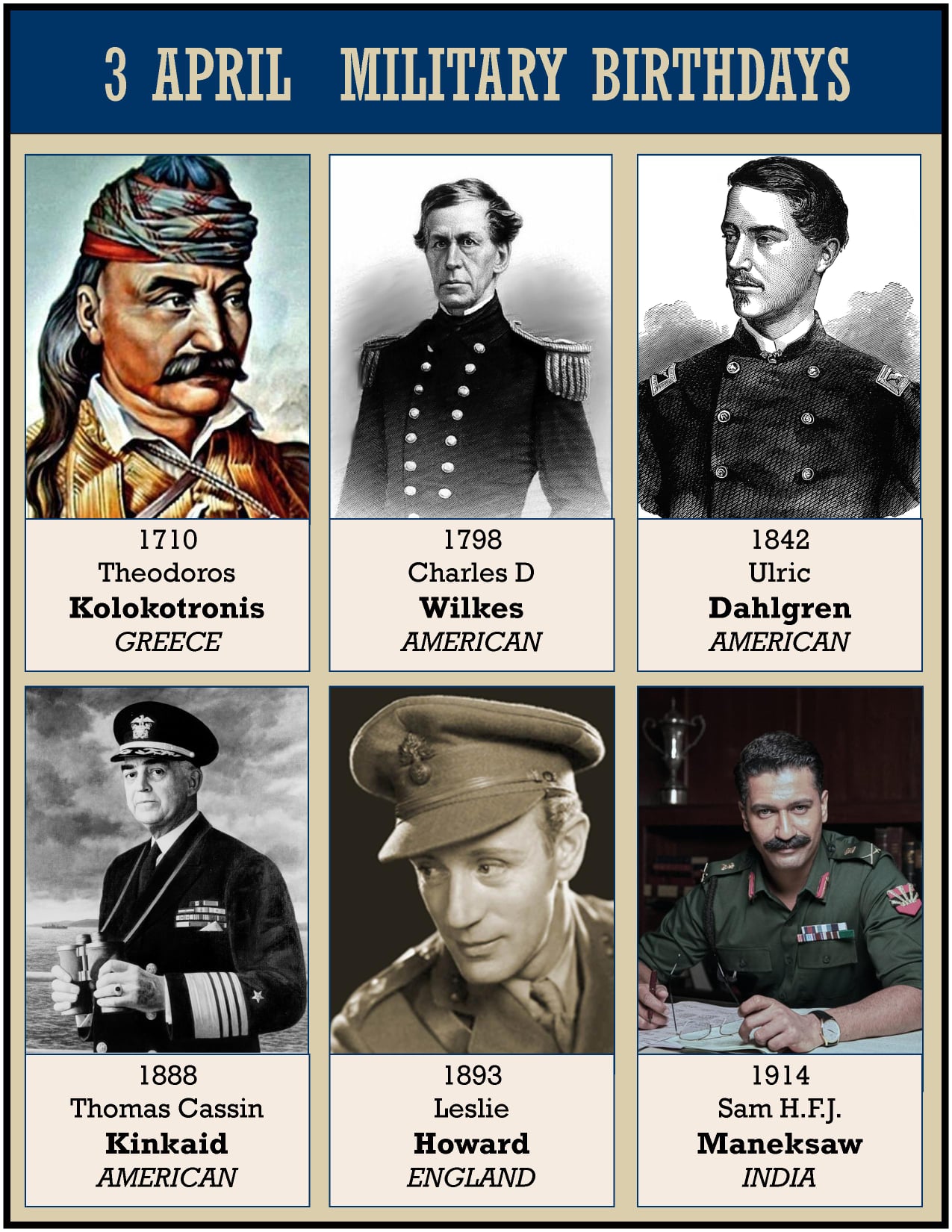
1770 Theodoros Kolokotronis also known as Geros tou Moria (Greek: ÎεÏδÏÏÎ¿Ï ÎολοκοÏÏÏνηÏ; 3 April 1770 â 16 February 1843) was a Greek general and the pre-eminent leader of the Greek War of Independence (1821â1829) against the Ottoman Empire.[1][2][3] Kolokotronis’s greatest success was the defeat of the Ottoman army under Mahmud Dramali Pasha at the Battle of Dervenakia in 1822.[4] In 1825, he was appointed commander-in-chief of the Greek forces in Peloponnese. Today, Kolokotronis ranks among the most prominent figures in Greece’s War of Independence.
1798 Charles Wilkes was an American naval officer, ship’s captain, and explorer. He led the United States Exploring Expedition, 1838â1842. His behavior led to two convictions by court-martial, one stemming from the massacre of almost 80 Fijians on Malolo in 1840. During the American Civil War he commanded USS San Jacinto during the Trent Affair, where he stopped a Royal Mail Ship and removed two Confederate diplomats, which almost led to war between the US and the UK.
1842 Ulric Dahlgren (April 3, 1842 â March 2, 1864) was a colonel in the Union Army during the American Civil War. He was the son of Union Navy Rear Admiral John A. Dahlgren and nephew to Confederate Brigadier General Charles G. Dahlgren. He fought in several key battles in the Eastern Theater of the American Civil War and had his leg amputated below the knee after being wounded at the Battle of Gettysburg. He returned to military service and was killed in 1864 during the Battle of Walkerton while leading a raid on the Confederate capital of Richmond, Virginia. Confederate forces found documents on Dahlgren with orders to free Union prisoners from Belle Isle, burn the city of Richmond and assassinate Confederate President Jefferson Davis and his cabinet. The documents were published in the Richmond newspapers and caused outrage in the South with accusations that the orders came from President Lincoln. Union newspapers claimed the papers were forged and reports of mistreatment of Dahlgren’s corpse inflamed public opinion in the North. The controversy became known as the Dahlgren Affair.
1888 Thomas Cassin Kinkaid (3 April 1888 â 17 November 1972) was an admiral in the United States Navy, known for his service during World War II. He built a reputation as a “fighting admiral” in the aircraft carrier battles of 1942 and commanded the Allied forces in the Aleutian Islands Campaign. He was Commander Allied Naval Forces and the Seventh Fleet under General of the Army Douglas MacArthur in the Southwest Pacific Area, where he conducted numerous amphibious operations, and commanded an Allied fleet during the Battle of Leyte Gulf, the largest naval battle of World War II and the last naval battle between battleships in history.
1893 Leslie Howard was a superstar actor of his day. The son of Jewish immigrants from Hungary he was born in London in 1893 and served during the First World War, he was mustered out of the army a few weeks before the Battle of the Somme began in 1916 as he was suffering from shell shock. It was actually his doctor who suggested acting as a therapy little knowing that Howard would go on to international fame, particularly for his roles in Pygmalion and Gone With The Wind.
1914 Field Marshal Sam Hormusji Framji Jamshedji Manekshaw, (3 April 1914 â 27 June 2008), widely known as Sam Manekshaw and Sam Bahadur (“Sam the Brave”), was the Chief of the Army Staff of the Indian Army during the Indo-Pakistani War of 1971, and the first Indian Army officer to be promoted to the rank of field marshal. His military career spanned four decades and five wars, beginning with service in the British Indian Army in World War II.
MILITARY HISTORY SOCIETY OF ROCHESTER
ROCHESTERMILITARY.COM