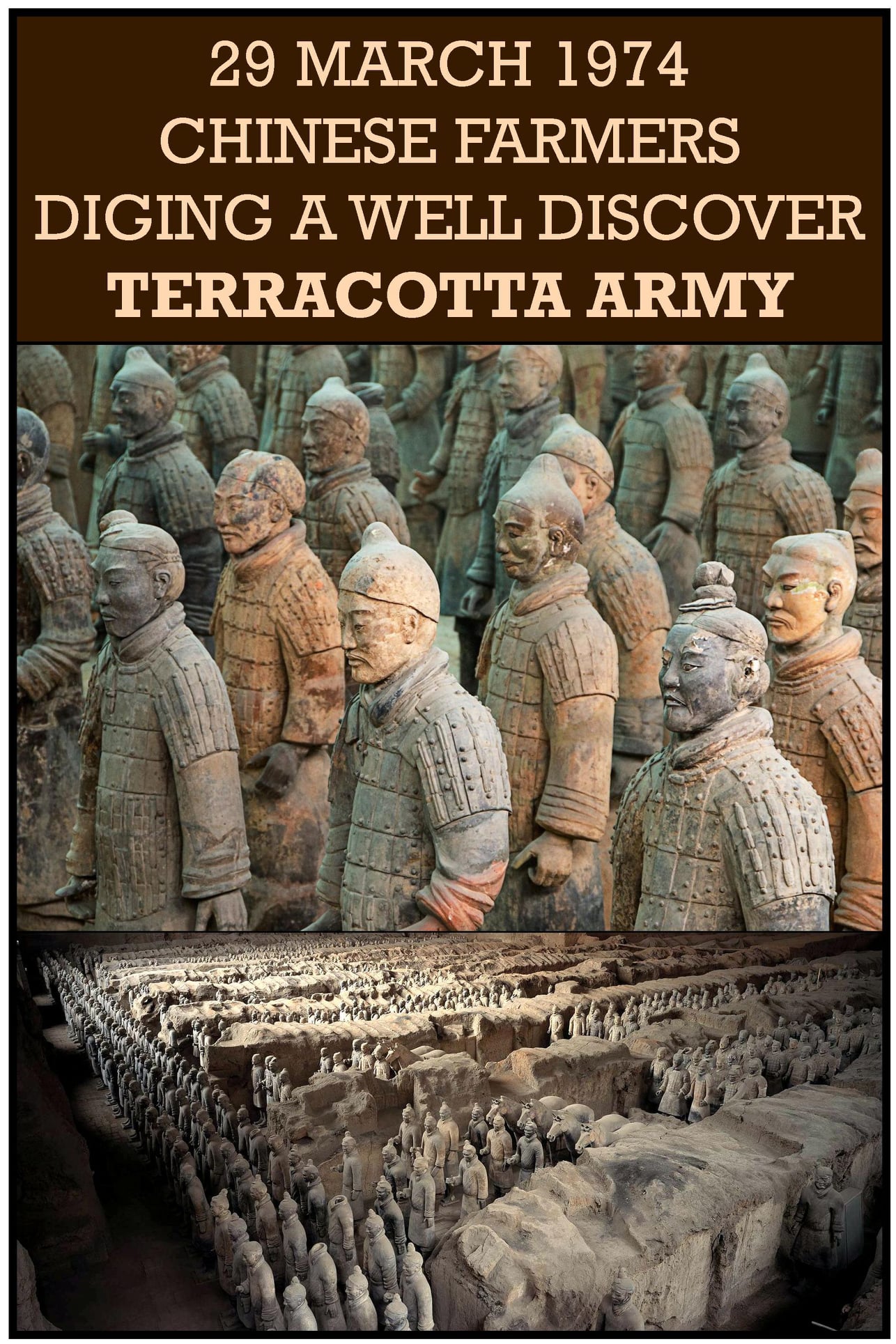
On 29 March 1974, a group of peasants digging a well in drought-parched Shaanxi province in northwest China unearthed fragments of a clay figureâthe first evidence of what would turn out to be one of the greatest archaeological discoveries of modern times. The Terracotta Army is a collection of terracotta sculptures depicting the armies of Qin Shi Huangdi, the first Emperor of China. It is a form of funerary art buried with the emperor in 210â209 BCE with the purpose of protecting the emperor in his afterlife. Near the unexcavated tomb of Qin Shi Huangdiâwho had proclaimed himself first emperor of China in 221 B.C.âlay an extraordinary underground treasure: an entire army of life-size terra cotta soldiers and horses, interred for more than 2,000 years. The figures vary in height according to their roles, with the tallest being the generals. The figures include warriors, chariots and horses. Estimates from 2007 were that the three pits containing the Terracotta Army held more than 8,000 soldiers, 130 chariots with 520 horses, and 150 cavalry horses, the majority of which remained buried in the pits near Qin Shi Huang’s mausoleum. Other terracotta non-military figures were found in other pits, including officials, acrobats, strongmen, and musicians.
MILITARY HISTORY SOCIETY OF ROCHESTER
ROCHESTRMILITARY.COM