MARCH 26
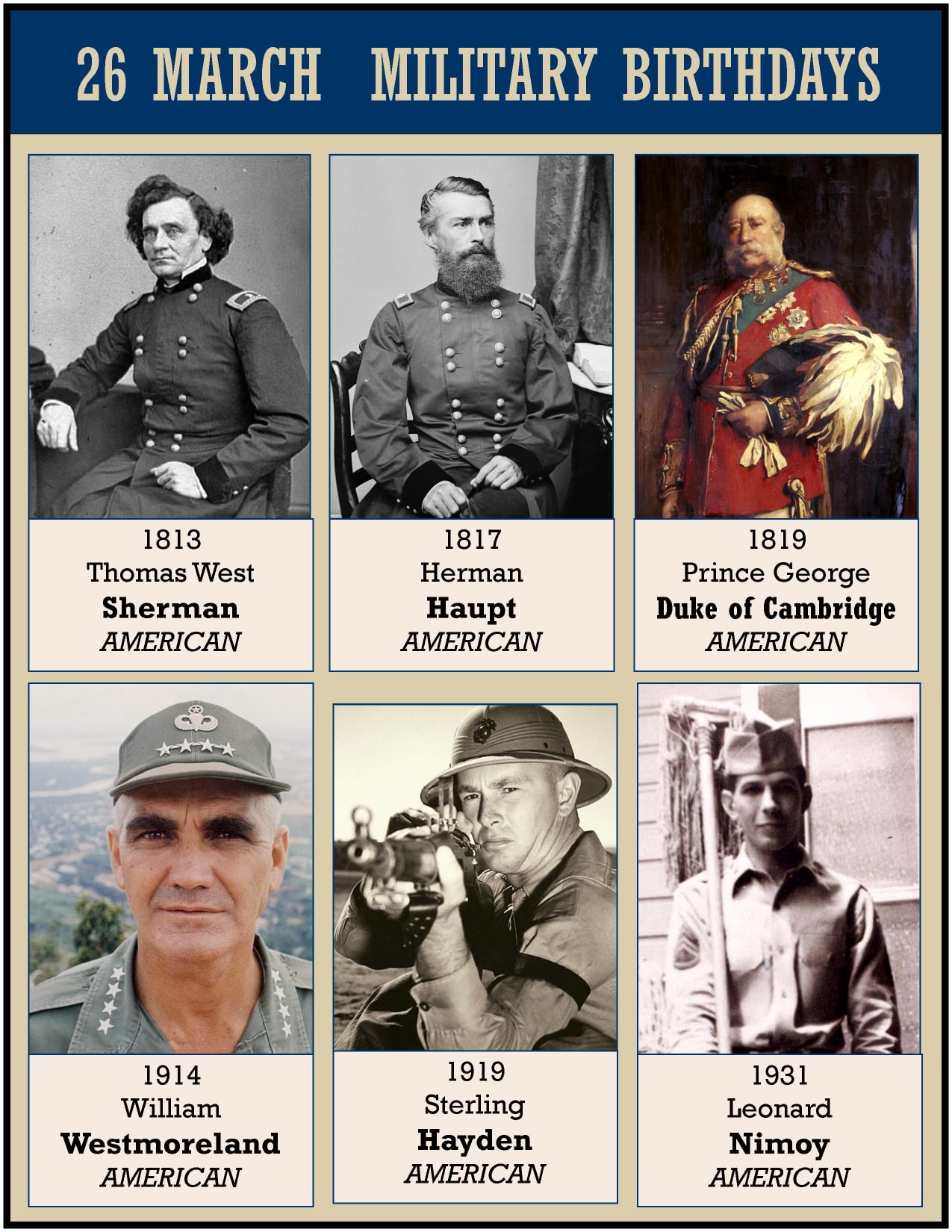
1813 Thomas West Sherman (March 26, 1813 â December 31, 1879) was a United States Army officer with service during the MexicanâAmerican War and the American Civil War. While some contemporaries mistakenly identified him as the brother of the more famous General William T. Sherman, modern scholarship notes that the two were not closely related.
1817 Herman Haupt (Philadelphia, March 26, 1817 â Jersey City, December 14, 1905) was an American civil engineer and railroad construction engineer and executive. As a Union Army General during the American Civil War, he revolutionized U.S. military transportation, particularly the use of railroads.
1819 Prince George, Duke of Cambridge (George William Frederick Charles; 26 March 1819 â 17 March 1904) was a member of the British royal family, a male-line grandson of King George III and cousin of Queen Victoria. The Duke was an army officer by profession and served as Commander-in-Chief of the Forces (military head of the British Army) from 1856 to 1895. He became Duke of Cambridge in 1850 and field marshal in 1862. Deeply devoted to the old Army, he worked with Queen Victoria to defeat or minimize every reform proposal, such as setting up a general staff. His Army became a moribund and stagnant institution. Its weaknesses were dramatically revealed by the poor organization at the start of the Second Boer War.
1914 William Westmoreland, U.S. army general during the Vietnam War. General Westmoreland took command in Vietnam in June 1964 replacing Gen. Paul Harkins. He was instrumental in raising the level of US forces deployed in Vietnam and in developing the strategies implemented in the region. Westmoreland continuously requested for an increase in manpower in Vietnam and President Johnson, who had his own troubles at home, refused to send more troops and finally recalled Westmoreland after he successfully stopped the North Vietnamese Tet Offensive in 1968. He was replaced by General Creighton W. Abrams. Upon his return to the US, Westmoreland was appointed as Chief of Staff of the US Army. His biggest challenge was to withdraw the troops from Vietnam and ready them for duty in other regions of the world. He was successful in restructuring the Army at a difficult time, but his tactics in Vietnam had become unpopular with some groups in the US. He maintained for many years that the policy in Vietnam had been the right one. General Westmoreland retired in 1972.
1916 Sterling Walter Hayden (born Sterling Relyea Walter; March 26, 1916 â May 23, 1986) was an American actor, author, sailor and decorated Marine Corps officer and OSS agent (from services during World War II). After two film roles, he left Hollywood to fight in World War II. He enlisted in the Army and was sent to Scotland for training, but broke his ankle and was discharged. He returned to the US and tried to buy a half-interest in a schooner but could not raise the money. He joined the United States Marine Corps as a private, under the name John Hamilton, an alias he never used otherwise. While at Parris Island, he was recommended for Officer Candidate School.
After graduation from OCS, he was commissioned a second lieutenant and was transferred to service as an undercover agent with William J. “Wild Bill” Donovan’s Office of the Coordinator of Information. He remained there after it became the Office of Strategic Services (OSS).
As OSS agent John Hamilton, his World War II service included sailing with supplies from Italy to Yugoslav partisans and parachuting into fascist Croatia. Hayden, who also participated in the NaplesâFoggia campaign and established air crew rescue teams in enemy-occupied territory, became a first lieutenant on September 13, 1944, and a captain on February 14, 1945. He received the Silver Star for gallantry in action in the Balkans and Mediterranean (according to his citation, “Lt. Hamilton displayed great courage in making hazardous sea voyages in enemy-infested waters and reconnaissance through enemy-held areas”), a Bronze Arrowhead device for parachuting behind enemy lines, and a commendation from Yugoslavia’s Josip Broz Tito. He left active duty on December 24, 1945. Tito awarded him the Order of Merit.
1931 Leonard Nimoy By the early 1950s, Nimoy was appearing in bit parts in feature films, and his first title role came with 1952’s boxing-themed Kid Monk Baroni. He served a two-year stretch in the U.S. Army Reserve beginning in 1953 until 1955, as a staff sergeant with the Army Public Affairs Center, US Army Public Affairs Office as a recreation specialist. He Later he served as science and first officer aboard the starship Enterprise.
MILITARY HISTORY SOCIETY OT ROCHESTER
ROCHESTERMILITARY.COM