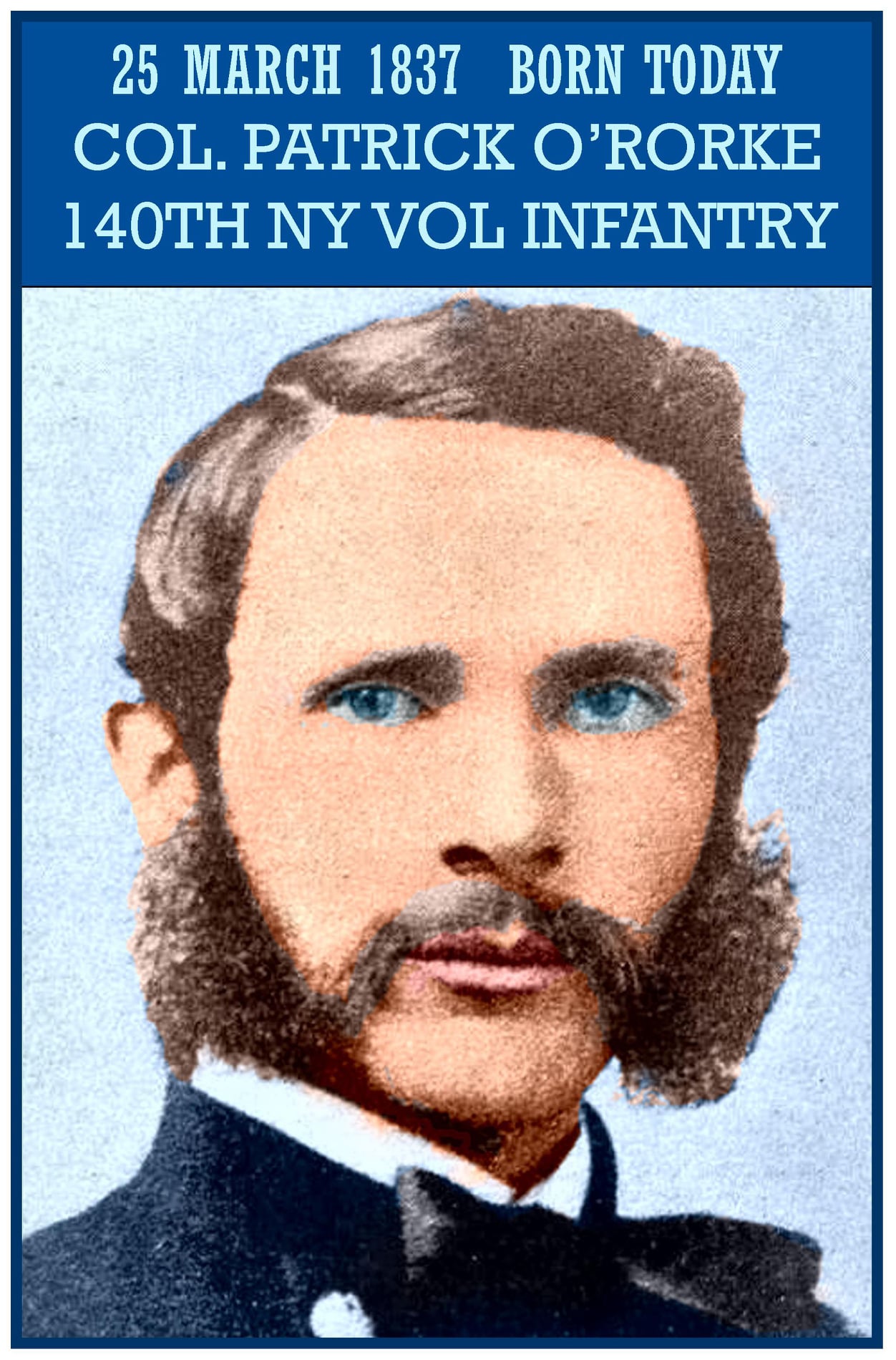
Patrick Henry “Paddy” O’Rorke (March 25, 1837 â July 2, 1863) was born in County Cavan, Ireland on March 25, 1837. He was a year old when his parents emigrated to the United States. In 1842, his family moved to Rochester, New York, where he attended the public schools.[4] In 1853, at age 16, he was awarded a scholarship to the University of Rochester; however, before attending college, his father died, and O’Rorke, to support his family, took a job as a marble cutter at the request of his mother. In 1857, he was appointed a cadet in the U.S. Military Academy at West Point, graduating first in his class in June 1861.The same class as George Armstrong Custer, who would graduate last. He was then commissioned to the Corps of Engineers as second lieutenant.
In September 1862, O’Rorke was appointed colonel of the 140th New York Infantry which was composed mostly of volunteers from his hometown of Rochester and heavily of fellow Irish-Americans. He led the 140th New York in the Battle of Fredericksburg in December. At Chancellorsville in May 1863, he temporarily commanded the 3rd Brigade, 2nd Division, V Corps which included the 140th New York, as well as the 5th New York and the 146th New York.
At Gettysburg, O’Rorke was back in command of his regiment while Brig. Gen. Stephen H. Weed commanded the 3rd Brigade. The 140th New York arrived in time for the second day of fighting (July 2, 1863). Brig. Gen. Gouverneur K. Warren was desperately searching for units to defend Little Round Top, and he encountered O’Rorke’s New Yorkers, the rearmost regiment in Weed’s brigade, on their way to reinforce the III Corps. O’Rorke initially declined Warren’s request for assistance because he was under orders to follow his brigade. Warren told him, “Never mind that, Paddy. Bring them up on the double-quick and don’t stop for aligning. I’ll take the responsibility.” O’Rorke rushed his men to the crest of the hill and plunged down its western face without pause, driving the attacking Confederates back down the slope. During the counterattack, O’Rorke caught up his regimental colors and, mounting a rock to urge on his men, was struck in the neck and fell dead.
O’Rorke was initially buried by members of the 140 New York near Gettysburg alongside General Weed. However, on about what would have been their first anniversary, O’Rorke’s widow Clara traveled to retrieve the body and it was returned by train to Rochester.
A funeral for Colonel O’Rorke was held on July 15 in Rochester drawing hundreds of attendees, both Catholic and Protestant and across a range of ethnic groups. The event is credited with bringing unity to the community. He was initially laid to rest in a Catholic cemetery on Pinnacle Hill,] but was ultimately interred in the Holy Sepulchre Cemetery in Rochester.
Col. George E. Ryan, a close friend of OâRorke, who took command of the 140th and was killed almost a year later (8 May 1865) at Spottsylvania is buried next to him at Holy Sepulchre.
MILITARY HISTORY SOCIETY OF ROCHESTER
ROCHESTERMILITARY.COM