March 25
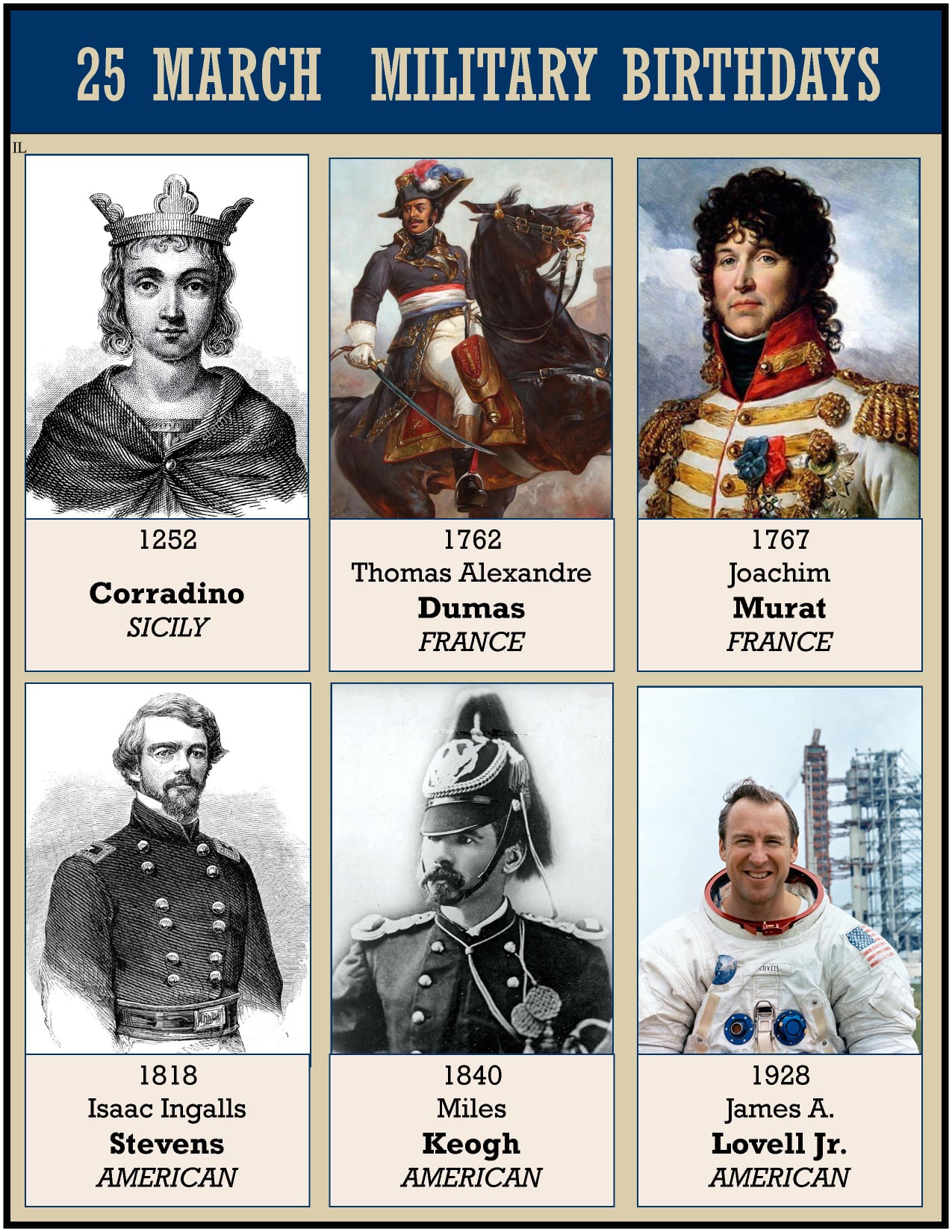
1252 Conrad or Corradino, King of Sicily (25 March 1252 â 29 October 1268), called the Younger or the Boy, but usually known by the diminutive Conradin (German: Konradin, Italian: Corradino), was the last direct heir of the House of Hohenstaufen. He was Duke of Swabia (1254â1268) and nominal King of Jerusalem (1254â1268) and Sicily (1254â1258). After his attempt to reconquer Sicily failed, he was caught and beheaded.
1762 Thomas-Alexandre Dumas Davy de la Pailleterie (French: [tÉmÉalÉksÉÌdÊdymÉdavidÉ la pajÉt(É)Êi]; also known as Alexandre Dumas; 25 March 1762 â 26 February 1806) was a French general in Revolutionary France. With Toussaint Louverture and Abram PetrovichGannibal in Imperial Russia, Thomas-Alexandre Dumas stands as one of the highest-ranking men of African descent (his father being white, and his mother black) ever to lead a European army.[1] He was the first person of color in the French military to become brigadier general, the first to become divisional general, and the first to become general-in-chief of a French army.[2] Dumas and Toussaint Louverture (appointed a general-in-chief in 1797[3]) were the two highest-ranking officers of sub-Saharan African descent in the Western world
1767 Joachim-Napoléon Murat born Joachim Murat; was a Marshal of the Empire and Admiral during the reign of Napoleon. He was also the 1st Prince Murat, Grand Duke of Berg from 1806 to 1808, and King of Naples from 1808 to 1815. Murat received his titles in part by being Napoleon’s brother-in-law through marriage to his younger sister, Caroline Bonaparte, as well as personal merit. He was noted as a daring, brave, and charismatic cavalry officer as well as a flamboyant dresser, for which he was known as “the Dandy King”.
1818 Isaac Ingalls Stevens (March 25, 1818 â September 1, 1862) was an American career Army officer and politician, who served as governor of the Territory of Washington from 1853 to 1857, and later as its delegate to the United States House of Representatives. During the American Civil War, he held several Union commands. He was killed at the Battle of Chantilly, while at the head of his men and carrying the fallen colors of one of his regiments against Confederate positions. According to one account, at the hour of his death Stevens was being considered by President Abraham Lincoln for appointment to command the Army of Virginia. He was posthumously advanced to the rank of Major General. Several schools, towns, counties, and lakes are named in his honor.
1840 Myles Walter Keogh (25 March 1840 â 25 June 1876) was an Irish soldier. Serving the armies of the Papal States during the war for Italian unification in 1860, he was recruited into the Union Army during the American Civil War, serving as a cavalry officer, particularly under Brig. Gen. John Buford during the Gettysburg Campaign and the three-day Battle of Gettysburg. After the war, Keogh remained in the regular United States Army as commander of I Troop of the 7th US Cavalry Regiment under George Armstrong Custer during the Indian Wars, until he was killed along with Custer and all of his men at the Battle of the Little Bighorn in 1876.
1928 James Arthur Lovell Jr. (born March 25, 1928) is a retired American astronaut, naval aviator, and mechanical engineer. In 1968, as command module pilot of Apollo 8, he became one of the first three humans to fly to and orbit the Moon. He then commanded the 1970 Apollo 13 lunar mission which, after a critical failure en route, circled around the Moon and returned safely to Earth through the efforts of the crew and mission control.
MILITARY HISTORY SOCIETY OF ROCHESTER
ROCHESTERMILITARY.COM