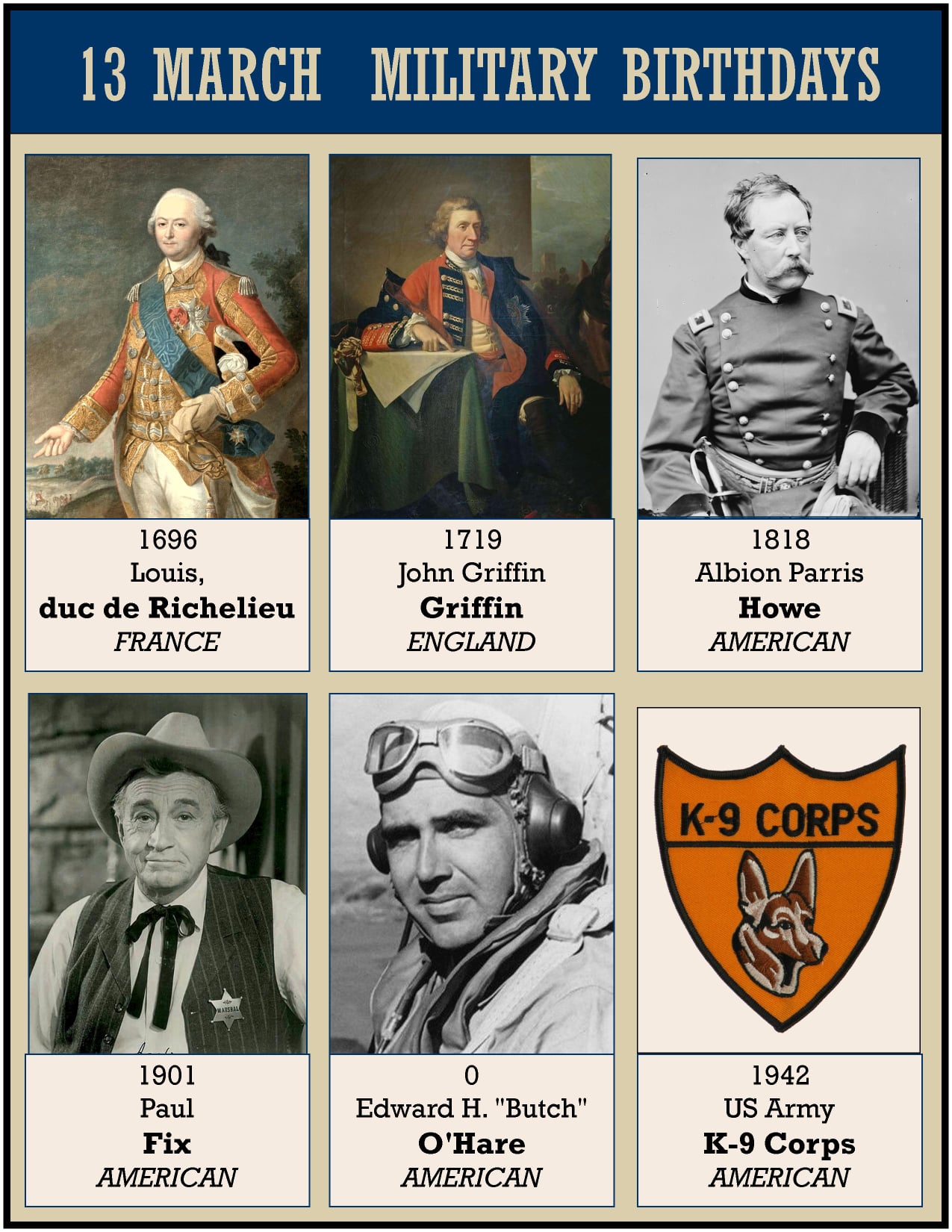
1696 Louis François Armand de Vignerot du Plessis, duc de Richelieu (13 March 1696 â 8 August 1788), was a French soldier, diplomat and statesman. He joined the army and participated in three major wars. He eventually rose to the rank of Marshal of France. In 1733â1734, he served in a Rhine campaign during the War of the Polish Succession. The following decade during the War of the Austrian Succession he fought with distinction at Dettingen and Fontenoy, where he directed the grapeshot upon the British columns, and three years afterwards he made a brilliant defence of Genoa.
1719 Field Marshal John Griffin Griffin, 4th Baron Howard de Walden, 1st Baron Braybrooke (13 March 1719 â 25 May 1797),[2] (born Whitwell), KB, of Audley End in Essex, was a British nobleman and soldier. He served as a junior officer with the Pragmatic Army in the Netherlands and Germany during the War of the Austrian Succession. After changing his surname to Griffin in 1749, he commanded a brigade of at least four battalions at the Battle of Corbach in July 1760 during the Seven Years’ War. He also commanded a brigade at the Battle of Warburg and was wounded at the Battle of Kloster Kampen.
1818 Albion Parris Howe (March 13, 1818 â January 25, 1897) was a Union Army general in the American Civil War. Howe’s contentious relationships with superior officers in the Army of the Potomac eventually led to his being deprived of division command.
1914 Lieutenant Commander Edward Henry O’Hare (March 13, 1914 â November 26, 1943) was an American naval aviator of the United States Navy, who on February 20, 1942, became the Navy’s first flying ace when he single-handedly attacked a formation of nine heavy bombers approaching his aircraft carrier. Even though he had a limited amount of ammunition, he was credited with shooting down five of the enemy bombers and became the first naval recipient of the Medal of Honor in World War II.
1901 Paul Fix was born in Dobbs Ferry, New York, to Wilhelm Fix, a brewmaster, and the former Louise C. Walz,[citation needed] though some sources say he was born Paul Fix Morrison[1] His mother and father were German immigrants who had left their Black Forest home and arrived in New York City in the 1870s. Around 1917, Fix enlisted in the National Guard, and served at Peekskill, New York. after three months, he went AWOL and enlisted in the Army. After serving at Fort Slocum for three months, he again went AWOL and enlisted in the Navy and was sent to Providence, Rhode Island. While serving in the Navy he was recruited to perform in a Navy Relief Organization production of H.M.S. Pinafore. He went on to serve as a hospital corpsman aboard troop transports ferrying troops to Europe. He was discharged on September 5, 1919.
1942 On March 13, 1942, the Quartermaster Corps (QMC) of the United States Army begins training dogs for the newly established War Dog Program, or âK-9 Corps.â In the United States, the practice of training dogs for military purposes was largely abandoned after World War I. When the country entered World War II in December 1941, the American Kennel Association and a group called Dogs for Defense began a movement to mobilize dog owners to donate healthy and capable animals to the Quartermaster Corps of the U.S. Army. Training began in March 1942, and that fall the QMC was given the task of training dogs for the U.S. Navy, Marines and Coast Guard as well.
MILITARY HISTORY SOCIETY OF ROCHESTER
ROCHESTERMILITARY.COM