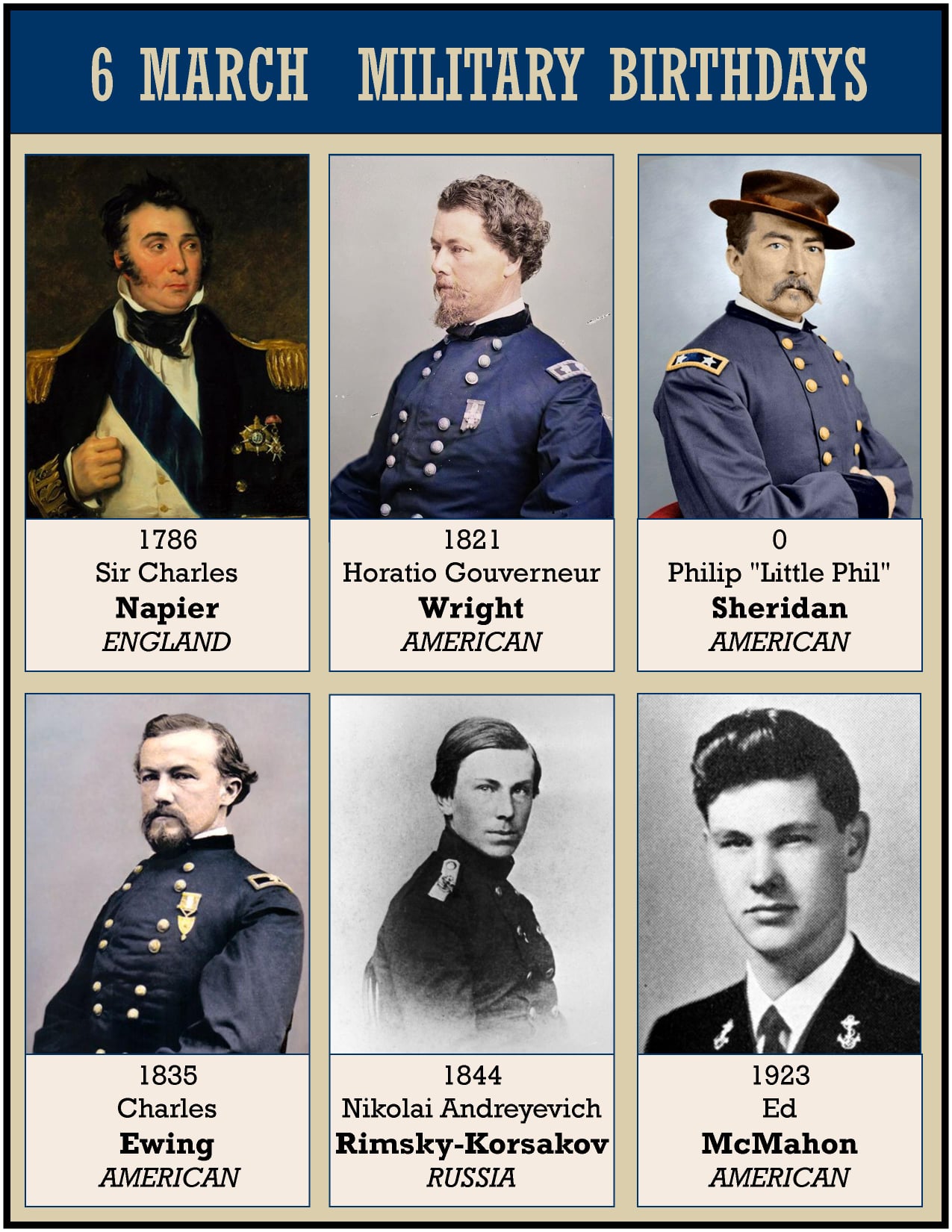
1786 Admiral Sir Charles John Napier KCB GOTE RN (6 March 1786 â 6 November 1860) was a British naval officer whose sixty years in the Royal Navy included service in the War of 1812, the Napoleonic Wars, Syrian War and the Crimean War (with the Russians), and a period commanding the Portuguese navy in the Liberal Wars. An innovator concerned with the development of iron ships, and an advocate of humane reform in the Royal Navy, he was also active in politics as a Liberal Member of Parliament and was probably the naval officer most widely known to the public in the early Victorian Era.
1820 Horatio Gouverneur Wright (March 6, 1820 â July 2, 1899) was an engineer and general in the Union Army during the American Civil War. He took command of the VI Corps in May 1864 following the death of General John Sedgwick. In this capacity, he was responsible for building the fortifications around Washington DC, and in the Overland Campaign he commanded the first troops to break through the Confederate defenses at Petersburg. After the war, he was involved in a number of engineering projects, including the Brooklyn Bridge and the completion of the Washington Monument, and served as Chief of Engineers for the U.S. Army Corps of Engineers.
1831 Philip Henry Sheridan (March 6, 1831 â August 5, 1888) was a career United States Army officer and a Union general in the American Civil War. His career was noted for his rapid rise to major general and his close association with General-in-chief Ulysses S. Grant, who transferred Sheridan from command of an infantry division in the Western Theater to lead the Cavalry Corps of the Army of the Potomac in the East. In 1864, he defeated Confederate forces under General Jubal Early in the Shenandoah Valley and his destruction of the economic infrastructure of the Valley, called “The Burning” by residents, was one of the first uses of scorched-earth tactics in the war. In 1865, his cavalry pursued Gen. Robert E. Lee and was instrumental in forcing his surrender at Appomattox.
1835 Charles Ewing (March 6, 1835 â June 20, 1883) was an attorney and Union Army general during the American Civil War. He was the son of Interior Secretary Thomas Ewing, the brother of Thomas Ewing Jr. and Hugh Boyle Ewing, and the foster brother and brother-in-law of William T. Sherman. Ewing’s sister and Sherman’s wife was Ellen Ewing Sherman.
1844 Rimsky-Korsakov was born in 1844. Several people from his family had careers in the Russian army and navy. Both his grandmothers, however, were simple people who had lived in the country. When he was young he showed a great interest in music. He sang every tune he heard and knew, without looking, the names of the notes that he heard being played on the piano. When he was six he started piano lessons. The opera Life for the Tsar by Glinka made a big impression on him. However, he wanted to join the navy, so in 1862 he entered the College of Naval Cadets, where his brother (who was 22 years older) was the director. He continued to learn the piano while he was at Cadet school. He was never a brilliant pianist, but he enjoyed playing tunes from operas on the piano. He got to know several young composers who were already becoming famous: Balakirev, Cui and Mussorgsky. Balakirev gave him advice about his compositions. He started to write a symphony, but then he had to go to sea for two-and-a-half years. He sailed on a clipper called Almaz. The boat went to Gravesend, the Baltic Sea, New York, Rio de Janeiro and the Mediterranean When he got back, Balakirev made him finish the symphony.
1923 Ed McMahon When the United States began gearing up for World War II, McMahon wanted to become a Marine fighter pilot. Since the Navy’s V-5 program required two years of college, he enrolled in Boston College. When the Navy relaxed the two-year requirement, McMahon dropped out of school and signed up. In early 1943, he first went to a civilian-run Wartime Training School in Texarkana where the Navy evaluated cadets’ potential by checking them out in a Piper Cub. Then came the three-month Preflight School at Athens, Georgia. McMahon received primary training at Dallas and intermediate training at Pensacola. McMahon received the single engine carrier syllabus and was assigned to the Marines. After receiving his commission and wings in early 1945, McMahon was sent to the Corsair Operational Training Unit at Lee Field, Green Cove Springs, Florida. Upon completion of training, he was “plowed back” and became an instructor in the same unit. On the day the atomic bomb was dropped on Hiroshima, McMahon received orders to join the Marine carrier program on the West Coast. His orders were cancelled and he returned to civilian life.
MILITARY HISTORY SOCIETY OF ROCHESTER
ROCHESTERMILITARY.COM