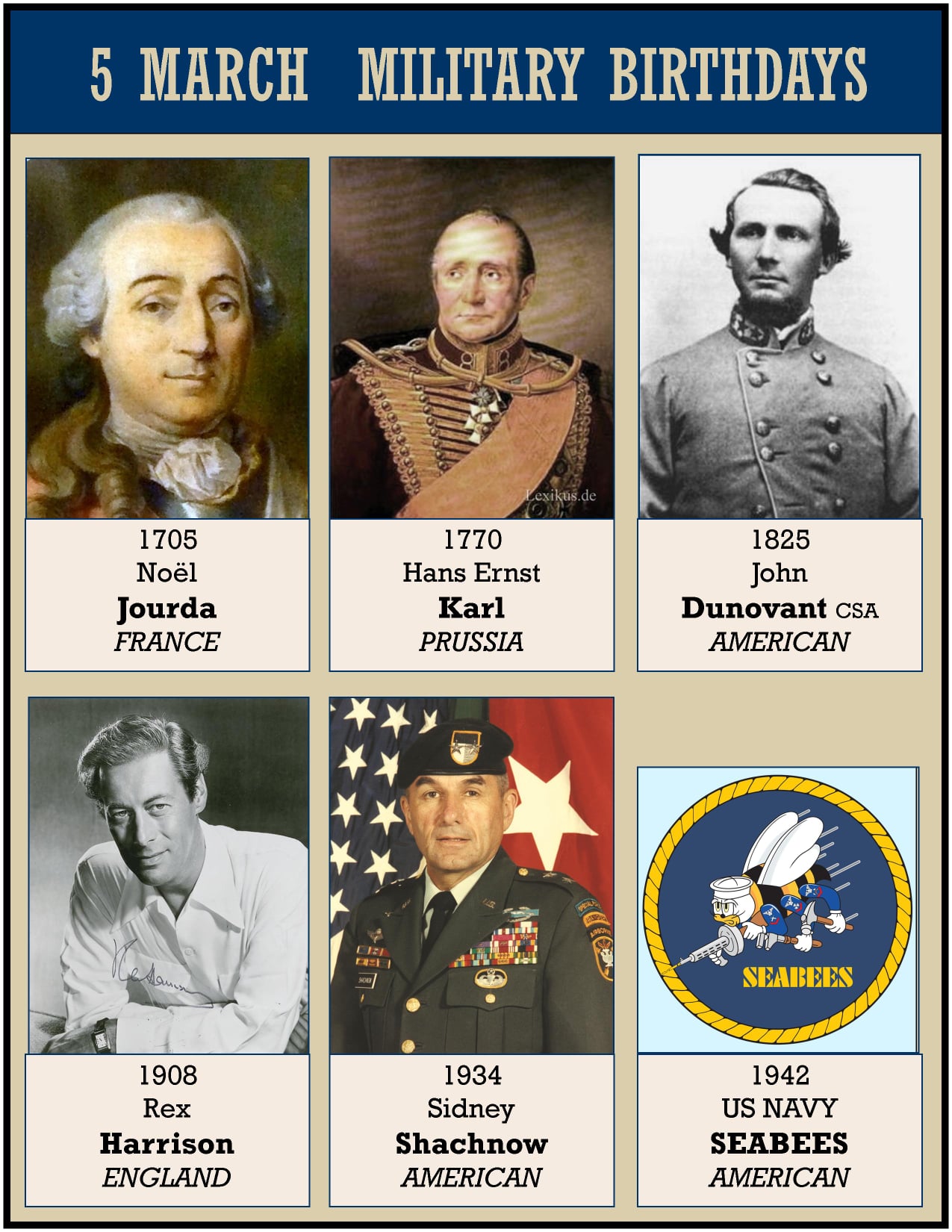
1705 Noël Jourda de Vaux (12 March 1705 in Château des Vaux au Puy-en-Velay â 14 September 1788 in Grenoble), comte de Vaux, seigneur d’Artiac was a French nobleman and General. He oversaw the conquest of the Corsican Republic in 1769. He was given command of land forces in the planned Franco-Spanish Invasion of Britain in 1779, but this was abandoned. He became a Marshal of Francein 1783.
1770 Hans Ernst Karl Graf von Zieten (March 5, 1770 â May 3, 18481)2he was an officer in the Prussian Army during the Napoleonic Wars. Zieten was born in Dechtow in the Brandenburg Margraviate; was not related to the general of Frederick the Great Hans Joachim von Zieten. During the Waterloo campaign of 1815, Lieutenant-General von Zieten commanded the I. Prussian Corps. The corps fought an action against the French thrust on 15 January, and was strongly engaged against the French the next day at the Battle of Ligny,and again two days later on 18 June at the Battle of Waterloo.
1825 John Dunovant was a brigadier general with temporary rank in the Confederate States Army during the American Civil War. Dunovant was a native of South Carolina who had been a MexicanâAmerican War veteran and captain in the U.S. Army from March 3, 1855, to December 29, 1860.
1904 Rex Harrison When WWII broke out, Harrison was determined to join the fightâuntil something from his past came back to haunt him. Harrison was denied entry to the Royal Air Force as a result of his damaged eye. Regardless, he knew he wanted to help. In 1942 the Royal Air Force finally accepted him. Harrison then worked his way up to the rank of flight lieutenant. He helped guide flight crews safely back from dangerous missions.
1934 A Holocaust survivor, Sidney Shachnow rose through the enlisted and officer ranks to become Commanding General, U.S. Army Special Forces Command and John F. Kennedy Special Warfare Center and School. Shachnow enlisted in the U.S. Army in 1955. His special operations career began in 1963, and included service in South Vietnam, and command of SF Detachment-A, in Cold War Berlin. Shachnow served as the G3, Chief of Staff, and Deputy Commanding General for 1st Special Operations Command during a critical five year period. He worked for the establishment of SF as an Army Branch, revitalized training, and shaped the birth of the U.S. Army Special Operations Command as a Major Command. He produced soldiers with the regional orientation, languages, and capability to work âby, with and throughâ host nation forces. In doing so, MG Shachnow laid the modern foundations of Special Forces
1942 The Naval Construction Force, better known as the Seabees, was born 5 March 1942. To meet the Navyâs need for construction of advanced bases in combat zones in WWII, Rear Admiral Ben Moreell, Chief of the Bureau of Yards and Docks, requested specific authority to activate, organize, and man Navy construction units. The first Seabee units were authorized on 5 January 1942, and official authorization of the Seabee name and insignia occurred on 5 March 1942.
MILITARY HSITORY SOCIETY OF ROCHESTER
ROCHESTERMILITARY.COM