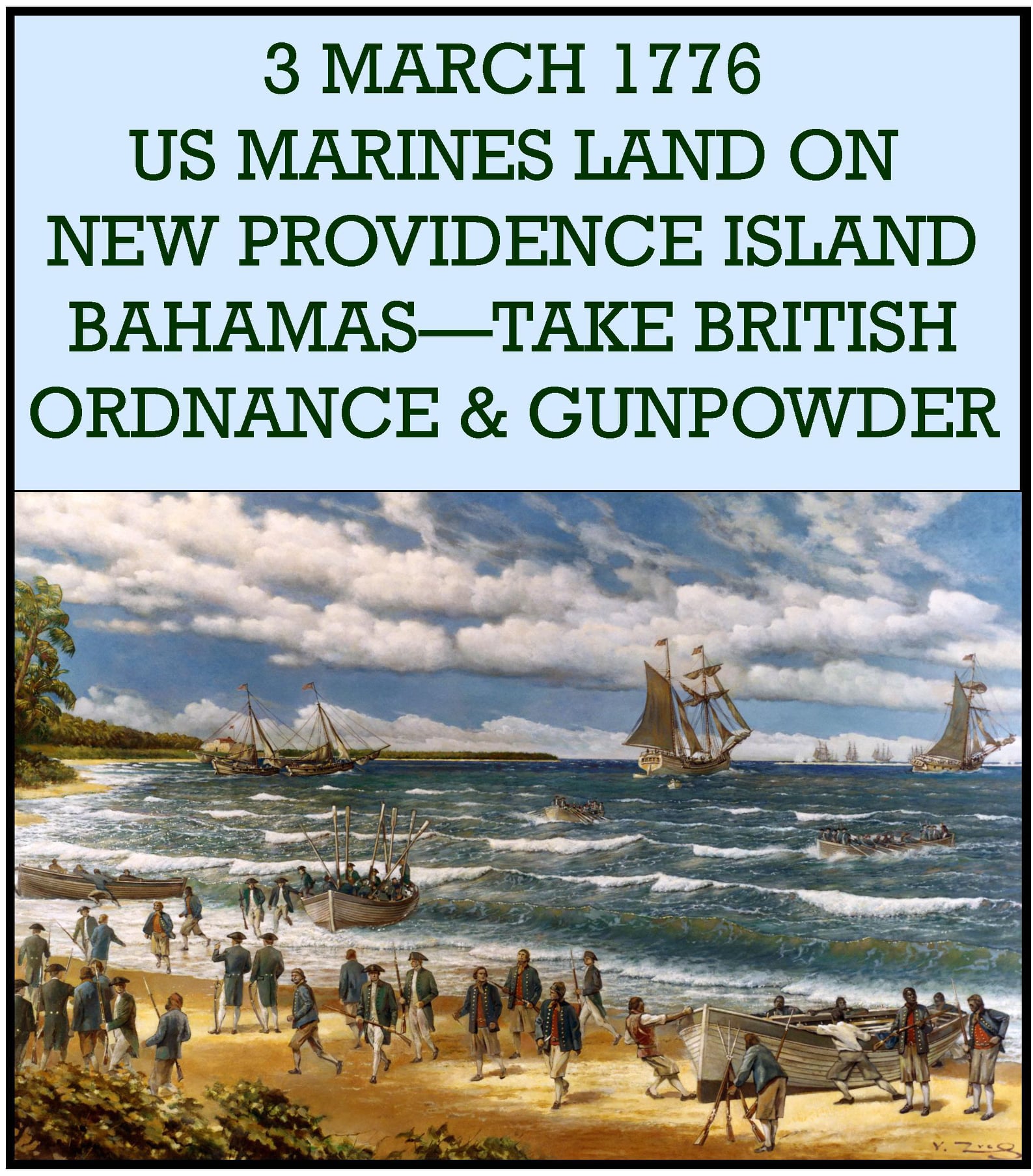
The Raid of Nassau (March 1â10, 1776) was a naval operation and amphibious assault by Colonial forces against the British port of Nassau, Bahamas, during the American Revolutionary War. The battle is considered one of the first engagements of the newly established Continental Navy and the Continental Marines, the respective progenitors of the United States Navy and Marine Corps. The action was also the Marines’ first amphibious landing. It is sometimes known as the “Battle of Nassau”.
Departing from Cape Henlopen, Delaware on February 17, 1776, the fleet arrived in the Bahamas on March 1, with the objective of seizing gunpowder and munitions known to be stored there. Two days later the Marines came ashore seizing Fort Montagu at the eastern end of the Nassau harbor, but did not advance to the town where the gunpowder was stored. That night Nassau’s governor had most of the gunpowder loaded aboard ships sailing for St. Augustine. On March 4, the Continental Marines advanced and took control of the poorly defended town.
The Continental forces remained at Nassau for two weeks and took away all the remaining gunpowder and munitions found. The fleet returned to New London, Connecticut in early April after capturing a few British supply ships, but failed to capture HMS Glasgow in an action on April 6.
MILITARY HISTORY SOCIETY OF ROCHESTER
ROCHESTERMILITARY.COM