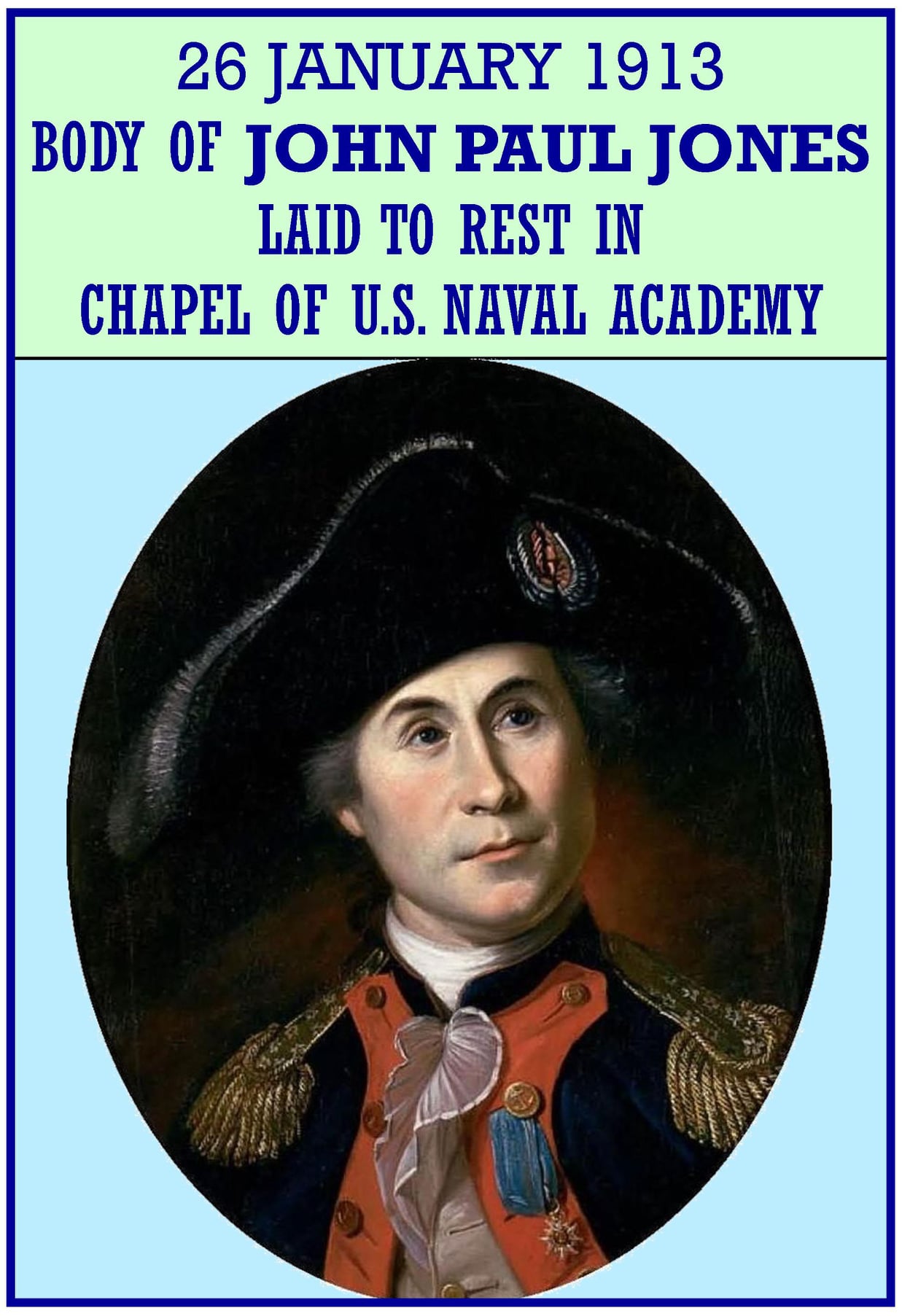
John Paul Jones (born John Paul; July 6, 1747 â July 18, 1792) was the United States’ first well-known naval commander in the American Revolutionary War. He made many friends among America’s political elites (including John Hancock and Benjamin Franklin ), as well as enemies (who accused him of piracy), and his actions in British waters during the Revolution earned him an international reputation which persists to this day. He died in Paris on July 18, 1792 and was buried in Paris at the Saint Louis Cemetery, which belonged to the French royal family. Four years later, France’s revolutionary government sold the property and the cemetery was forgotten. In 1905, Jones’s remains were identified by U.S. Ambassador to France Gen. Horace Porter, who had searched for six years to track down the body using faulty copies of Jones’s burial record. Jones’s body was brought to the United States aboard the USS Brooklyn (CA-3), escorted by three other cruisers. On approaching the American coastline, seven U.S. Navy battleships joined the procession escorting Jones’s body back to America. On April 24, 1906, Jones’s coffin was installed in Bancroft Hall at the United States Naval Academy, Annapolis, Maryland, following a ceremony in Dahlgren Hall, presided over by President Theodore Roosevelt who gave a speech paying tribute to Jones and holding him up as an example to the officers of the Navy. On January 26, 1913, the Captain’s remains were finally re-interred in a magnificent bronze and marble sarcophagus at the Naval Academy Chapel in Annapolis.
rochestermilitary.com