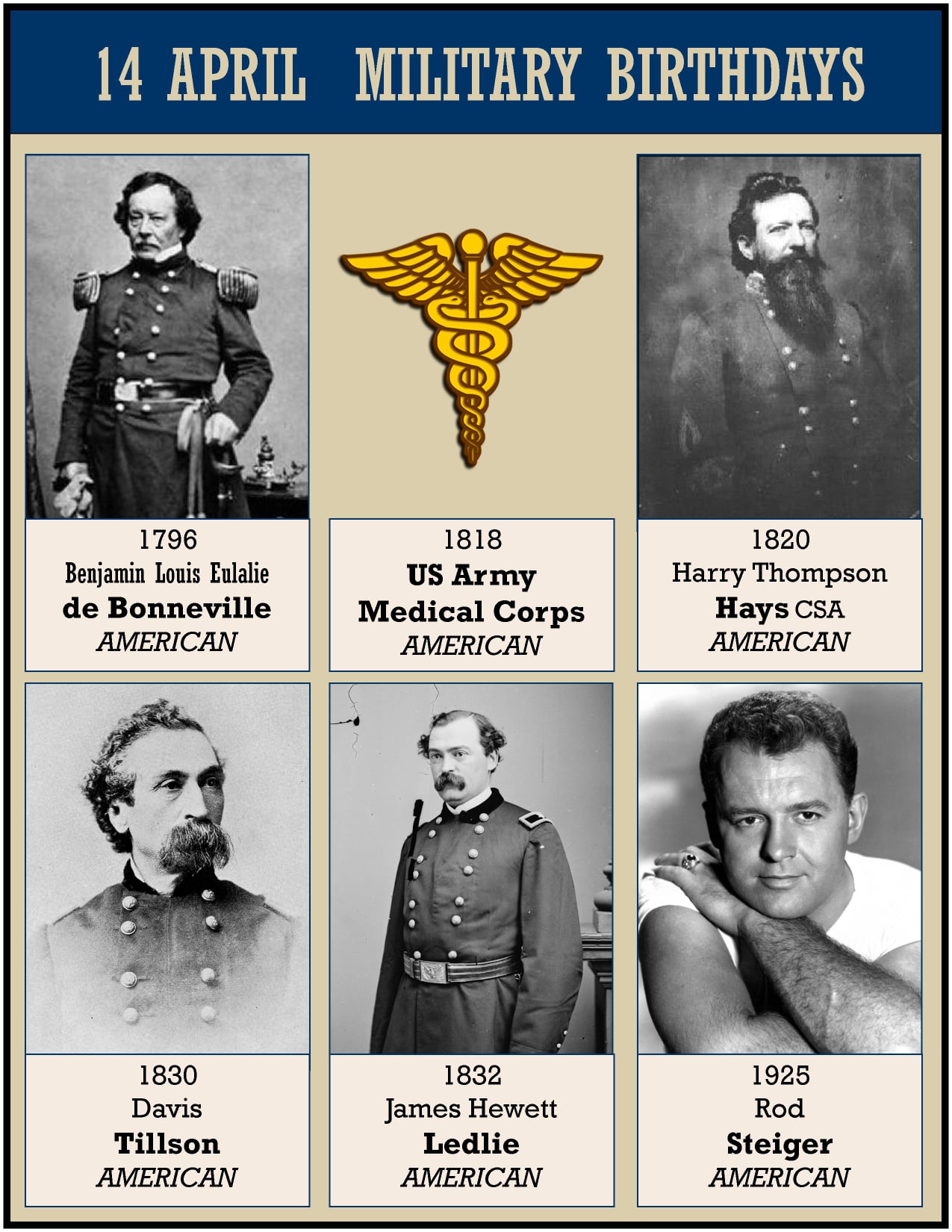
14 APRIL
1796 Benjamin Louis Eulalie de Bonneville (April 14, 1796 â June 12, 1878) was an American officer in the United States Army, fur trapper, and explorer in the American West. He is noted for his expeditions to the Oregon Country and the Great Basin, and in particular for blazing portions of the Oregon Trail. During his lifetime, Bonneville was made famous by an account of his explorations in the West written by Washington Irving.
1818 The Medical Corps (MC) of the U.S. Army is a staff corps (non-combat specialty branch) of the U.S. Army Medical Department (AMEDD) consisting of commissioned medical officers â physicians with either an M.D. or a D.O. degree, at least one year of post-graduate clinical training, and a state medical license. The MC traces its earliest origins to the first physicians recruited by the Medical Department of the Army, created by the Second Continental Congress in 1775. The US Congress made official the designation “Medical Corps” in 1908, although the term had long been in use informally among the Medical Department’s regular physicians. Currently, the MC consists of over 4,400 active duty physicians representing all the specialties and subspecialties of civilian medicine. They may be assigned to fixed military medical facilities, to deployable combat units or to military medical research and development duties. They are considered fully deployable soldiers. The Chief of the Medical Corps Branch (under the Army’s Human Resources Command) is a colonel and the senior-most Medical Corps officer in the Army is the U.S. Army Surgeon General, a lieutenant general.
1820 Harry Thompson Hays (April 14, 1820 â August 21, 1876) was an American Army officer serving in the MexicanâAmerican War and a general who served in the Confederate Army during the American Civil War. Known as the “Louisiana Tigers,” his brigade played a major role during the Battle of Gettysburg in July 1863, where they ascended Cemetery Hill in the darkness and overran several artillery batteries before finally being driven off for lack of support.
1830 Davis Tillson (14 Apr 1830 â 30 Apr 1895) When General Ulysses S. Grant visited Knoxville during the winter of 1863, Tillson requested permission to raise a regiment of colored heavy artillerymen. General Foster issued an order on January 6, 1864, granting Tillsonâs request to recruit a colored unit to defend Knoxville: âAll able-bodied colored men between the ages of eighteen and forty-five within our lines, except those employed in the several staff departments, officersâ servants, and those servants of loyal citizens who prefer remaining with their masters, will be sent forthwith to Knoxville, Loudon, or Kingston, Tenn., to be enrolled, under the direction of Brig. Gen. Davis Tillson, chief of artillery, with a view to be the formation of a regiment of artillery, to be composed of troops of African descent.â The unit was designated as the 1st U.S. Colored Heavy Artillery and remained under Tillsonâs command for the remainder of the war.
1832 James Hewett Ledlie (April 14, 1832 â August 15, 1882) was a civil engineer for American railroads and a general in the Union Army during the American Civil War. He is best known for his dereliction of duty at the Battle of the Crater during the Siege of Petersburg.
1925 Rodney Stephen Steiger (April 14, 1925 â July 9, 2002) He enlisted on May 11, 1942, and received his training at the U.S. Naval Training Station in Newport, Rhode Island. He first served on USS Benham (DD-397) as a Seaman 1st Class then joined the newly commissioned USS Taussig (DD-746) on May 20, 1944 as a Petty Officer 3rd Class. While serving as a torpedoman on destroyers, he saw action in the South Pacific, including the Battle of Iwo Jima. Steiger later commented: “I loved the Navy. I was stupid enough to think I was being heroic.” His experiences during the war haunted him for the rest of his life, particularly the loss of Americans during the Battle of Iwo Jima, as well as the sinking of vessels by the Taussig which were known to have women and children aboard. On December 17, 1944, off the coast of Luzon in the Philippines, Steiger and the Taussig encountered a severe typhoon, which became known as Halsey’s Typhoon, with winds reaching one hundred knots (115 mph) and 80 foot waves. As a result, three U.S. destroyers were lost, but the Taussig survived, with Steiger tying a rope to himself on deck and flattening himself as waves engulfed the ship.
MILITARY HISTORY SOCIETY OF ROCHESTER
ROCHESTERMILITARY.COM