16 APRIL
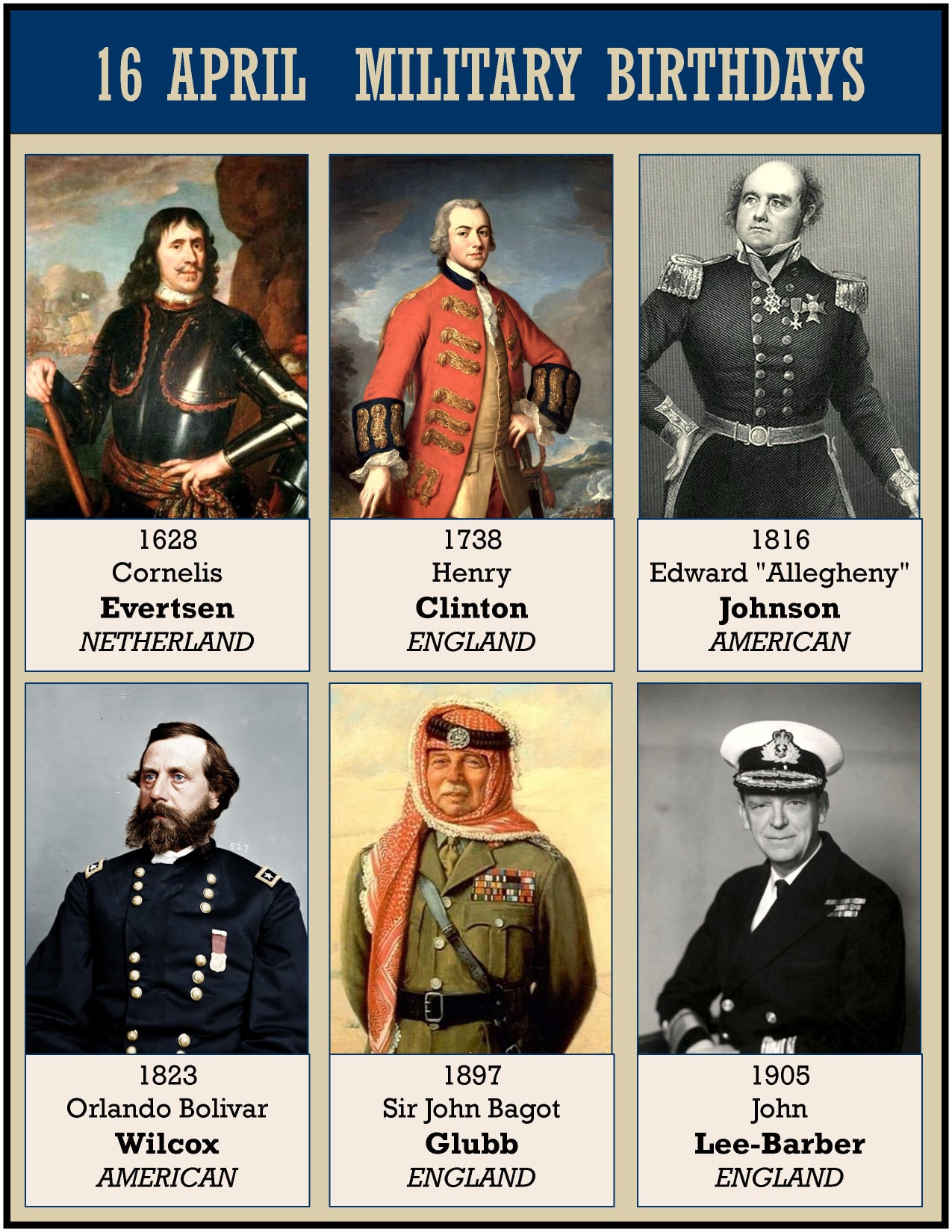
1628 Cornelis Evertsen the Younger (Flushing, 16 April 1628 â Flushing, 20 September 1679) was a Dutch Admiral from the 17th century. Cornelis was the son of Lieutenant-Admiral Johan Evertsen and the nephew of Lieutenant-Admiral Cornelis Evertsen the Elder. He is not to be confused with his cousin Lieutenant-Admiral Cornelis Evertsen the Youngest.
1730 General Sir Henry Clinton, KB (16 April 1730 â 23 December 1795) was a British army officer and politician who sat in the House of Commons between 1772 and 1795. He is best known for his service as a general during the American War of Independence. First arriving in Boston in May 1775, from 1778 to 1782 he was the British Commander-in-Chief in North America. In addition to his military service, due to the influence of his cousin Henry Pelham-Clinton, 2nd Duke of Newcastle, he was a Member of Parliament for many years. Late in life he was named Governor of Gibraltar, but died before assuming the post.
1816 Edward “Allegheny” Johnson (April 16, 1816 â March 2, 1873) was a United States Army officer and Confederate general in the American Civil War. Highly rated by Robert E. Lee, he was made a divisional commander under Richard S. Ewell. On the first evening of the Battle of Gettysburg (July 1, 1863), Ewell missed his opportunity to attack Cemetery Hill, and Johnson opted against attacking Culp’s Hill, for which he had a discretionary order, though he attempted this on the second and third days. Ewell and Johnson are blamed by many for the loss of this decisive battle.
1823 Orlando Bolivar Willcox was born in Detroit, Michigan. He entered the United States Military Academy in West Point, New York, in 1843. Following graduation in 1847, he was commissioned Second Lieutenant in the 4th U.S. Artillery. He would subsequently serve in the United States Army in various capacities over a period of forty years. Willcox served in the MexicanâAmerican War, fought against the Indians on the frontier, and again in the Third Seminole War. When the Civil War began, Willcox was appointed colonel of the 1st Michigan Volunteer Infantry. He was wounded and captured in the First Battle of Bull Run (First Manassas) while in command of a brigade in Maj. Gen. Samuel P. Heintzelman’s division. He later received the Medal of Honor in 1895 for “most distinguished gallantry” during the battle. After his release and exchange more than a year later, on August 19, 1862, President Abraham Lincoln appointed Willcox a brigadier general of volunteers, to rank from July 1, 1861. The President had to submit the nomination three times, the last on March 7, 1863, before the U.S. Senate finally confirmed the appointment on March 11, 1863. Willcox commanded the 1st Division of Maj. Gen. Ambrose Burnside’s IX Corps in 1862. He led the division at the Battle of Antietam and the corps at the Battle of Fredericksburg.
1897 Lieutenant-General Sir John Bagot Glubb, KCB, CMG, DSO, OBE, MC, KStJ, KPM (16 April 1897 â 17 March 1986), known as Glubb Pasha, was a British soldier, scholar and author, who led and trained Transjordan’s Arab Legion between 1939 and 1956 as its commanding general. During the First World War, he served in France. Glubb has been described as an “integral tool in the maintenance of British control.”
1905 Rear-Admiral John Lee-Barber CB, DSO (16 April 1905 â 14 November 1995) was a British Royal Navy officer who is possibly best known for having served on board HMS Griffin during the Norwegian Campaign of AprilâMay 1940.
MILITARY HISTORY SOCIETY OF ROCHESTER
ROCHESTERMILITARY.COM