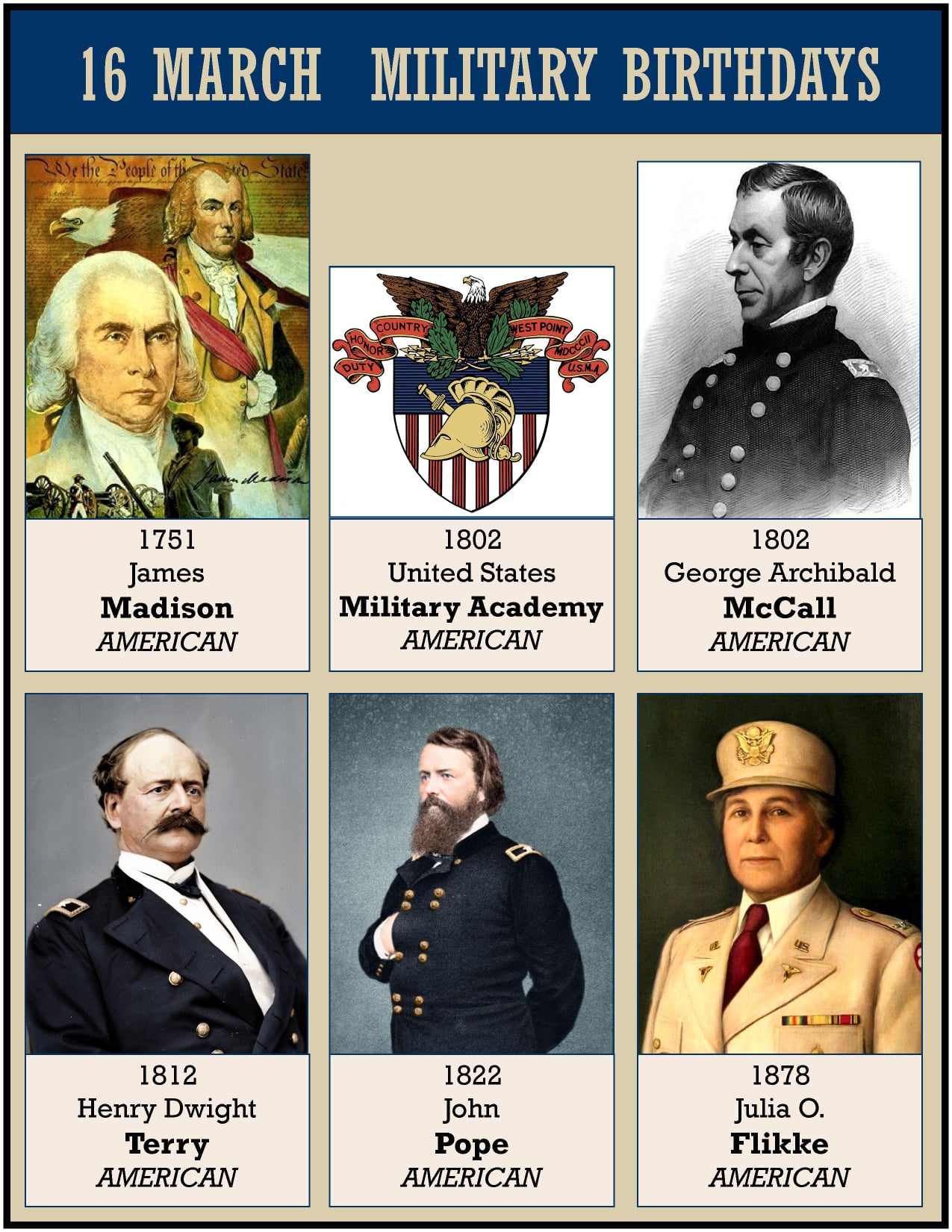
16 MARCH
1751 James Madison (16 March 1751 â 28 June 1836) Other than Abraham Lincoln, who was present at the Battle of Fort Stevens during the Civil War, Madison is the only sitting commander-in-chief to be directly involved in a military engagement. When British forces marched on Washington, D.C. during the War of 1812, the bookish president borrowed a pair of dueling pistols from his treasury secretary and set off for the American lines to help rally his troops. He and his entourage nearly blundered into British forces upon arriving, and they soon heard the whistle of enemy Congreve rockets overhead, prompting Madison to tell his cabinet secretaries that it âwould be proper to withdraw to a position in the rear.â After American militiamen were put to a rout, Madison joined his troops in fleeing the city, leaving the victorious British free to torch the White House and U.S. Capitol. Madison was able to return to Washington a few days later, but damage to the executive mansion forced him to take up residence in the cityâs Octagon House.
1802 The United States Military Academy (USMA), also known as West Point, Army, Army West Point, The Academy, or simply The Point, is a four-year federal service academy in West Point, New York. It was originally established as a fort that sits on strategic high ground overlooking the Hudson River with a scenic view, 50 miles north of New York City. It is the oldest of the five American service academies and educates cadets for commissioning into the United States Army. The academy was founded in 1802, one year after President Thomas Jefferson directed that plans be set in motion to establish the United States Military Academy at West Point. The entire central campus is a national landmark and home to scores of historic sites, buildings, and monuments. The majority of the campus’s Norman-style buildings are constructed from gray and black granite.
1802 George Archibald McCall (March 16, 1802 â February 25, 1868) was a United States Army officer who became a brigadier general and prisoner of war during the American Civil War. McCall served in the Peninsula Campaign and was wounded and captured at Frayser’s Farm, Virginia, in June 1862. He was imprisoned in Libby Prison in Richmond, Virginia. Previous illness was aggravated by his confinement in prison, and after his exchange (for Simon Bolivar Buckner) in August, McCall resigned due to poor health in March 1863.
1812 Henry Dwight Terry was born in Hartford, Connecticut on March 16, 1812 with strong New England roots. When Terry was young he moved to Michigan to study law, where he began his practice in Detroit (2.2). When the Civil War broke out Terry actively became interested and began to recruit soldiers in Michigan. Henry Dwight Terry became a Colonel of the Fifth Michigan Infantry Regiment during the Civil War. Colonel Terry ran a well-disciplined regiment, proving what a good military man he was. He led the Fifth Michigan through the Peninsula Campaign and was a key factor in preventing major losses during the Battle of Williamsburg. Soon after, Terry was promoted to Brigadier General and sent to Virginia. Terry commanded troops in a few more battles and directed enemy soldiers at a prison before eventually retiring. Terry is an important part of history in that he contributed to Union wins and Confederate losses or impasses. Terry is a hero who led his troops wisely on and off the battlefield for his country.
1822 John Pope (March 16, 1822 â September 23, 1892) was a career United States Army officer and Union general in the American Civil War. He had a brief stint in the Western Theater, but he is best known for his defeat at the Second Battle of Bull Run (Second Manassas) in the East. Pope was a graduate of the United States Military Academy in 1842. He served in the MexicanâAmerican War and had numerous assignments as a topographical engineer and surveyor in Florida, New Mexico, and Minnesota. He spent much of the last decade before the Civil War surveying possible southern routes for the proposed First Transcontinental Railroad. He was an early appointee as a Union brigadier general of volunteers and served initially under Maj. Gen. John C. Frémont. He achieved initial success against Brig. Gen. Sterling Price in Missouri, then led a successful campaign that captured Island No. 10 on the Mississippi River. This inspired the Lincoln administration to bring him to the Eastern Theater to lead the newly formed Army of Virginia.
1878 Julia O. Flikke was an American nurse. Her service to the United States Army Nurse Corps spanned both world wars and included overseas assignments in the Philippines and China. In 1927, she was appointed Assistant Superintendent of the ANC and was promoted to the relative rank of captain. In 1937, she succeeded Julia Stimson as Superintendent with the relative rank of major. She was the last superintendent to hold the office before the statutory limitation of four years was placed on the tenure. She was also the first woman to hold the rank of full colonel in the Army.
MILITARY HISTORY SOCIETY OF ROCHESTER
ROCHESTERMILITARY.COM