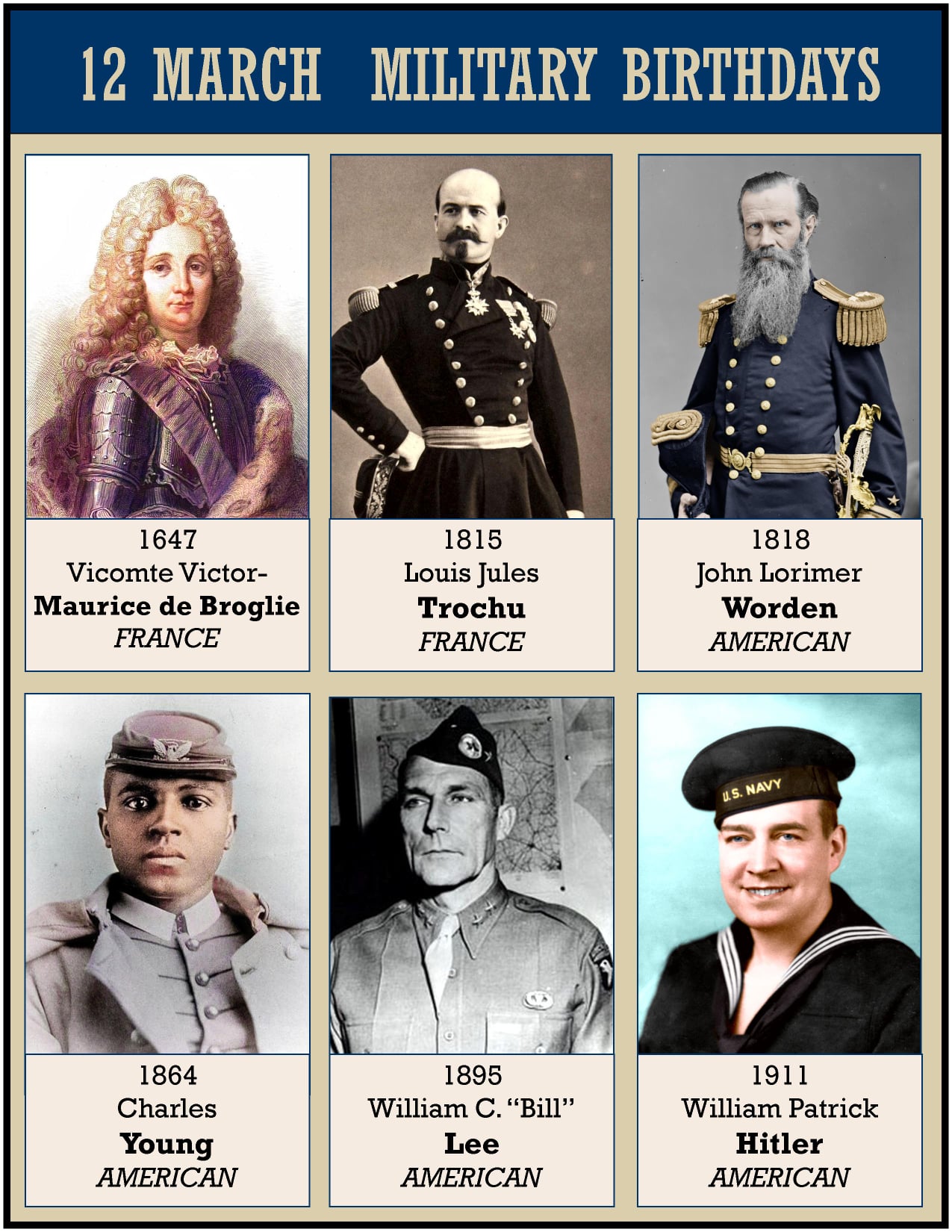
1647 Victor-Maurice de Broglie was born in the De Broglie house, a noble family originally from Piedmont. He was the son of François-Marie, comte de Broglie and Angelique de Vassal, Countess of Favria. After the death of his father he inherited the countships of Revel [1] and de Broglie, the marquisate of Senonches and also received the Government of La Bassee, near Lille. He served under Condé, Turenne, and other commanders of the age of Louis XIV in the Franco-Dutch War and other conflicts. He was named maréchal de camp in 1676, lieutenant-general in 1688, and finally marshal of France in 1724, just three years before his death.
1815 Louis Jules Trochu was born at Le Palais on the island of Belle-Ãle-en-Mer, off the coast of Brittany. Educated at St. Cyr, he received a commission in the Staff Corps in 1837, and was promoted to lieutenant in 1840, and captain in 1843. He served as a captain in Algeria under Marshal Bugeaud, who, in recognition of his gallantry in the battles of Sidi Yussuf and Isly, made him his aide-de-camp and entrusted him with important commissions. He was promoted to major in 1845, and to colonel in 1853. He served with distinction throughout the Crimean campaign, first as aide-de-camp to Marshal St. Arnaud, and then as general of brigade, and was made a commander of the Légion d’honneur and general of division. He again distinguished himself in command of a division in the Italian campaign of 1859, where he won the Grand Cross of the Légion d’honneur.
1818 John Lorimer Worden (March 12, 1818 â October 19, 1897) was a U.S. Navy officer in the American Civil War, who was commander of the USS Monitor in the Battle of Hampton Roads, the first-ever engagement between ironclads. In early 1862 he went to New York to oversee the completion of the ship, and after some setbacks sailed to Hampton Roads, Virginia, with the Monitor. On March 8, 1862, the Monitor arrived at Cape Henry, Virginia, after a Confederate ironclad, the CSS Virginia, had attacked Union vessels. On March 9, 1862, when the CSS Virginia returned to Hampton Roads to attack the Union navy, Worden led the Monitor in battle, forcing the first battle between iron warships in history. The ships fired at each other for four hours, during which time Worden was wounded when a shell exploded near him partially blinding him. The Monitor temporarily withdrew, allowing the CSS Virginia to also withdraw, bringing the battle to an end. The future of navies around the world were changed with this battle.
1864 Charles Young (March 12, 1864 â January 8, 1922) was an American soldier. He was the third African-American graduate of the United States Military Academy, the first black U.S. national park superintendent, first black military attaché, first black man to achieve the rank of colonel in the United States Army, and highest-ranking black officer in the regular army until his death in 1922.
1895 William Carey “Bill” Lee (March 12, 1895 âJune 25, 1948) was a senior United States Army officer who fought in both World War I and World War II, where he commanded the 101st Airborne Division, nicknamed the “Screaming Eagles”. Lee is often referred to as the “Father of the U.S. Airborne”.
1911 William Patrick “Willy” Stuart-Houston (Hitler) (12 March 1911 â 14 July 1987) was the nephew of Adolf Hitler. Born to Adolf’s half-brother, Alois Hitler, Jr., and his first wife, Bridget Dowling in Liverpool, Lancashire, William later moved to Germany and subsequently escaped, eventually going to the United States, where he enlisted to fight in World War II. He served in the U.S. Navy during World War II as a Pharmacist’s Mate (a designation later changed to Hospital Corpsman) until he was discharged in 1947. He had been wounded in action during the war and was awarded a Purple Heart medal.
MILITARY HISTORY SOCIETY OF ROCHESTER
ROCHESTERMILITARY.COM