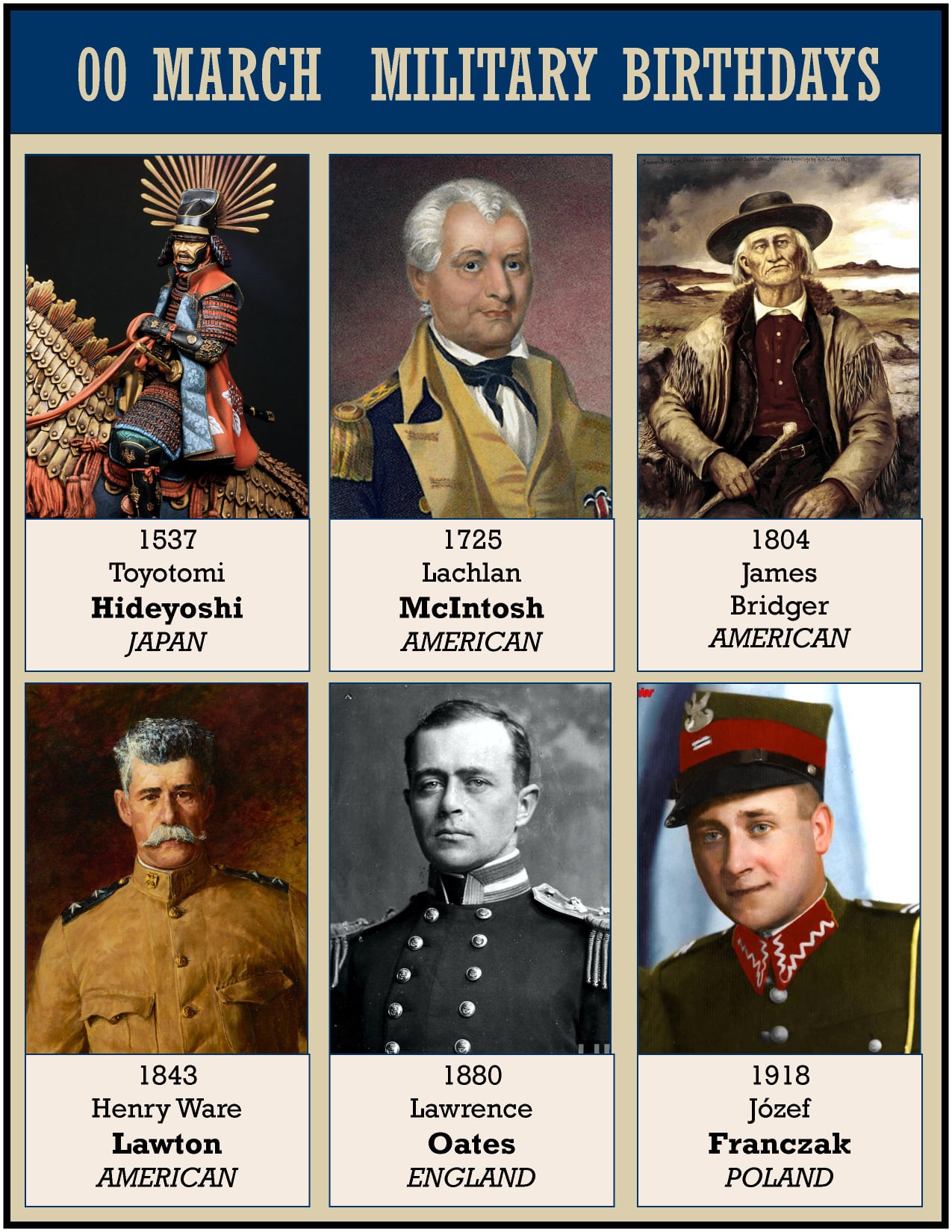
17 MARCH
1537 Toyotomi Hideyoshi (è±è£ ç§å, 17 March 1537 â 18 September 1598) was a Japanese samurai and daimyÅ of the late Sengoku period regarded as the second “Great Unifier” of Japan. Hideyoshi rose from a peasant background as a retainer of the prominent lord Oda Nobunaga to become one of the most powerful men in Japan. Hideyoshi succeeded Nobunaga after the HonnÅ-ji Incident in 1582 and continued Nobunaga’s campaign to unite Japan that led to the closing of the Sengoku period. Hideyoshi became the de facto leader of Japan and acquired the prestigious positions of Chancellor of the Realm and Imperial Regent by the mid-1580s. Hideyoshi launched the Japanese invasions of Korea in 1592 to initial success, but eventual military stalemate damaged his prestige before his death in 1598. Hideyoshi’s young son and successor Toyotomi Hideyori was displaced by Tokugawa Ieyasu at the Battle of Sekigahara in 1600 which would lead to the founding of the Tokugawa Shogunate. Hideyoshi’s rule covers most of the AzuchiâMomoyama period of Japan, partially named after his castle, Momoyama Castle. Hideyoshi left an influential and lasting legacy in Japan, including Osaka Castle, the Tokugawa class system, the restriction on the possession of weapons to the samurai, and the construction and restoration of many temples some of which are still visible in Kyoto.
1725 Lachlan McIntosh (March 17, 1725 â February 20, 1806) was a Scottish American military and political leader during the American Revolution and the early United States. In a 1777 duel, he fatally shot Button Gwinnett, a signer of the Declaration of Independence.
1804 James Felix Bridger (17 March 1804 â 17 July 1881) was an American mountain man, trapper, Army scout, and wilderness guide who explored and trapped in the Western United States in the first half of the 19th century. He was from the Bridger family of Virginia, English immigrants that had been in North America since the early colonial period.
1843 Henry Ware Lawton (March 17, 1843 â December 19, 1899) was a U.S. Army officer who served with distinction in the Civil War, the Apache Wars, the SpanishâAmerican War and was the only U.S. general officer to be killed during the PhilippineâAmerican War, and the first general officer of the United States killed in overseas action. The city of Lawton, Oklahoma, takes its name from General Lawton, as does a borough in the city of Havana, Cuba. Liwasang Bonifacio (Bonifacio Square) in downtown Manila was formerly named Plaza Lawton in his honor.
1880 Captain Lawrence Edward Grace “Titus” Oates (17 March 1880 â 17 March 1912) was a British army officer, and later an Antarctic explorer, who died during the Terra Nova Expedition when he walked from his tent into a blizzard. His death is seen as an act of self-sacrifice when, aware that the gangrene and frostbite from which he was suffering was compromising his three companions’ chances of survival, he chose certain death for himself in order to relieve them of the burden of caring for him.
1918 Józef Franczak (17 March 1918 â 21 October 1963) was a soldier of the Polish Army, Armia Krajowa World War II resistance, and last of the cursed soldiers â members of the militant anti-communist resistance in Poland. He used codenames Lalek (best known), LaluÅ, Laleczka, GuÅciowa, and fake name Józef BabiÅski. He was a resistance fighter for 24 out of 45 years of his life.
MILITARY HISTORY SOCIETY OF ROCHESTER
ROCHESTERMILITARY.COM