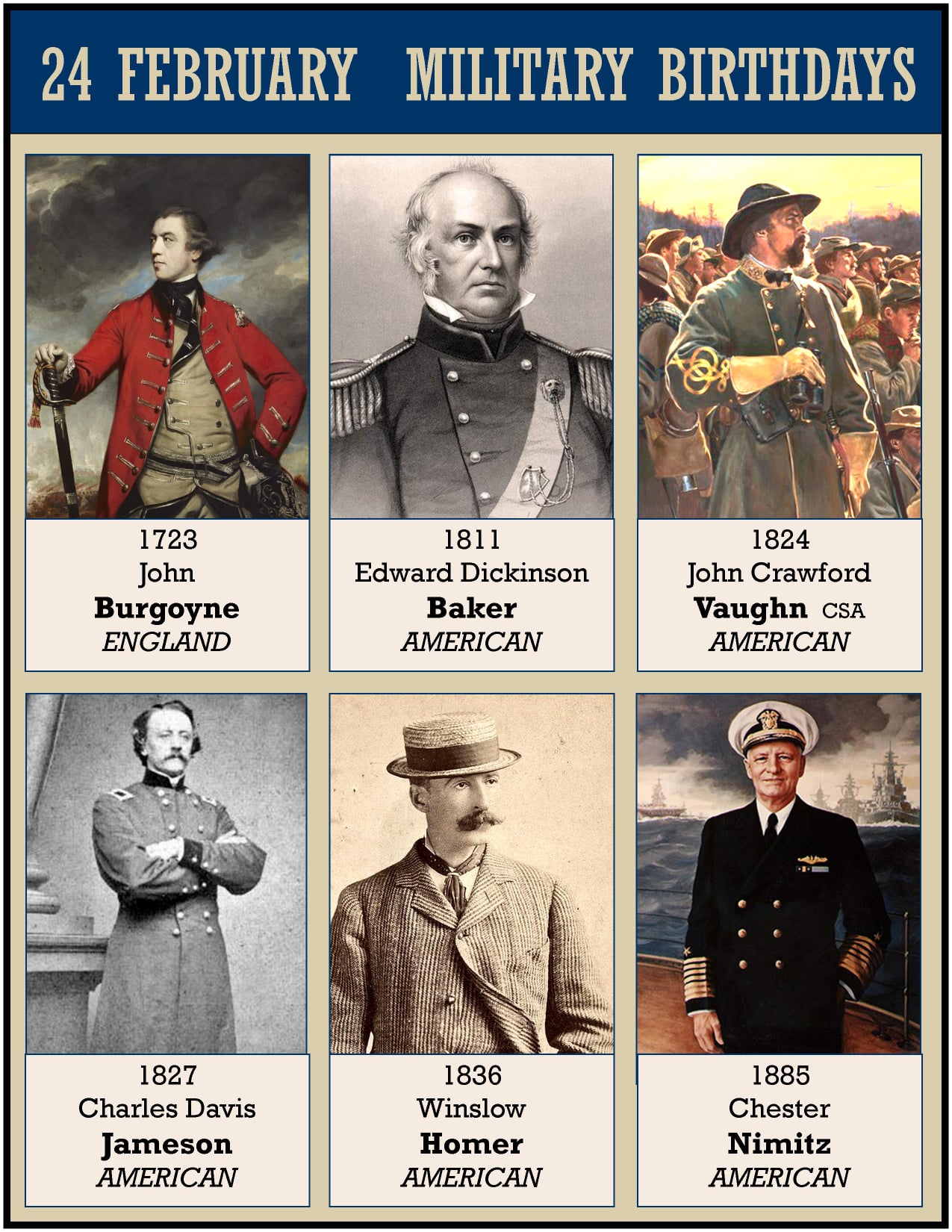
1722 General John Burgoyne (24 February 1722 â 4 August 1792) was a British army officer, dramatist and politician who sat in the House of Commons from 1761 to 1792. He first saw action during the Seven Years’ War when he participated in several battles, most notably during the Portugal Campaign of 1762. Burgoyne is best known for his role in the American Revolutionary War. He designed an invasion scheme and was appointed to command a force moving south from Canada to split away New England and end the rebellion. Burgoyne advanced from Canada but his slow movement allowed the Americans to concentrate their forces. Instead of coming to his aid according to the overall plan, the British Army in New York City moved south to capture Philadelphia. Burgoyne fought two small battles near Saratoga but was surrounded by American forces and, with no relief in sight, surrendered his entire army of 6,200 men on 17 October 1777. His surrender, says historian Edmund Morgan, “was a great turning point of the war, because it won for Americans the foreign assistance which was the last element needed for victory.” He and his officers returned to England; the enlisted men became prisoners of war. Burgoyne came under sharp criticism when he returned to London, and never held another active command.
1811 Edward Dickinson Baker was an American politician, lawyer, and military leader. In his political career, Baker served in the U.S. House of Representatives from Illinois and later as a U.S. Senator from Oregon. He was also known as an orator and poet. A long-time close friend of the President of the United States, Abraham Lincoln, Baker served as U.S. Army colonel during both the MexicanâAmerican War and the American Civil War. Baker was killed in the Battle of Ball’s Bluff while leading a Union Army regiment, becoming the only sitting U.S. senator ever to be killed in a military engagement.
1824 John Crawford Vaughn was a Confederate cavalry officer from East Tennessee. He served in the MexicanâAmerican War, prospected in the California Gold Rush, and participated in American Civil War battles including First Manassas, Vicksburg, Piedmont and Saltville.
1827 Charles Davis Jameson was an American Civil War general and Democratic Party candidate for Governor of Maine. He contracted “camp fever” at the Battle of Fair Oaks, returned to his native state of Maine, dying in transit or soon after.
1836 Winslow Homer (February 24, 1836 â September 29, 1910) was an American landscape painter and printmaker, best known for his marine subjects. He is considered one of the foremost painters in 19th-century America and a preeminent figure in American art. Recognition came for his exceptional Civil War and Spanish-American War images.
1885 Chester William Nimitz, Sr. was a fleet admiral of the United States Navy. He played a major role in the naval history of World War II as Commander in Chief, U.S. Pacific Fleet and Commander in Chief, Pacific Ocean Areas, commanding Allied air, land, and sea forces during World War II.
MILITARY HISTORY SOCIETY OR ROCHESTER
ROCHESTERMILITARY.COM