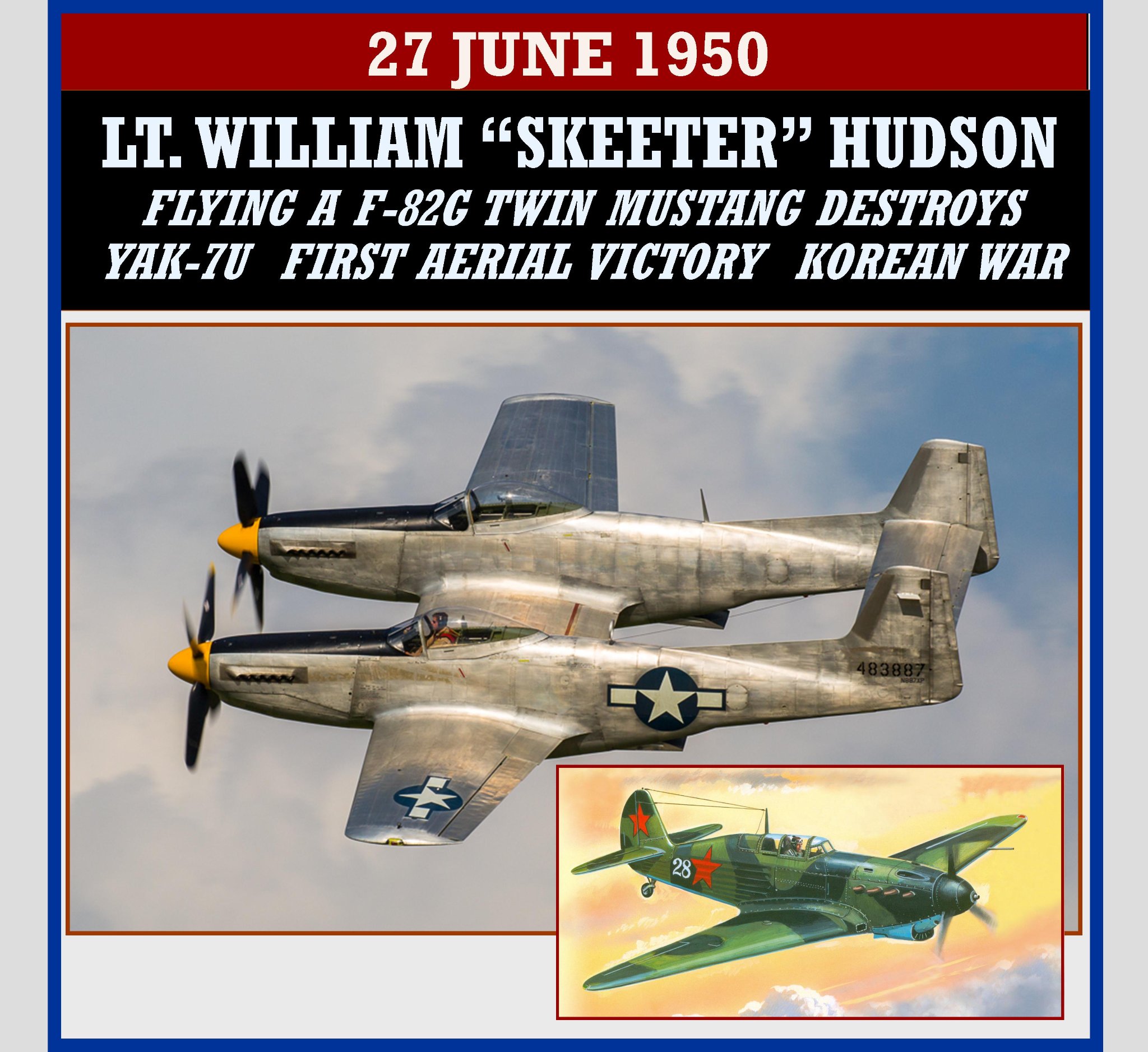
1950 â Flying a F-82G Twin Mustang in a defensive mission over Kimpo Airfield, Lieutenant William G. âSkeeterâ Hudson, 68th Fighter (All-Weather) Squadron, destroyed a Yak-7U fighter and was officially credited with the first aerial victory of the Korean War. Lieutenant Carl Fraser occupied the second cockpit as copilot.
To many fans of World War II aviation, there is nothing greater than the North American P-51 Mustang, the silvery, iconic warbird that dominated the air in every theatre it flew in. But what could be better than a P-51 Mustang? Well, at least according to one North American designer, the only thing better would be two P-51 Mustangs fused together. While strange-looking, the F-82 Twin Mustang was quite the aircraft, and a fantastic all-weather day/night fighter for its time.
27 June – Fearing that the North Koreans would shoot at American transports loaded with civilians, a request for fighter cover was made, and several Japan-based F-82s from the 399th Fighter All Weather Squadron were available to answer the call. Taking to the skies, the Twin Mustangs arrived at Kimpo Air Base in South Korea and orbited in a stacked formation as the transports took off. Just before noon, a mixed group of Soviet-built North Korean fighters appeared, determined to destroy the transports. The F-82s, however, had other plans and began defending the helpless cargo planes. During the dogfight, Lt. William G. âSkeeterâ Hudson initiated a high-G turn and began peppering a Yak-11 with six .50 caliber machine guns, downing the enemy plane.
MILITARY HISTORY SOCIETY OF ROCHESTER
ROCHESTERMILITARY.COM