5 MAY
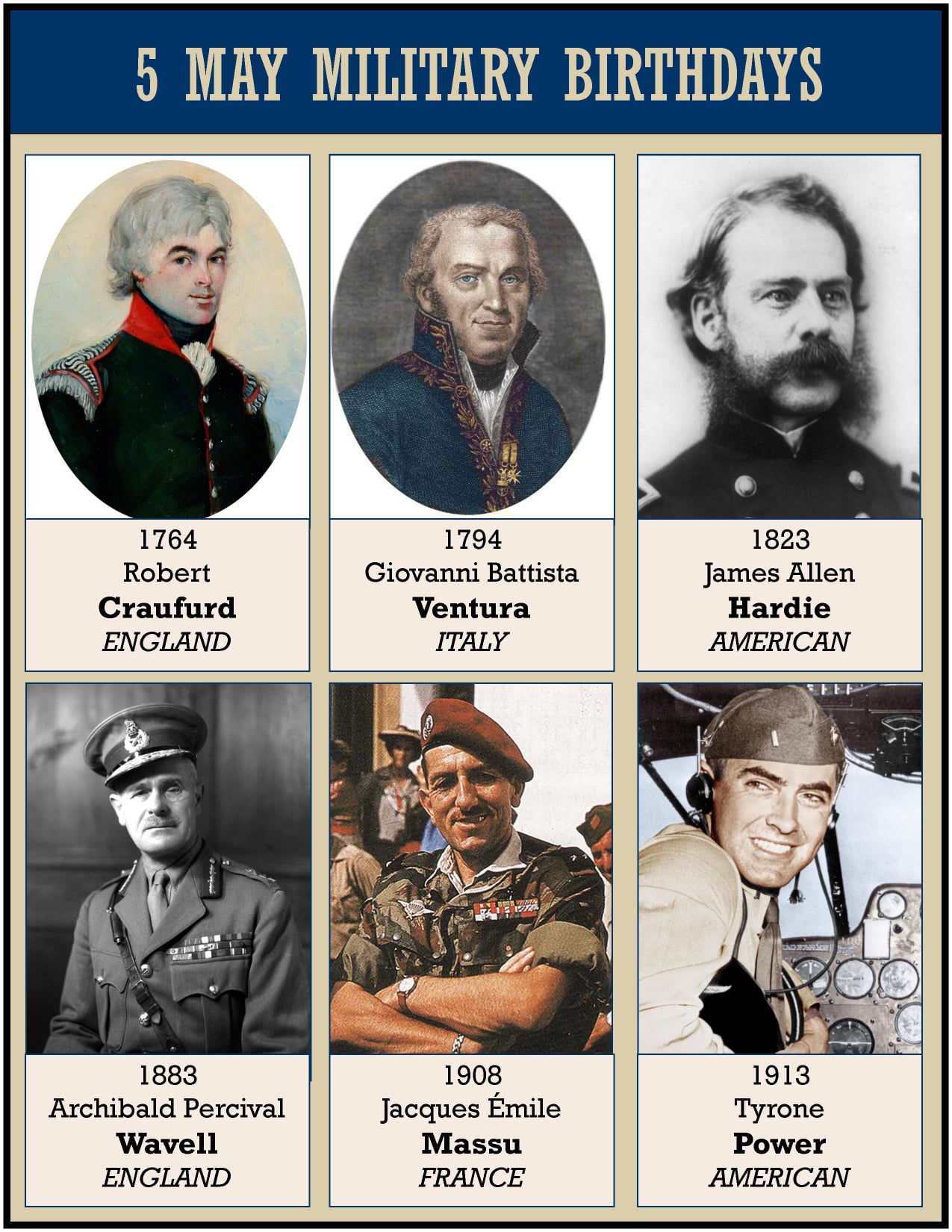
1764 Major-General Robert Craufurd (5 May 1764 â 23 January 1812) was a British soldier. Craufurd was born at Newark, Ayrshire, the third son of Sir Alexander Craufurd, 1st Baronet (see Craufurd Baronets),[1] and the younger brother of Sir Charles Craufurd. After a military career which took him from India to the Netherlands, in 1810 in the Napoleonic Peninsular War he was given command of the Light Division, composed of the elite foot soldiers in the army at the time, under the Duke of Wellington. Craufurd was a strict disciplinarian and somewhat prone to violent mood swings which earned him the nickname “Black Bob”. He was mortally wounded storming the lesser breach in the Siege of Ciudad Rodrigo on 19 January 1812 and died four days later.
1794 Jean-Baptiste (Giovanni Battista) Ventura, born Rubino (25 May 1794â3 April 1858), was an Italian soldier, an important General in Maharaja Ranjit Singh’s Sarkar-i-Khalsa, and early archaeologist of the Punjab region of the Sikh Empire.
1823 James Allen Hardie (May 5, 1823 â December 14, 1876) was an American soldier, serving in a number of important administrative positions in the Union Army during the American Civil War. Hardie played an important administrative role in two key incidents during the war. During the Battle of Fredericksburg, he delivered the attack orders to Maj. Gen. William B. Franklin on December 13, 1862. Franklin did not conduct his attack to Maj. Gen. Ambrose E. Burnside’s expectations, and Hardie has been criticized for not ensuring that the two generals understood each other correctly. On June 28, 1863, Hardie was the officer who delivered the surprise order to Maj. Gen. George G. Meade at Frederick, Maryland, appointing him commander of the Army of the Potomac, three days prior to the Battle of Gettysburg.
1883 Archibald Percival Wavell, 1st Earl Wavell, GCB, GCSI, GCIE, CMG, MC, KStJ, PC (5 May 1883 â 24 May 1950) was a senior officer of the British Army. He served in the Second Boer War, the Bazar Valley Campaign and World War I, during which he was wounded in the Second Battle of Ypres. He served in the Second World War, initially as Commander-in-Chief Middle East, in which role he led British forces to victory over the Italians in western Egypt and eastern Libya during Operation Compass in December 1940, only to be defeated by the German Army in the Western Desert in April 1941. He served as Commander-in-Chief, India, from July 1941 until June 1943 (apart from a brief tour as Commander of ABDACOM) and then served as Viceroy of India until his retirement in February 1947.
1908 Jacques Ãmile Massu (5 May 1908 â 26 October 2002) was a French general who fought in World War II, the First Indochina War, the Algerian War and the Suez crisis. He led French troops in the Battle of Algiers, first supporting and later denouncing their use of torture.
1914 Tyrone Power (May 5, 1914 â November 15, 1958) Patriotic fever was sweeping through Hollywood in 1942 and many actors entered the services. Power could have received a direct commission and a cushy job, but his goal at the time was to become a Marine glider pilot. Because of his age and lack of education, he did not qualify to enter flight training as a cadet. The only recourse open was to enter flight training as an officer; therefore, he enlisted as a private in the Marine Corps in August 1942. He delayed entering active duty several months to complete the war movie Crash Dive. Power went through boot camp at San Diego and OCS at Quantico before being commissioned as a Second Lieutenant on June 2, 1943.
As an experienced pilot with 180 solo hours, Power went through an accelerated flight training program at Corpus Christi. Since he was considered too old for combat flying, Power trained in the multiengine land pipeline as a prospective transport pilot. He won his wings and was promoted to First Lieutenant. in April 1944.
Power assigned VMR-353 and joined that squadron on Kwajalein in February 1945, and moved with that unit to Saipan in March. Power took part in the air supply and evacuation of wounded from Iwo Jima and Okinawa. One of VMR-353’s aircraft was destroyed by a Japanese suicide squad on Okinawa.
Orders sent Power back to the United States in November 1945 and the Marines released him from active duty in January 1946. Power held the American Campaign Medal, the Asiatic-Pacific Campaign Medal with two bronze stars, and the World War II Victory Medal. Power returned to his acting career and made 22 motion pictures after the war. He was promoted to Captain in the Reserves on May 8, 1951, but was not recalled for the Korean War.
MILITARY HISTORY SOCIETY OR ROCHESTER
ROCHESTERMILITARY.COM