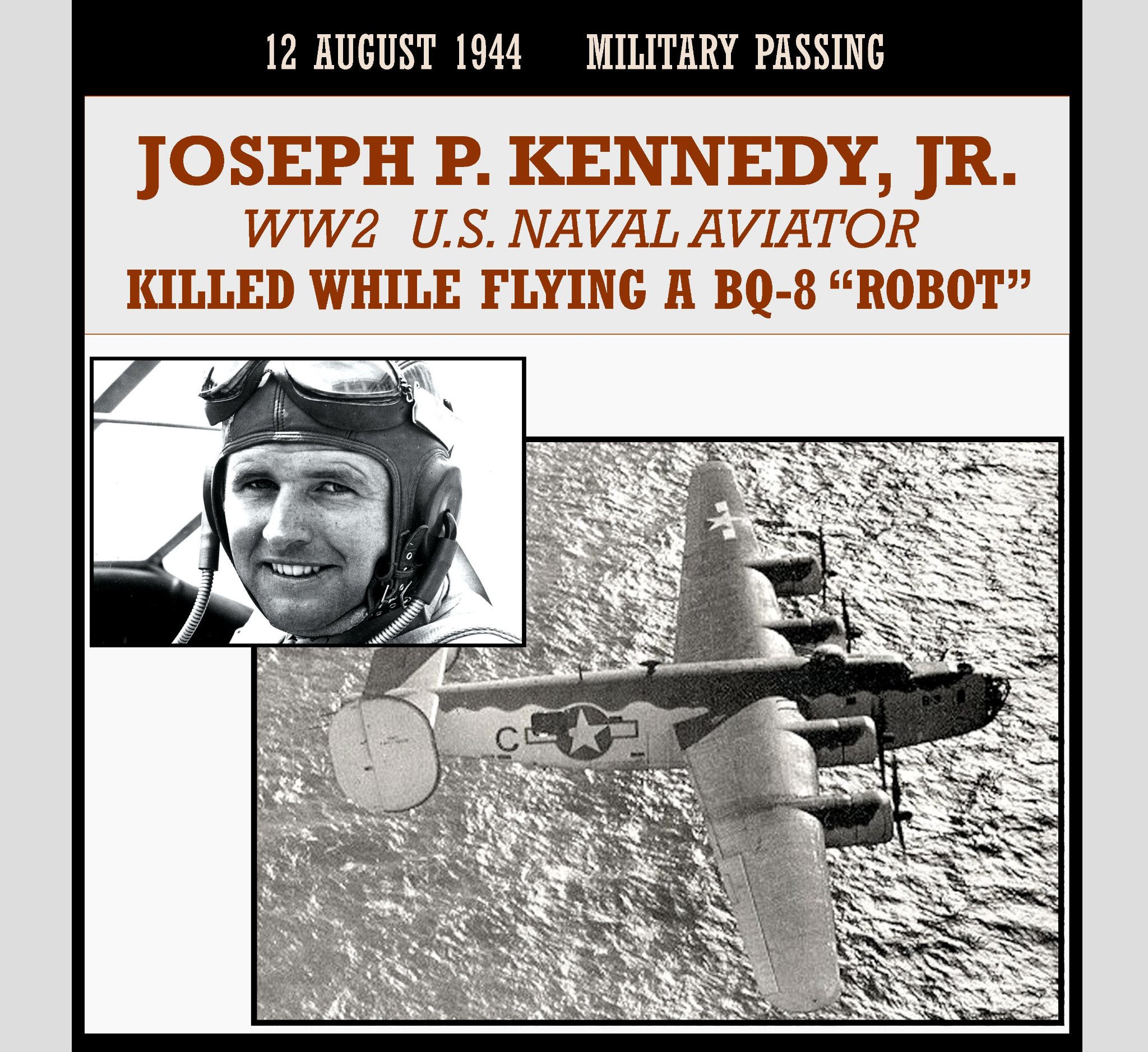
Joseph Patrick Kennedy Jr. (July 25, 1915 â August 12, 1944) was the eldest of the nine children born to Joseph P. Kennedy Sr. and Rose Fitzgerald Kennedy. A US Navy lieutenant, he was killed in action during World War II while serving as a land-based patrol bomber pilot, and posthumously awarded the Navy Cross.
Kennedy and his co-pilot Willy flew a BQ-8 “robot” aircraft (a converted B-24 Liberator) for the Navy’s first Aphrodite mission. Initially, two Lockheed Ventura mother planes and a Boeing B-17 navigation plane took off from RAF Fersfield, Norfolk, England at 1800 on Saturday, August 12, 1944. Then the BQ-8 aircraft, loaded with 21,170 lb of Torpex explosive, took off to be used against the U-boat pens at Heligoland in the North Sea.
Following them in a USAAF F-8 Mosquito to film the mission were pilot Lt. Robert A. Tunnel and combat cameraman Lt. David J. McCarthy, who filmed the event from the perspex nose of the aircraft. As planned, Kennedy and Willy remained aboard as the BQ-8 completed its first remote-controlled turn at 2,000 ft near the North Sea coast. Kennedy and Willy removed the safety pin, arming the explosive package, and Kennedy radioed the agreed code Spade Flush, his last known words. Two minutes later and well before the planned crew bailout, near RAF Manston, the Torpex explosive detonated prematurely and destroyed the Liberator, killing Kennedy and Willy instantly. Wreckage landed near the village of Blythburgh in Suffolk, England, causing widespread damage and small fires, but there were no injuries on the ground. According to one report, a total of 59 buildings were damaged in a nearby coastal town.
MILITARY HISTORY SOCIETY OF ROCHESTER
ROCHESTERMILITARY.COM