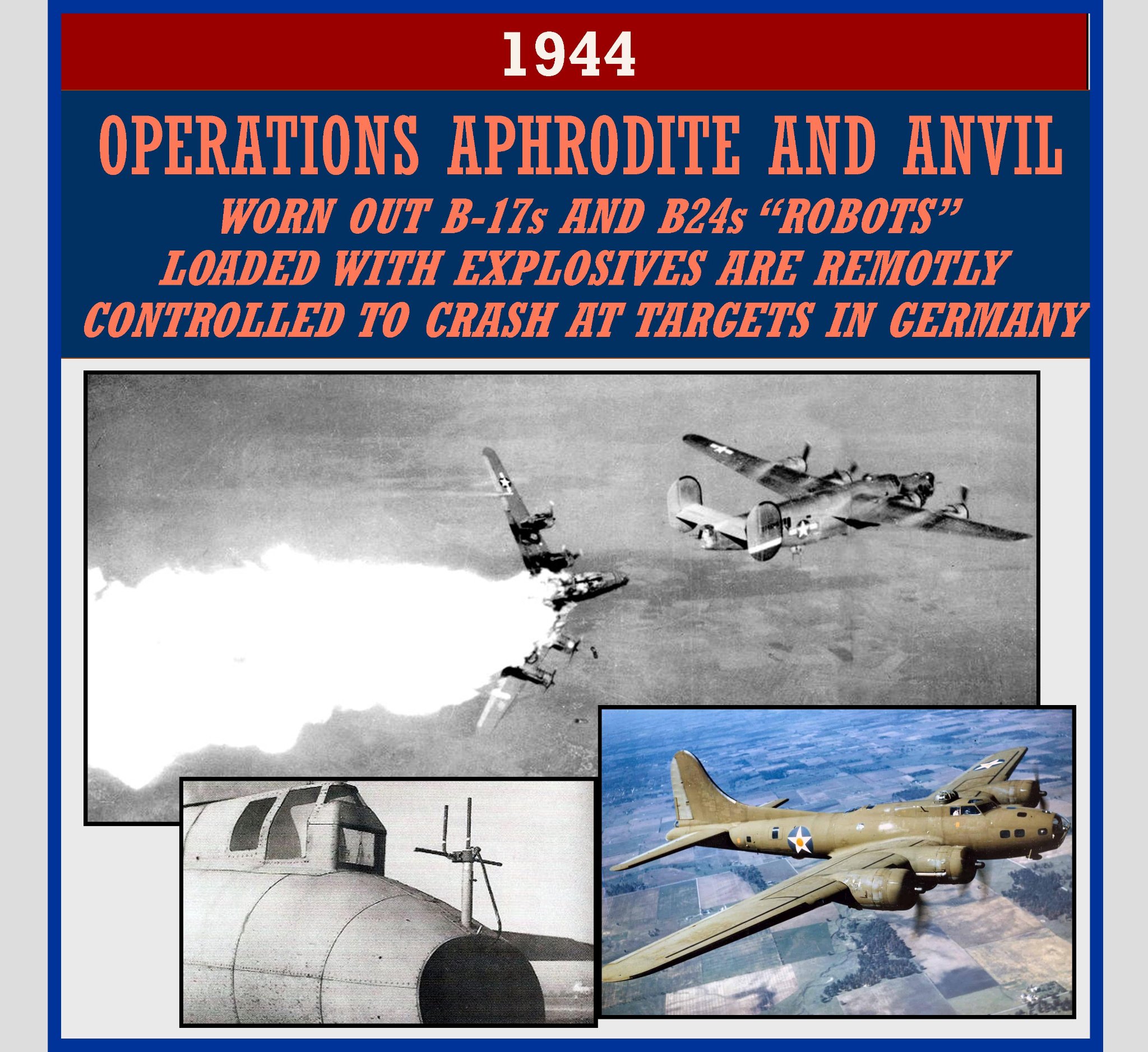
Aphrodite and Anvil were the World War II code names of United States Army Air Forces and United States Navy operations to use Boeing B-17 Flying Fortress and Consolidated PB4Y bombers as precision-guided munitions against bunkers and other hardened/reinforced enemy facilities, such as “Crossbow” operations against German long range missiles.
The plan called for B-17E/Fs that had been taken out of operational service (various nicknames existed such as “robot”, “baby”, “drone” or “weary Willy”) to be loaded to capacity with explosives, and flown by radio control into bomb-resistant fortifications such as German U-boat pens and V-weapon sites.
Old Boeing B-17 Flying Fortress bombers and PB4Ys (Navy B-24s) were stripped of all normal combat armament and all other non-essential gear (armor, guns, bomb racks, transceiver, seats, etc.), relieving them of about 12,000 lb (5,400 kg) of weight. To allow easier exit when the pilot and co-pilot were to parachute out, the canopy was removed. Azon radio remote-control equipment was added, with two television cameras fitted in the cockpit to allow a view of both the ground and the main instrumentation panel to be transmitted back to an accompanying B-17 “CQ-4” ‘mothership’.
The drone was loaded with explosives weighing more than twice that of a B-17’s normal bomb payload. The British Torpex (from “Torpedo Explosive”) used for the purpose was itself 50% more powerful than TNT alone. The remote control system was insufficient for safe takeoff, so each drone was taken aloft by a volunteer crew of a pilot and a flight engineer to an altitude of 2,000 ft (600 m) for transfer of control to the CQ-4 operators. After successful turnover of control of the drone, the two-man crew would arm the payload and parachute out of the cockpit. The ‘mothership’ would then direct the missile to the target.
MILITARY HISTORY SOCIETY OF ROCHESTER
ROCHESTERMILITARY.COM