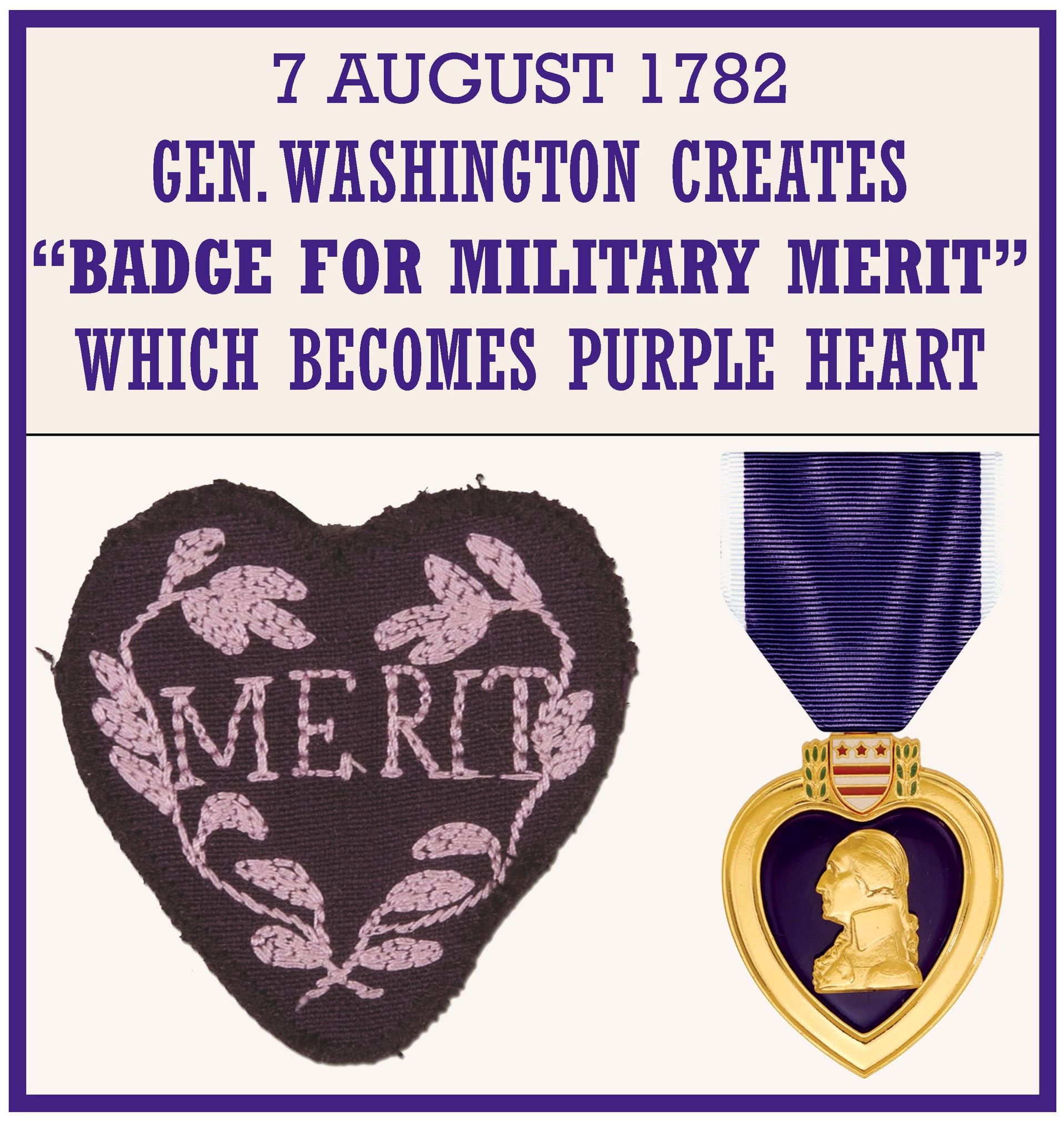
1782 â At his headquarters in Newburgh, New York, General George Washington, the commander in chief of the Continental Army, creates the âBadge for Military Merit,â a decoration consisting of a purple, heart-shaped piece of silk, edged with a narrow binding of silver, with the word Merit stitched across the face in silver. The badge was to be presented to soldiers for âany singularly meritorious actionâ and permitted its wearer to pass guards and sentinels without challenge. The honoreeâs name and regiment were also to be inscribed in a âBook of Merit.â Washingtonâs âPurple Heartâ was awarded to only three known soldiers during the Revolutionary War: Elijah Churchill, William Brown, and Daniel Bissell, Jr. The âBook of Meritâ was lost, and the decoration was largely forgotten until 1927, when General Charles P. Summerall, the U.S. Army chief of staff, sent an unsuccessful draft bill to Congress to ârevive the Badge of Military Merit.â In 1931, Summerallâs successor, General Douglas MacArthur, took up the cause, hoping to reinstate the medal in time for the bicentennial of George Washingtonâs birth. On February 22, 1932, Washingtonâs 200th birthday, the U.S. War Department announced the creation of the âOrder of the Purple Heart.â In addition to aspects of Washingtonâs original design, the new Purple Heart also displays a bust of Washington and his coat of arms. The Order of the Purple Heart, the oldest American military decoration for military merit, is awarded to members of the U.S. armed forces who have been killed or wounded in action against an enemy. It is also awarded to soldiers who have suffered maltreatment as prisoners of war.
MILITARY HISTORY SOCIETY OF ROCHESTER
ROCHESTERMILITARY.COM