12 APRIL
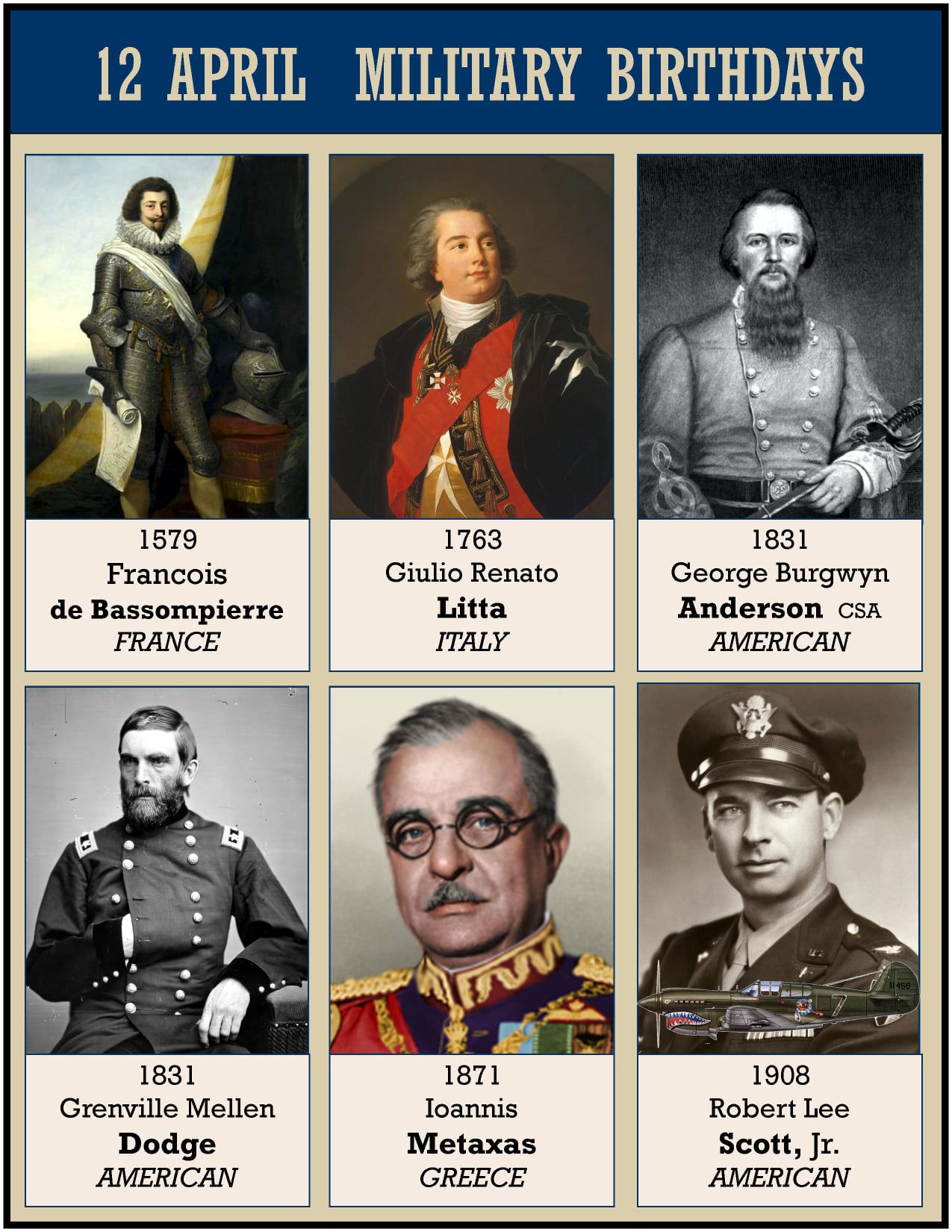
1579 François de Bassompierre (12 April 1579 â 12 October 1646) was a French courtier. The son of Christophe de Bassompierre (1547â1596), he was born at the castle of Haroué in Lorraine. He was descended from an old family which had for generations served the dukes of Burgundy and Lorraine, and after being educated with his brothers in Bavaria and Italy, was introduced to the court of King Henry IV of France in 1598. He became a great favourite of the king and shared to the full in the dissipations of court life. In 1600, he took part in the brief campaign in Savoy, and in 1603 fought in Hungary against the Turks for emperor Rudolf II.
1763 Giulio Renato Litta Visconti Arese(Born 12 April 1763 â 26 January 1839)was an Italian admiral.At the age of 19 he joined the navy of the Sovereign Military Order of Malta,becoming a knight and gaining valuable experience in the field that will benefit him much later. When Tsarina Catherine II of Russia in 1788 asked Grand Master Emmanuel de Rohan-Polduc to provide him with a valid sea man to reorganize the Russian fleet in anticipation of an imminent war withSweden in exchange for the large handouts that the Russian sovereign was making to the Order, the choice fell to the young Litta. which in January of the following year was already in St. Petersburg.
1831 George Burgwyn Anderson (April 12, 1831 â October 17, 1862) was a career military officer, serving first in the antebellum U.S. Army and then dying from wounds inflicted during the American Civil War while a general officer in the Confederate Army. He was among six generals killed or mortally wounded at the Battle of Antietam in September 1862.
1831 Grenville Mellen Dodge (April 12, 1831 â January 3, 1916) was a Union Army officer on the frontier and a pioneering figure in military intelligence during the Civil War, who served as Ulysses S. Grant’s intelligence chief in the Western Theater. He served in several notable assignments, including command of the XVI Corps during the Atlanta Campaign. He later served as a U.S. Congressman, businessman, and railroad executive who helped direct the construction of the Transcontinental Railroad. Historian Stanley P. Hirshon suggested that Dodge, “by virtue of the range of his abilities and activities,” could be considered “more important in the national life after the Civil War than his more famous colleagues and friends, Grant, Sherman, and Sheridan.”
1871 Ioannis Metaxas (12 April 1871 â 29 January 1941) was a Greek military officer and politician, serving as Prime Minister of Greece from 1936 until his death in 1941. He governed constitutionally for the first four months of his tenure, and thereafter as the strongman of the 4th of August Regime. Born to an aristocratic family in Ithaca, Metaxas took part in the Greco-Turkish War of 1897 and the Balkan Wars (1912â13), quickly rising through the ranks of the Hellenic Army. A royalist during the National Schism, Metaxas unsuccessfully opposed Prime Minister Eleftherios Venizelos and Greece’s entry in World War I; as a result, he was exiled to Corsica in 1917. On his return, Metaxas moved into politics and founded the Freethinkers’ Party, but had only limited success under the Hellenic Republic. The Greek monarchy was restored in 1935, and Metaxas was appointed Prime Minister in April 1936. On 4 August 1936, with the support of King George II, Metaxas initiated a self-coup and established an authoritarian, nationalist and anti-communist regime. Metaxas attempted to maintain Greek neutrality early in the Second World War. On 28 October 1940, Metaxas rejected an ultimatum imposed by the Italians to surrender, committing Greece to the Allies and bringing the country into the war. He died in January 1941, before the German invasion and subsequent fall of Greece.
1908 Robert Lee Scott Jr. (12 April 1908 â 27 February 2006) was a brigadier general in the United States Air Force and a flying ace of World War II, credited with shooting down 13 Japanese aircraft. Scott is best known for his memoir, God is My Co-Pilot (1943), about his exploits in World War II with the Flying Tigers and the United States Army Air Forces in China and Burma. The book was adapted as a film of the same name, which was released in 1945.
MILITARY HISTORY SOCIETY OF ROCHESTER
ROCHESTERMILITARY.COM