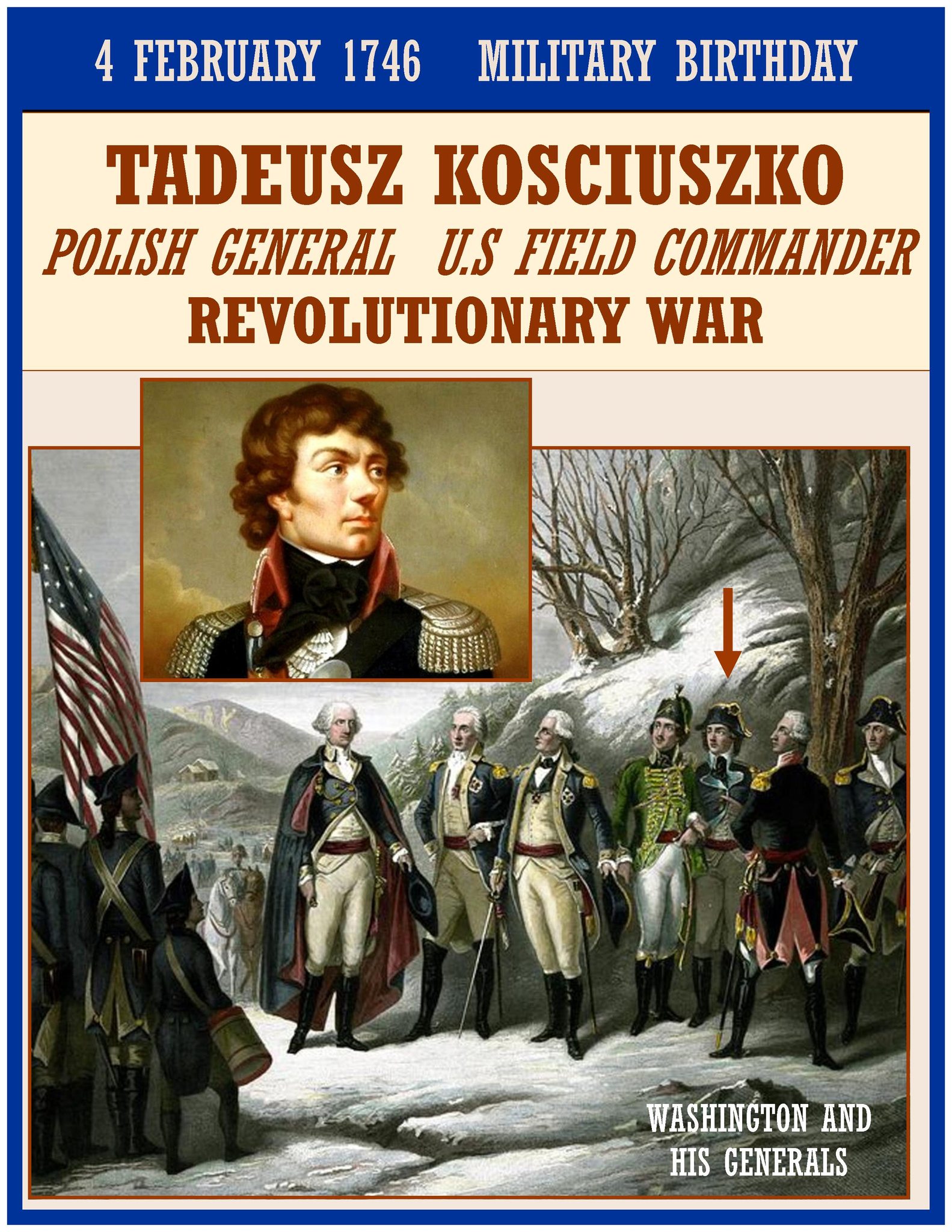
Andrzej Tadeusz Bonawentura KoÅciuszko (4 February 1746 â 15 October 1817) was a Polish-Lithuanian military engineer, statesman, and military leader who became a national hero in Poland, Lithuania, Belarus, and the United States. He fought in the PolishâLithuanian Commonwealth’s struggles against Russia and Prussia, and on the US side in the American Revolutionary War. As Supreme Commander of the Polish National Armed Forces, he led the 1794 KoÅciuszko Uprising.
Late in August 1776, Thaddeus KoÅciuszko stepped off a ship and onto the docks in Philadelphia, Pennsylvania. After making the acquaintance of Benjamin Franklin and proving his worth by designing blockades and fortresses along the Delaware River, KoÅciuszko was given the rank of colonel by Congress in October 1776. In December, he designed Fort Mercer in Red Bank, New Jersey. In the summer of 1777, he ordered the troops retreating from Ticonderoga to delay the British by felling trees and moving boulders onto the path, as well as diverting and damming streams to turn the woodland path into a swamp. In the autumn of 1777, KoÅciuszkoâs structures and use of topography contributed to the American victory at Saratoga.
Reaching Fort West Point in New York in March 1778, KoÅciuszko heavily fortified the base, as well as the section of the Hudson River that it overlooked. It was here that he met the witty and charismatic Agrippa Hull, a black New-Englander who would accompany KoÅciuszko for the rest of the war as his servant, assistant, and companion.
Finally leaving West Point late in the summer of 1780, the engineer traveled south to meet up with his friend and mentor, General Horatio Gates. Gates, however, was soon replaced by General Nathanael Greene, whom KoÅciuszko would serve for the rest of the war. As the British general Lord Cornwallis chased Greeneâs forces around the Carolinas, KoÅciuszko proved himself invaluable by leading the troops through shortcuts and building a fleet of small boats which could be used to transport supplies and soldiers across rivers.
In June 1781, while attempting to burrow closer to an enemy fort known as âNinety-Six,â KoÅciuszko was bayoneted in the buttocks while inspecting his trench. He soon recovered from the criticism of his failed plan, as well as the embarrassment from his wound. In early autumn 1782, as the war was drawing to a close, KoÅciuszko was made a field commander. On November 14, KoÅciuszko led a skirmish outside Charleston, South Carolina, one of the last military skirmishes of the American Revolutionary War.
MILITARY HISTORY SOCIETY OF ROCHESTER
ROCHESTERMILITARY.COM