APRIL 9
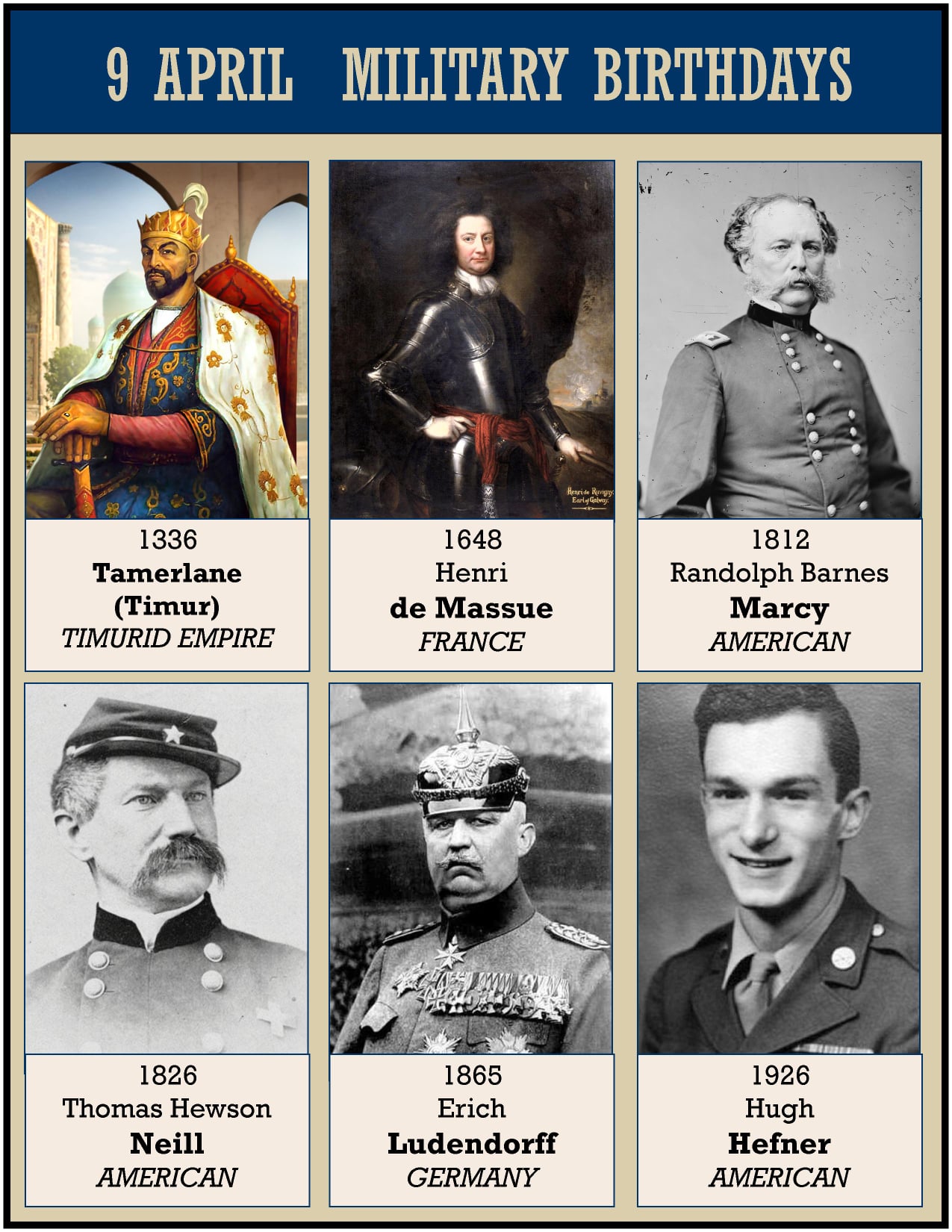
1336 Timur or Tamerlane (9 April 1336 â 17 February 1405) was a Mongol conqueror in the 14th century who is regarded as one of history’s greatest military leaders and strategists. He founded the Timurid Empire in 1370. The empire was large and included Transoxiana, parts of Turkestan, Afghanistan, Persia, Syria, Qurdistan, Baghdad, Georgia and Asia Minor. He successfully conquered southern Russia and parts of India. He invaded Delhi in 1398. He called himself “Sword of Islam”. He is also known to have invented the Tamerlane Chess. Not related to Genghis Khan but claiming to be his successor, he caused the death of thousands of people. Timur is considered the last of the great nomadic conquerors of the Eurasian Steppe. His empire led to the Gunpowder Empires in the 1500s and 1600s, most notably the Mughal Empire of India.
1648 Henri de Massue, 2nd Marquis de Ruvigny, Earl of Galway, PC (9 April 1648 â 3 September 1720) was a French Huguenot soldier and diplomat who was influential in the English service in the Nine Years’ War and the War of the Spanish Succession.
1812 Randolph Barnes Marcy (April 9, 1812 â November 22, 1887) was an officer in the United States Army, chiefly noted for his frontier guidebook, the Prairie Traveler (1859), based on his own extensive experience of pioneering in the west. This publication became a key handbook for the thousands of Americans wanting to cross the continent. In the Civil War, Marcy became chief of staff to his son-in-law George B. McClellan, and was later appointed Inspector General of the U.S. Army.
1826 Neill was born in Philadelphia, Pennsylvania on April 9, 1826. Educated in local schools, he attended the University of Pennsylvania before transferring to the United States Military Academy at West Point, New York. He graduated 27th of a class numbering 38 members in 1847. Neill served on the frontier, usually with the 5th U.S. Infantry, before the outbreak of the Civil War. He also taught briefly at West Point. At the outbreak of the war Neill was a captain, having reached that rank on April 1, 1857.
1865 Erich Friedrich Wilhelm Ludendorff (9 April 1865 â 20 December 1937) was a German general, politician and military theorist. He achieved fame during World War I for his central role in the German victories at Liège and Tannenberg in 1914. Upon his rise to First Quartermaster-general (German: Erster Generalquartiermeister) of the Imperial Army’s Great General Staff in 1916, he became the chief policymaker in a de facto military dictatorship that dominated Germany for the rest of the war. After Germany’s defeat, he contributed significantly to the Nazis’ rise to power.
1926 Hugh Hefner He’s best known as the swingingest guy on the planet and the man behind Playboy magazine, but before he became the biggest Playboy of them all, Hugh Hefner was an Army Soldier in World War II. A descendent of Plymouth governor William Bradford from back in America’s colonial days, Hefner was born in Chicago in 1926. He always had smarts (he had an IQ rating of 152 as a child) and showed an interest in the journalistic life early on when he started a high school newspaper. Upon graduation in 1944 he enlisted in the Army as an infantry clerk; during Basic Training he won a sharpshooter badge for firing the M1 and made it through “Killer College,” in which troops went through maneuvers while throwing real grenades. Posted at Camp Adair in Salem, Oregon, and Camp Pickett in Virginia, Hefner contributed cartoons for Army newspapers.
MILITARY HISTORY SOCIETY OF ROCHESTER
ROCHESTERMILITARY.COM