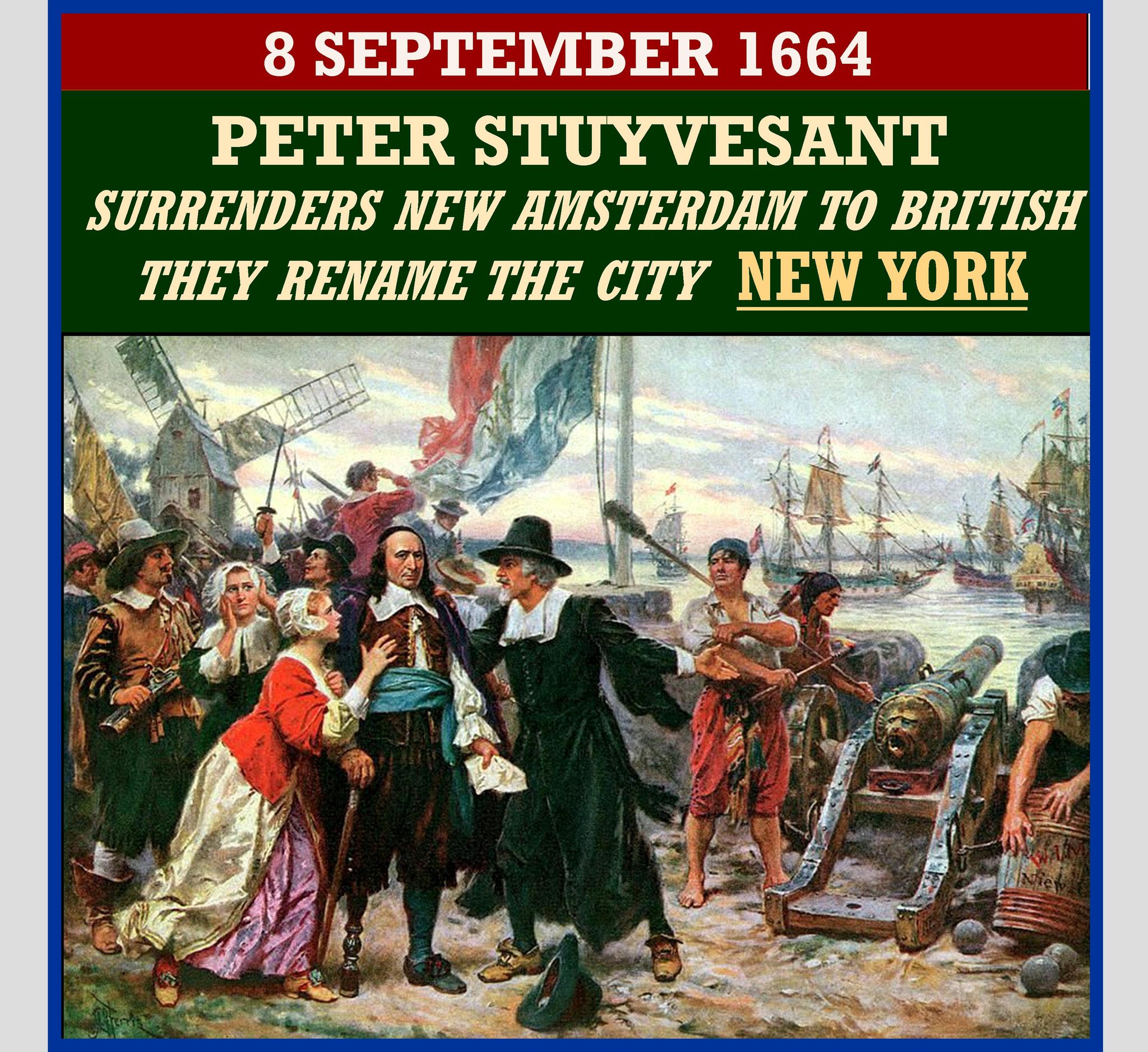
At its peak, only about 9,000 people lived in New Netherland, leaving it vulnerable to attack from the English, who fought three wars against the Dutch, their main commercial rivals, between 1652 and 1674 and who vastly outnumbered them in the New World. The breaking point came in March 1664, when English King Charles II awarded the colonyâs land to his brother, the Duke of York, even though the two countries were then technically at peace. A few months later, four warships with several hundred soldiers onboard arrived in New Amsterdamâs harbor and demanded that the Dutch surrender. Though Stuyvesant at least outwardly prepared to fight, prominent city residents persuaded him to stand down, and on September 8 he signed the colony over without any blood being shed. The English commander was Richard Nicolls. New Amsterdam was renamed New York City and New Netherland became New York State. Stuyvesant went to the Netherlands to report in 1665 and then returned to New York City, where he spent his remaining years quietly at his farm, which was called the Bouwerij and left its name to the street now called the Bowery. When he died in 1672 he was buried there, at St Markâs Church. The bust of him in the church was presented by Queen Wilhelmina of the Netherlands in 1912. The nearby Stuyvesant Street, Stuyvesant Square and the Bedford-Stuyvesant area of Brooklyn bear his name.
In 1673, during the Third Anglo-Dutch War, the Dutch re-conquered Manhattan with an invasion force of some 600 men. But they gave it up the following year as part of a peace treaty in which they retained Suriname in South America. âThey thought that was going to be worth more.â âThey were wrong.â
MILITARY HISTORY SOCIETY OF ROCHESTER
ROCHESTERMILITARY.COM