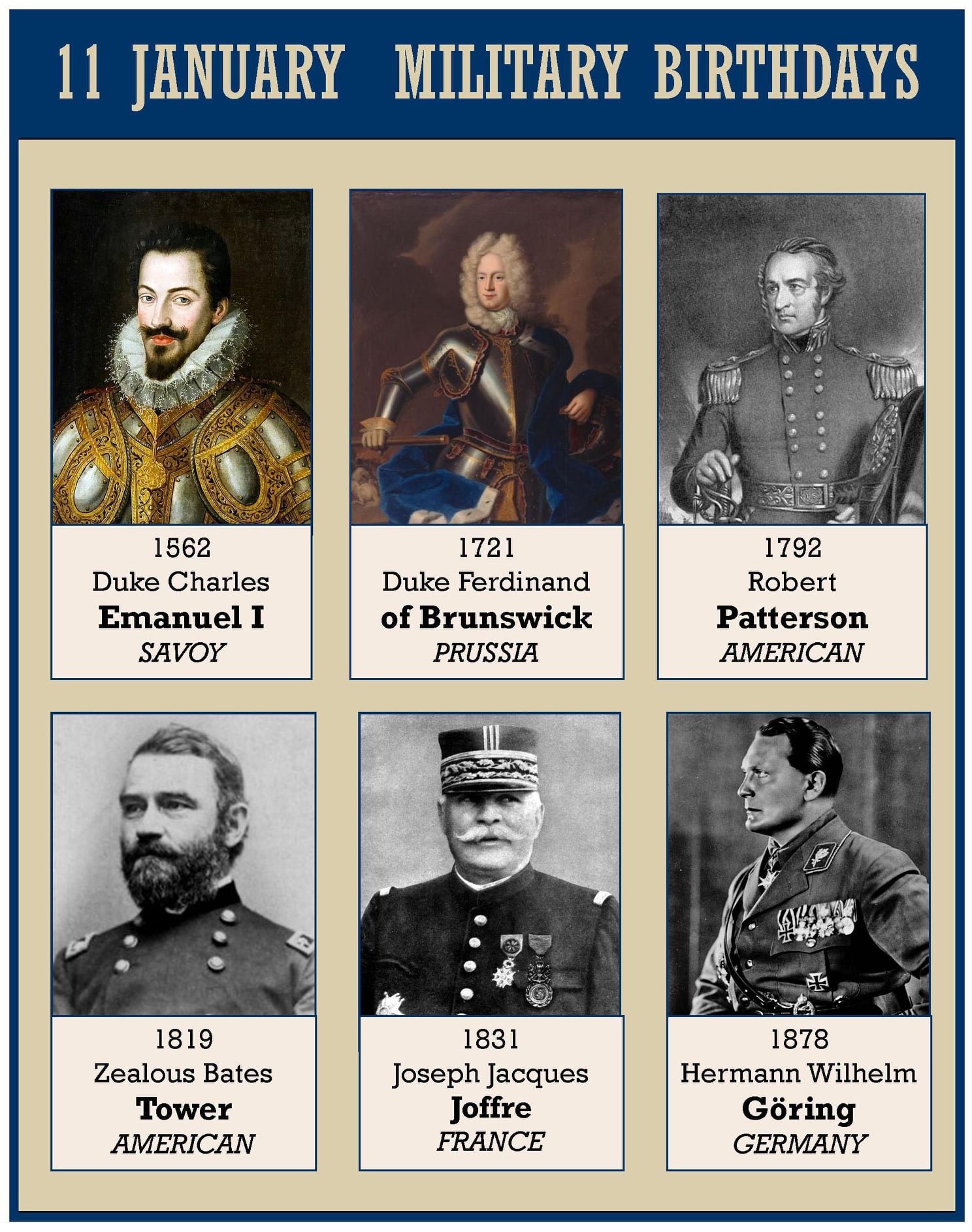
Charles Emmanuel I (Italian: Carlo Emanuele di Savoia; 12 January 1562 â 26 July 1630), known as the Great, was the Duke of Savoy from 1580 to 1630. He was nicknamed Testad’feu (“the Hot-Headed”) for his rashness and military aggression.
Duke Ferdinand of Brunswick-Wolfenbüttel Ferdinand, Prince of Brunswick-Lüneburg (12 January 1721, Wolfenbüttel â 3 July 1792, Vechelde), was a German-Prussian field marshal (1758â1766) known for his participation in the Seven Years’ War.
The American Civil War brought Robert Patterson (12 January 1792) back to military service. He was appointed major general of Pennsylvania volunteers and commanded the Department of Pennsylvania and the Army of the Shenandoah. In 1861, Winfield Scott, now General-in-Chief of the U.S. Army, gave Patterson vague orders to retake Harpers Ferry. Patterson failed to immediately act on these orders, was outmaneuvered after the Battle of Hoke’s Run, and a Confederate army at Winchester, Virginia, under Brig. Gen. Joseph E. Johnston
Zealous Bates Tower (January 12, 1819 â March 20, 1900) was an American soldier and civil engineer who served as a general in the Union Army during the American Civil War. He was most noted for constructing the solid defenses of Federal-occupied Nashville, Tennessee, which proved to withstand repeated attacks by the Confederates.
Joseph Jacques Césaire Joffre (12 January 1852 â 3 January 1931 ) was a French general who served as Commander-in-Chief of French forces on the Western Front from the start of World War I until the end of 1916. He is best known for regrouping the retreating allied armies to defeat the Germans at the strategically decisive First Battle of the Marne in September 1914.
Hermann Wilhelm Göring (or Goering;[a] German: 12 January 1893 â 15 October 1946) was a German political and military leader and a convicted war criminal. Göring was one of the most powerful figures in the Nazi Party, which ruled Germany from 1933 to 1945. A veteran World War I fighter pilot ace, he was a recipient of the Pour le Mérite (“The Blue Max”). An early member of the Nazi Party, Göring was among those wounded in Adolf Hitler’s failed Beer Hall Putsch in 1923. While receiving treatment for his injuries, he developed an addiction to morphine which persisted until the last year of his life. After Hitler became Chancellor of Germany in 1933, Göring was named as minister without portfolio in the new government. One of his first acts as a cabinet minister was to oversee the creation of the Gestapo, which he ceded to Heinrich Himmler in 1934.
rochestermilitary.com