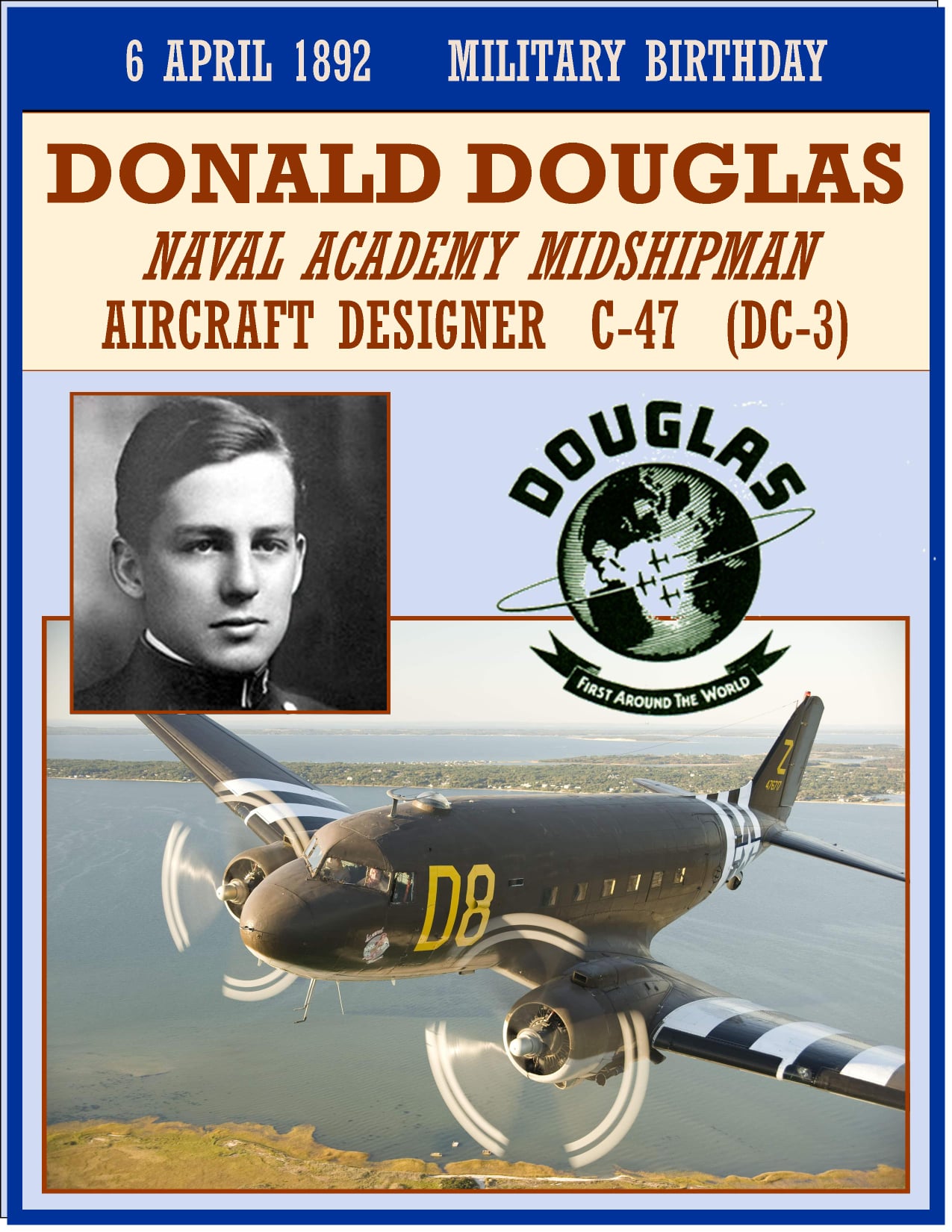
Donald Wills Douglas Sr. (April 6, 1892 â February 1, 1981) was an American aircraft industrialist and engineer.
Douglas was born in Brooklyn, New York, the second son of an assistant cashier at the National Park Bank. He attended Trinity Chapel School and was of Scottish descent. After graduation in 1909, he enrolled in the Naval Academy in Annapolis, Maryland. He had been an early aviation enthusiast; at the age of 16 in the fall of 1908, he convinced his mother that he needed to witness the Fort Myer trials of the Wright Flyer. He later built model airplanes, some with rubber-bands and other motors, in his dormitory room at Annapolis and tested them on the grounds and in the academy’s armory. In 1912 he resigned from the academy in order to pursue a career in aeronautical engineering.
The Douglas DC-3 is a propeller-driven airliner, which had a lasting effect on the airline industry in the 1930s to 1940s and World War II. It was developed as a larger, improved 14-bed sleeper version of the Douglas DC-2. It is a low-wing metal monoplane with conventional landing gear, powered by two radial piston engines of 1,000â1,200 hp (750â890 kW). (Although most DC-3s flying today use Pratt & Whitney R-1830 Twin Wasp engines, many DC-3s built for civil service originally had the Wright R-1820 Cyclone.) The DC-3 has a cruising speed of 207 mph (333 km/h), a capacity of 21 to 32 passengers or 6,000 lbs (2,700 kg) of cargo, and a range of 1,500 mi (2,400 km), and can operate from short runways.
Civilian DC-3 production ended in 1942 at 607 aircraft. Military versions, including the C-47 Skytrain (the Dakota in British RAF service), and Soviet- and Japanese-built versions, brought total production to over 16,000. Many continued to be used in a variety of niche roles; 2,000 DC-3s and military derivatives were estimated to be still flying in 2013; a 2017 article put the number at that time at more than 300.
MILITARY HISTORY SOCIETY OF ROCHESTER
ROCHESTERMILITARY.COM