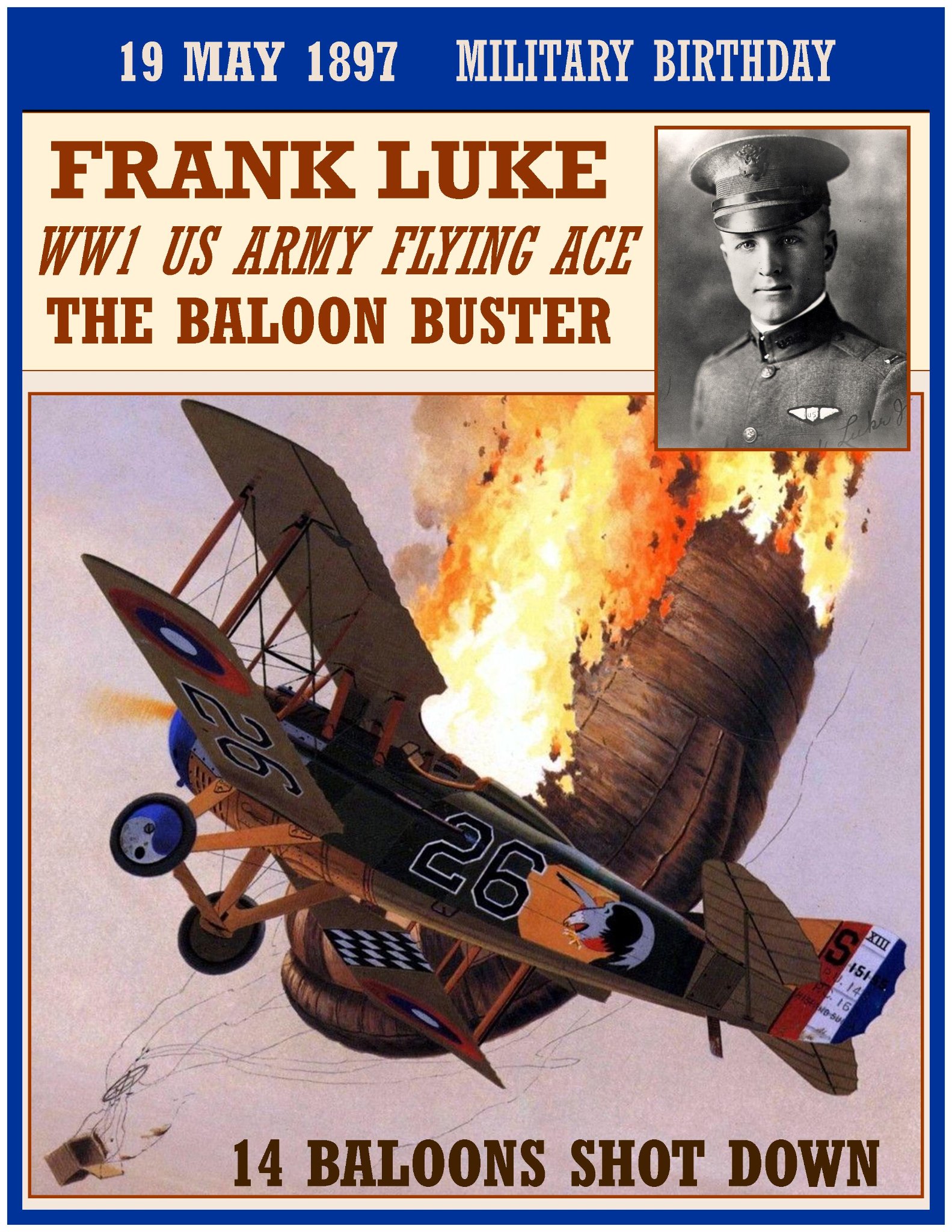
Frank Luke Jr. (May 19, 1897 â September 29, 1918) was an American fighter ace credited with 19 aerial victories, ranking him second among United States Army Air Service pilots after Captain Eddie Rickenbacker during World War I. Luke was the first airman to receive the Medal of Honor and first USAAS ace in day. Luke Air Force Base, Arizona, a United States Air Force pilot training installation since World War II, is named in his honor.
Frank enlisted in the Aviation Section, U.S. Signal Corps on September 25, 1917, and received pilot training in Texas and California. After being commissioned a second lieutenant in March 1918, he deployed to France for further training, and in July was assigned to the 27th Aero Squadron.
Between September 12 and September 29,1918, Luke was credited with shooting down 14 German balloons and four airplanes: Luke achieved these 18 victories during just 10 sorties in eight days, a feat unsurpassed by any pilot in World War I.
Luke’s final flight took place during the first phase of the Meuse-Argonne Offensive. On September 28, 1918, after achieving his 14th and 15th victories, he landed his SPAD XIII at the French aerodrome at Cicognes where he spent the night, claiming engine trouble. When he returned to the 1st Pursuit Group’s base at Rembercourt the next day, he was confronted by Captain Alfred A. Grant, his squadron’s commanding officer. Despite being under threat of arrest by Grant for absence without leave, Luke took off without authorization and flew to a forward airbase at Verdun, where his sympathetic group commander, Major Hartney, canceled the arrest order and gave Luke tacit approval to continue his balloon hunting. That evening Luke flew to the front to attack three balloons in the vicinity of Dun-sur-Meuse, six miles behind the German lines. He first dropped a message to a nearby United States balloon company, alerting them to observe his imminent attacks. Luke shot down the enemy balloons but was then severely wounded by a single machine gun bullet fired from a hilltop above him, a mile east of the last balloon site he had attacked. Luke landed in a field just west of the small village of Murvauxâafter strafing a group of German soldiers on the groundânear the Ruisseau de Bradon, a stream leading to the Meuse River. Although weakened by his wound, he made his way toward the stream, intending to reach the cover of its adjacent underbrush, but finally collapsed some 200 meters from his airplane. Approached by German infantry, Luke drew his Colt Model 1911 pistol and fired a few rounds at his attackers before dying.
MILITARY HISTORY SOCIETY OF ROCHESTER
ROCHESTERMILITARY.COM