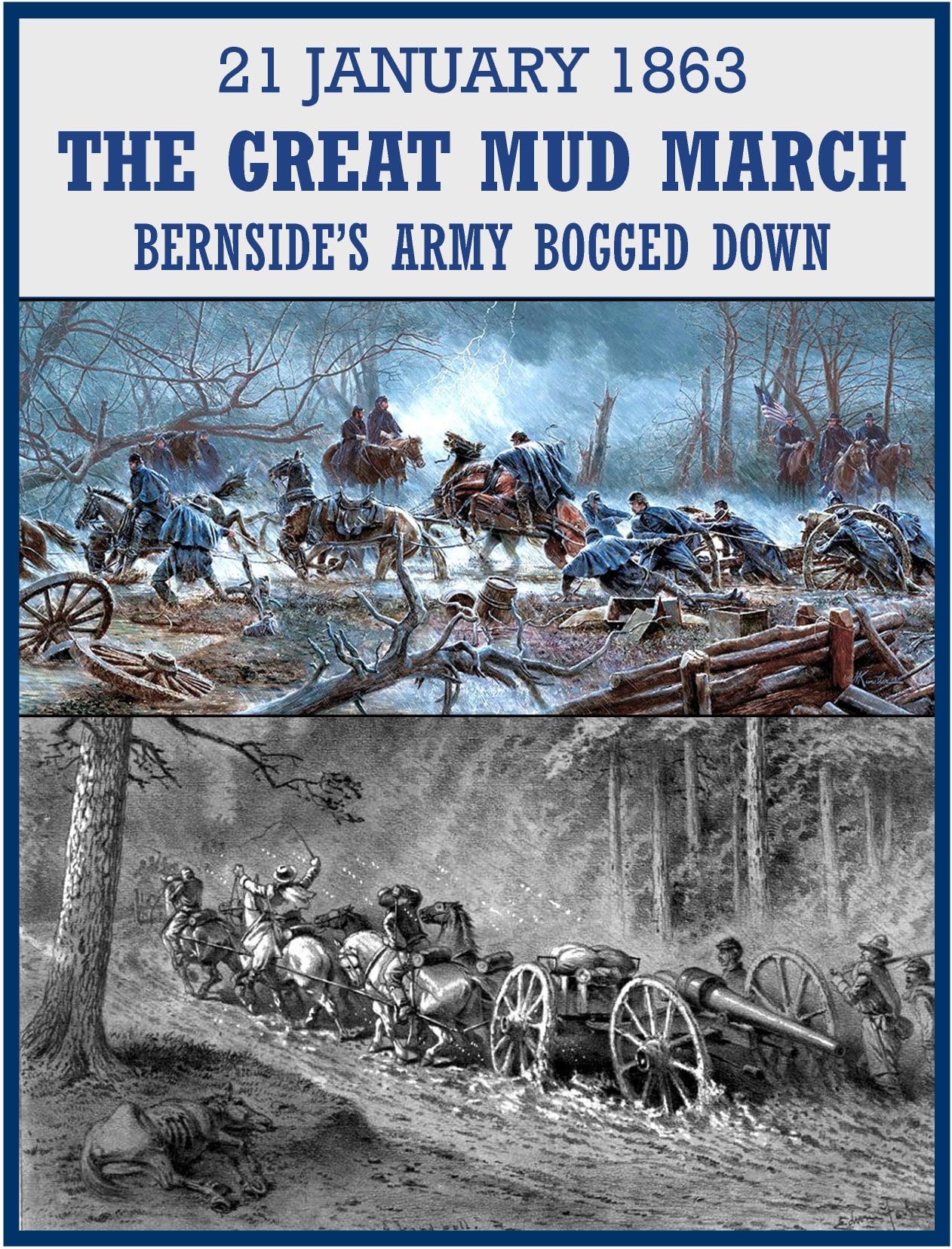
General Ambrose Burnside planned an offensive to make up for his disastrous defeat at the Battle of Fredericksburg in December of 1862.
Burnside decided to cross the Rappahannock River at Banks’ Ford. At dawn of January 21, engineers would push five bridges across; after that, two grand divisions would be over the river in four hours. Meanwhile, another grand division would distract the Confederate troops by repeating the December crossing at Fredericksburg.
The offensive began with a westward move on January 20, 1863, in unseasonably mild weather. During the night of the 20th as, the rain began, and by the morning of the 21st, the earth was soaked and the river banks had the appearance of a quagmire. Already, fifteen pontoons were on the river, nearly spanning it, and five more were amply sufficient. Burnside began at once to bring up his artillery, which had the effect of making a perfect mortar bed. For a considerable area around the ford all day the men worked in the rain but to little purpose. Quite a number of cannon were advanced near the ford, but the 22nd only added to the storm, and the artillery, caissons and even wagons were swamped in the mud.
The storm had delayed Burnside’s movements, giving Lee ample time to line the other shore with his army, though there was no attempt to interfere with his crossing except from the sharpshooters, who peppered away on all occasions. No doubt Lee was hoping Burnside would effect a crossing; with a swollen river in his rear, it would have been a sorry predicament for the Union Army indeed, but Burnside finally became resigned to his fate and gave the order for the army to retire to its quarters, and thus ended the famous mud march.
MILITARY HISTORY SOCIETY OF ROCHESTER
ROCHESTERMILITARY.COM