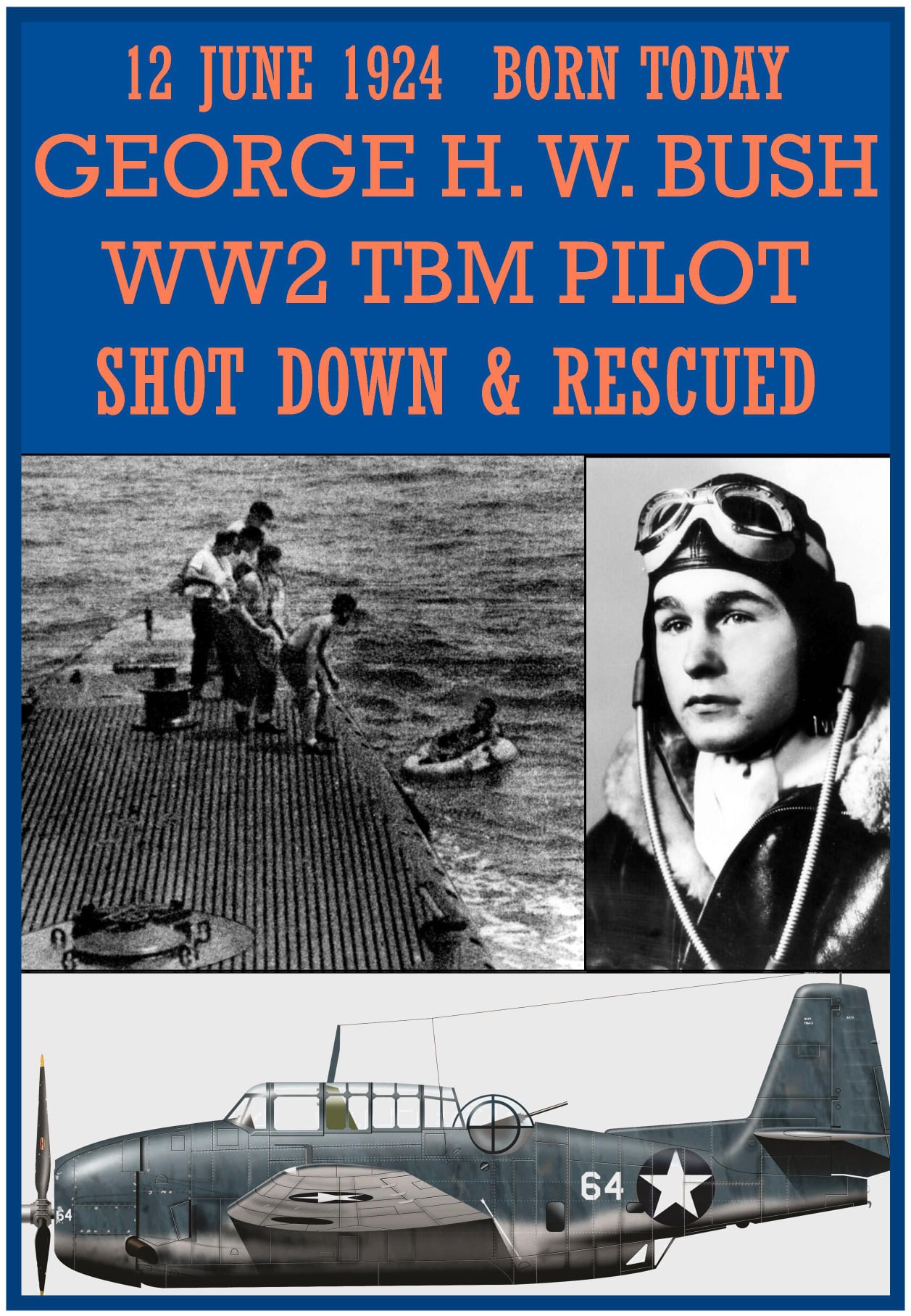
George Herbert Walker Bush (June 12, 1924 â November 30, 2018) was an American politician, diplomat, and businessman who served as the 41st president of the United States from 1989 to 1993. A member of the Republican Party, Bush also served as the 43rd vice president from 1981 to 1989 under Ronald Reagan, in the U.S. House of Representatives, as U.S. Ambassador to the United Nations, and as Director of Central Intelligence.
On June 12, 1942, Bush had graduated from high school and joined the Navy as a seaman, second class. But, in less than a year, he completed flight training at NAS Corpus Christi, Texas, was commissioned an ensign, and went on to fly TBM Avengers with VT-51. For a time, he was the youngest pilot in Naval Aviation.
It was September 2, 1944. Lieutenant Junior Grade George Bush was a pilot with Torpedo Squadron Fifty-One (VT-51 ) aboard the aircraft carrier USS San Jacinto (CVL-30), a light carrier which was deployed in the North Pacific.
The target was a Japanese radio station on ChiChi Jima, located about 600 miles southwest of Japan in the Bonin Islands. For a time, the enemy on that tiny island had been intercepting U.S. military radio transmissions and warning Japan and occupied enemy islands of impending American air strikes. It had to be destroyed.
Before 0900, Bush and two aircrewmen (his regular radioman, Radioman Second Class John Delaney, and substitute gunner Lieutenant Junior Grade William White) strapped themselves inside an Avenger and catapulted off San Jacinto. Three other bomb-laden VT-51 aircraft, as well as a number of VF-51’s F6F Hellcats, joined the mission.
Over the target, Bush started his dive and was hit by AA fire. Ltjg. Bush, who felt the plane “lift” from the hit, continued his dive toward the target and dropped his payload. The four 500-pound bombs exploded, causing damaging hits. For his courage and disregard for his own safety in pressing home his attack, he was later awarded a Distinguished Flying Cross.
Severely damaged, the plane could not make it back to the carrier. One crewman was dead and the other bailed out. Bush parachuted safely into the water, dangerously close to the shore. Unfortunately, the aircrewman fell helplessly to his death because his parachute failed to open properly.
Circling fighter planes transmitted Bush’s plight and position to the U.S. submarine Finback (SS-230), patrolling 15 to 20 miles from the island According to Lieutenant Commander Dean Spratlin, Finback’s executive officer at the time, the submarine had an area of 200 to 300 square miles to cover, which included Iwo Jima, ChiChi Jima and HaHa Jima in the Bonin Islands. A few hours after transmitting Bush’s position, Williams, then a commander, sighted him on the periscope about seven miles away from ChiChi. He ordered the submarine to the surface.
“I saw this thing coming out of the water and I said to myself, ‘Jeez, I hope it’s one of ours,'” Bush remarked.
Bush was taken inside Finback and the sub submerged.
MILITARY HSITORY SOCIETY OF ROCHESTER
ROCHESTERMILITARY.COM