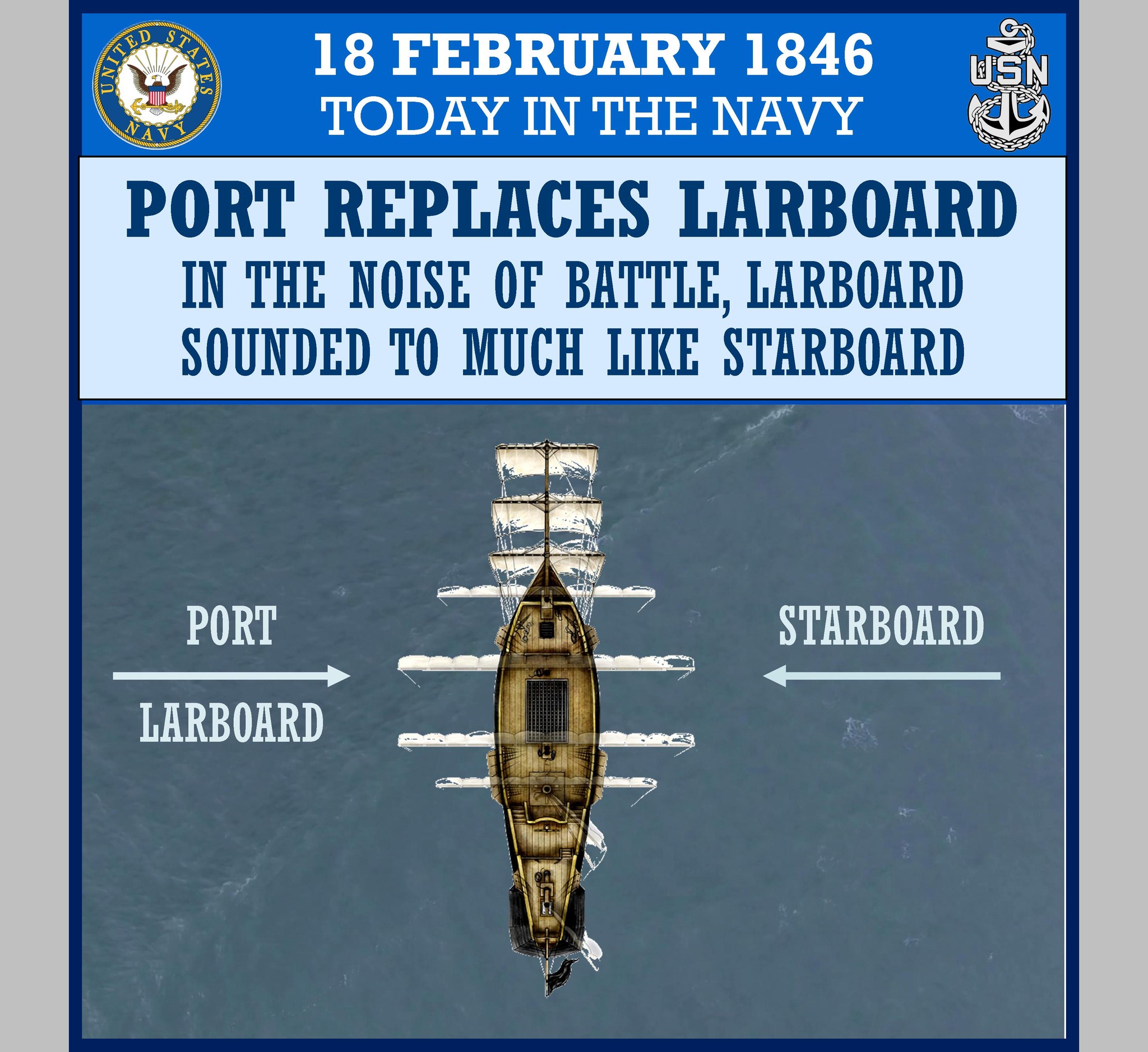
In the early days, mariners initially called the right side of the ship the âsteering sideâ or âsteerboard.â The strange names arose because most sailors were right-handed, and the majority of vessels had steering oars on the right side of the stern.
Over time, the âsteering sideâ turned into stÄorbord,â which is a combination of Old English stéor (âsteering oarâ) and bord (âside of the boatâ). Old English stÄorbord also meant âthe rudder side,â as the Teutonic peoples steered their sailboats with a paddle on the right side of a boat.
The word port is not an original term either, as sailors previously used âlarboardâ to describe the left side of the ship. Stemming from Old English bæcbord, the word larboard references the âloading sideâ of the ship. And since the loading side was opposite of the oar, the term naturally describes the left side of the boat.
Sailors soon realized how âlarboardâ was too similar to âstarboardâ and decided to use the word port, instead. Considering how the left side is port-facing, the transition to port makes sense. Even more serendipitous is how the word âportâ already stems from Latin portus for âhavenâ or âharbor.â
The convenient shift took place in Old English and stuck around through Middle English and Old French. But it wasnât until the 19th century that the United States and British Navy officially replaced âlarboardâ with âport.â As documented by the General Order of February 18, 1846, George Bancroft announced: â⦠in consequence of the similarity of sound, the word âPortâ is hereafter to be substituted for âLarboard.ââ
MILITARY HISTORY SOCIETY OF ROCHESTER
ROCHESTERMILITARY.COM